The underarm bag — also called a baguette bag, half-moon bag, or crescent bag depending on its specific silhouette — has become a commercially significant category in recent wholesale handbag sourcing. Understanding what drives this performance, and which specific underarm bag formats translate best at wholesale, is useful for a buyer building a collection for the current market.
This guide covers the main underarm bag silhouettes — baguette, crescent or half-moon, and mini underarm — along with material considerations and sizing specifications for production orders. For related sizing guidance on other bag categories, see the crossbody bag sizing guide and tote bag size guide.

What Defines the Underarm Bag Category?
The unifying characteristic of all underarm bags is their carry method: the bag is tucked under the arm rather than worn on the shoulder or carried primarily in the hand. This carry position creates specific design constraints — the bag needs to be narrow enough to tuck comfortably, long enough to rest against the body without slipping, and light enough to carry comfortably without a strap for shorter periods.
Most underarm bags also include a secondary strap — typically a slim chain or leather strap — allowing crossbody or shoulder carry when the tucked position becomes impractical. This dual-carry functionality is one of the more important reasons for the category's commercial strength: it works as a styling-forward underarm bag and as a more practical crossbody depending on the moment.
How Should the Right Shape Be Chosen for the Intended Carry?
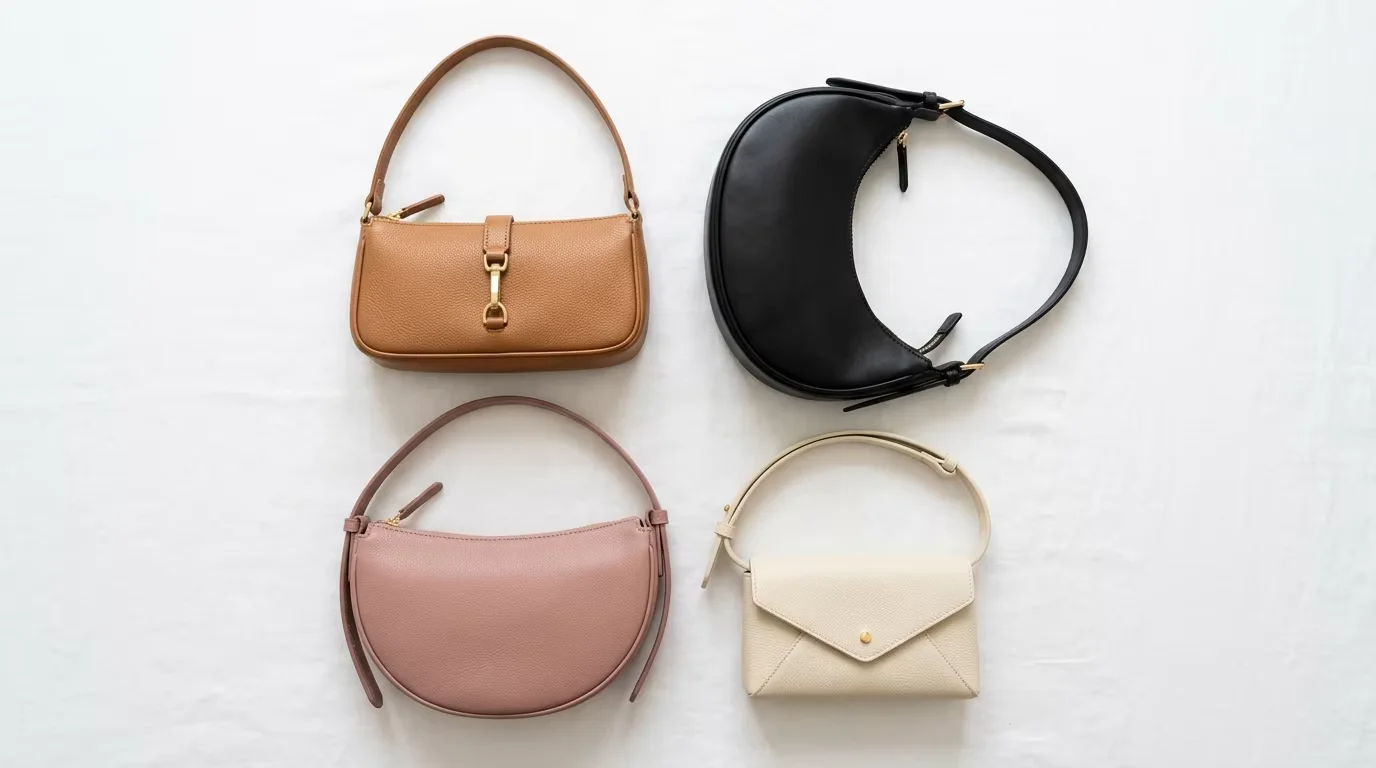
Choosing the baguette direction makes sense when a horizontal body and relatively straight opening suit the intended contents. A crescent is worth comparing when a curved body and closer underarm fit matter more to the design. A half-moon reference may shift the balance between curve, usable depth and opening access — the name alone does not settle fit, and testing all three against the same intended contents is more reliable than assuming an exterior silhouette defines actual capacity.
For a sample request, it is worth noting the intended carry position, maximum body width, opening width, usable depth, strap drop, and whether the bag needs to fit a specific phone or wallet model. Marking the closure's position and checking access while the bag is actually worn gives a far more accurate picture than reviewing a flat, unworn sample. Bringing a preferred silhouette image and a contents list to the initial discussion is a reasonable starting point — exact dimensions and construction can be confirmed once an actual sample exists. For adjacent shoulder-carry references, see the shoulder bag collection.
What Defines the Baguette Bag?
The baguette — named for the French bread it resembles in its elongated rectangular shape — is the original and most recognizable underarm silhouette. It is characterized by a horizontal orientation, meaningfully wider than it is tall, compact depth, and typically a single strap or chain. The baguette has shown notable staying power across multiple fashion cycles since its original rise to prominence, which speaks to the underlying strength of the silhouette itself rather than any single trend moment.
The length-to-height ratio is the defining visual characteristic of a baguette — a design that is too close to square loses the baguette silhouette entirely, so maintaining a clearly horizontal proportion matters more here than for most other bag formats, and even a modest deviation in height can noticeably change the bag's visual read.
A baguette tends to perform best in a material with some body to it, since it needs to hold its horizontal shape reasonably well when worn — a very soft or unstructured leather generally requires internal stiffening to maintain the silhouette. A mid-weight top-grain cowhide, a pebbled leather, or a quality PU tend to be the more commercially reliable baguette materials. A suede baguette can work but generally requires more careful specification to maintain its shape over time.
What Defines the Crescent and Half-Moon Bag?

The crescent and half-moon formats share the baguette's underarm carry position but replace the rectangular silhouette with a curved, C-shaped or semicircular form. This curved base tends to create a more organic, less structured aesthetic that aligns well with contemporary minimalist and quiet-luxury fashion directions.
The curve radius on a crescent can vary from shallow — almost rectangular with rounded corners — to pronounced, approaching a genuine half-circle. A more pronounced curve generally creates stronger visual impact but tends to be more challenging to keep organized inside, since the curved base means contents tend to settle toward the lowest point of the C-shape.
Both formats tend to photograph well specifically because the curved silhouette creates interesting shadow and light play — a real commercial advantage for any brand whose sales channel depends heavily on product photography or social content, worth weighing when deciding which formats to include in a collection.
What Defines the Mini Underarm Bag?
A mini underarm bag generally carries a phone, cards and keys only. Its commercial proposition tends to be almost entirely styling-driven rather than functional — it is generally worn to complete an outfit rather than to transport daily essentials. This occasion-driven purchase dynamic tends to give the mini underarm format strong performance in boutique and specialty retail channels, where a fashion-forward customer is often willing to invest in a bag serving a primarily aesthetic purpose.
The mini underarm format tends to carry particularly strong impulse-purchase dynamics among underarm bag categories, making it often more effective as an add-on item within a broader collection than as a standalone hero piece. It tends to work well as a gifting proposition and a natural complement to a larger everyday bag purchase.
Which Materials Perform Best in Underarm Bag Production?

Material choice for an underarm bag needs to balance shape retention with appropriate weight, since the bag is often held against the body primarily by arm pressure rather than a strap — meaning it needs to be light enough to carry without fatigue, yet structured enough to maintain its form when tucked.
A pebbled top-grain cowhide tends to be among the more commercially reliable materials for this category, offering enough body for genuine shape retention along with durability and consistent quality. A smooth top-grain cowhide offers a cleaner, more photogenic aesthetic but generally requires internal interfacing in the body panels to maintain shape — a reasonable tradeoff for a premium positioning. A high-quality PU vegan leather can work well in a structured format, particularly one with a fabric backing layer rather than a pure-PU construction, since the fabric backing adds dimensional stability that helps the bag maintain its shape through regular carry. Satin and velvet suit an evening or occasion underarm bag specifically, and typically require a rigid inner lining to maintain shape, generally performing best within a seasonal, occasion-driven window rather than as a year-round material choice.
For more detail on material selection across bag types, see the leather label guide and texture comparison guide.
How Should a Buyer Think About Retail Channel and Seasonal Fit?
Underarm bags tend to perform well in boutique and specialty fashion retail, contemporary department stores, and fashion-forward e-commerce brands, and tend to be less suited to mass-market retail, travel-focused accessory channels, or professional contexts where practical carrying capacity is the primary purchase driver.
The format's general seasonal tendency often skews toward spring and summer, where lighter materials and a less encumbered carry style suit warmer weather well. That said, a suede or velvet crescent variant can perform strongly in boutique channels during autumn or winter, suggesting the category is genuinely workable across most of the year with the right seasonal material variation rather than confined to a single season.
Celynora's standard terms for custom development: genuine leather starts at an MOQ of 100 units per style; non-leather materials start at 300 units per style. Sample lead time runs 7–10 days from spec confirmation; bulk production lead time runs approximately 15 days after sample approval.
Related wholesale styles currently in our catalog include the Shoulder Bag Commuting Style Genuine Leather Women’s Bag Baguette Bag and the Extended-Profile Baguette Shoulder Bag — useful reference points for material, hardware and sizing before specifying a custom order.
For related sourcing guidance, see Bucket Bag Wholesale Guide, Clutch Bag Wholesale Guide, Hobo Bag Wholesale Guide and Straw, Raffia, Rattan, Wicker and Woven Bags.
B2B Buyer Checklist
Before you request a quote, prepare the information that affects MOQ, sample cost, lead time and final unit price.
- Target product category, size and reference images.
- Expected order quantity per style and per color.
- Material preference, lining requirements and hardware finish.
- Logo method, packaging items and delivery country.
- Target retail price or target factory price range.
Decision Table
| Buyer Question | Why It Matters | What to Send the Factory |
|---|---|---|
| What is my MOQ target? | MOQ affects material sourcing, production planning and unit price. | Quantity per style, per color and launch schedule. |
| Which material should I choose? | Material controls price band, durability and brand positioning. | Reference photos, desired texture and target market. |
| How much customization do I need? | Logo, lining, hardware and packaging change sample time and cost. | Logo files, packaging references and required details. |
| What is my delivery deadline? | Sampling, production and shipping need realistic planning. | Launch date, delivery country and preferred shipping method. |