Which Bag Direction Fits the Project: Satchel or Fashion Saddle?
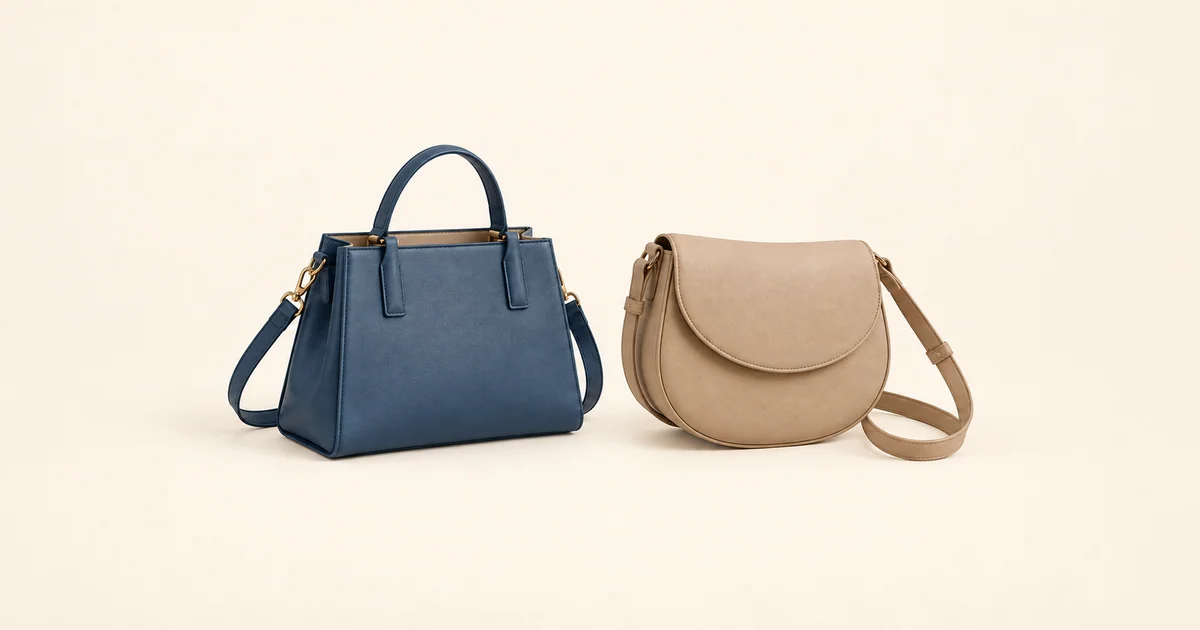
Choose a satchel direction when the brief starts with a defined body, base, opening and carry setup that may combine a top handle with a shoulder or crossbody strap. Choose a fashion saddle direction when the handbag brief starts with a curved lower profile and flap-led access for shoulder or crossbody carry. Neither name guarantees one closure, one level of structure, one interior layout or a specific carrying capacity. Confirm those points from the actual load, drawings, measurements and a loaded sample.
Here, “fashion saddle bag” means a handbag design direction—not a bicycle, motorcycle or equestrian equipment saddlebag. “Satchel” and “saddle” are working labels for comparing two handbag briefs, not universal or legal product classes. A buyer can keep both directions open until the reference shape, contents and access need make the tradeoff visible.
Begin with the use that must survive the design choice. Is the priority a particular front silhouette, a clear lower footprint for named objects, a way to reach the wallet under a flap, or a handle-and-strap combination? A satchel bag or saddle bag label cannot answer those questions. The following comparison turns the labels into items a development team can draw, measure and check on a current sample.
How Do Satchel and Fashion Saddle Handbags Differ?
The table is a starting vocabulary for this article, not a rule that every satchel or saddle handbag has the same construction. Record the chosen reference and its deviations from either direction before requesting a sample.
| Decision point | Satchel direction | Fashion saddle direction | Must be confirmed |
|---|---|---|---|
| Front silhouette | Defined body, often read through straighter or more geometric proportions | Curved lower profile is a primary visual cue | Reference front/side drawings and finished measurements |
| Opening and flap | May use a flap, zipper or another project-defined opening | Often starts from flap-led access, but flap and closure still need specification | Clear opening, flap coverage, closure position and access sequence |
| Base | Base geometry and usable footprint should be stated | Curved profile may change the usable lower footprint | Base length/depth/curve, reinforcement and loaded state |
| Carry setup | Top handle, shoulder/crossbody strap or a project-defined combination | Shoulder/crossbody direction in this article | Strap/handle dimensions, attachment points and opening interference |
| Structure | Soft, semi-structured or structured only when the brief and construction support it | Soft, semi-structured or structured only when the brief and construction support it | Shell, reinforcement, piping/edge, lining and sample state |
| Actual load | Named items determine usable interior and opening needs | Named items test the curved interior and access route | Load list, item dimensions, priority access and loaded sample |
For a satchel, sketch the body and base separately: a squared-looking front does not establish a flat usable floor, and an apparent top line does not show the clear opening beneath a zipper or flap. A top handle can be requested, omitted or paired with a longer strap. Buyers can review top-handle and satchel design references to discuss visual direction; a collection label is not a specification for this project.
For a fashion saddle direction, trace the lower curve and the flap as separate shapes. The curve may create a tighter usable area near the side or bottom than the outer photograph suggests; that is a measurement question, not a claim that every saddle bag holds less. Check where the strap joins the body and whether it crosses the route used to lift the flap or remove the priority item. Buyers can compare crossbody design references for carry direction without assuming that every crossbody bag is a saddle silhouette.
A “satchel purse” may be a retail description of the satchel direction, while “satchels” is a broad plural label. Neither phrase settles whether the intended bag is geometric, soft, flap-led or handle-led. Use the project drawing and load list to fix those choices.
Does a satchel always need a top handle or flap?
No. In this brief, record the body, base, opening, any flap, closure, top handle and shoulder or crossbody strap as separate choices. A name alone cannot confirm that combination; the selected reference, measurements and sample must show what this project actually uses.
Is a Fashion Saddle Bag the Same as a Cycling, Motorcycle or Equestrian Saddlebag?
No. This article concerns fashion handbags for a B2B product brief. A bicycle, motorcycle or equestrian saddlebag has a different use and may require mounting, load-position, environmental and test decisions that this handbag comparison does not address. A team seeking that equipment should use a separate equipment-specific specification, not infer suitability from the fashion name.
That distinction also keeps visual research focused. A curved flap on a fashion photograph can suggest a handbag silhouette, but it cannot prove a brand origin, equipment function or a universally accepted saddle shape. Describe the reference features the buyer wants—lower curve, flap coverage, strap path and intended contents—instead of borrowing a branded outline as an assumed standard.
Is a fashion saddle handbag an equipment saddlebag?
No. “Fashion saddle” here names a handbag direction. Equipment saddlebags for riding, vehicles or tack involve different attachment and use conditions; this guide makes no claims about their mounting, load or protective performance.
What Should Buyers Record About Silhouette, Opening, Base and Structure?
Build one versioned silhouette/opening/base/structure record before comparing quotations or approving a sample. Take any numbers from the current drawing, tech pack or identified sample. If a value is unknown, mark it Open rather than borrowing a generic satchel size or estimating from a photo.
For the front and side views, mark the widest point, relevant center and side heights, side depth, top line and lower profile. A curved saddle outline makes “bag height” ambiguous unless the measured point is named: the center can sit at a different height from the side. For a satchel, record whether the side panel or gusset narrows toward the opening. The finished outside width is not the same as the narrowest route an item can actually pass.
The opening record should show its smallest usable width and height along the insertion path, not just the top edge on a flat drawing. Note how far the flap covers the opening, where the closure sits, and whether a handle or strap restricts access. If the closure decision is still open, compare handbag closure types separately; this page does not assign one closure to either silhouette.
At the bottom, distinguish the visible lower curve from the area that can support the intended contents. Record base length, depth, curve, usable flat area if any, and the edge, piping or reinforcement that occupies space. Note the empty and loaded shape. Neither direction is guaranteed to stand upright: whether standing matters is itself a project decision to verify. A leather satchel also needs its actual shell, backing, lining and reinforcement described; “leather” alone does not make it rigid or establish a usable base. For a repeatable method across sample versions, record repeatable handbag measurement points while retaining the curve-specific points below.
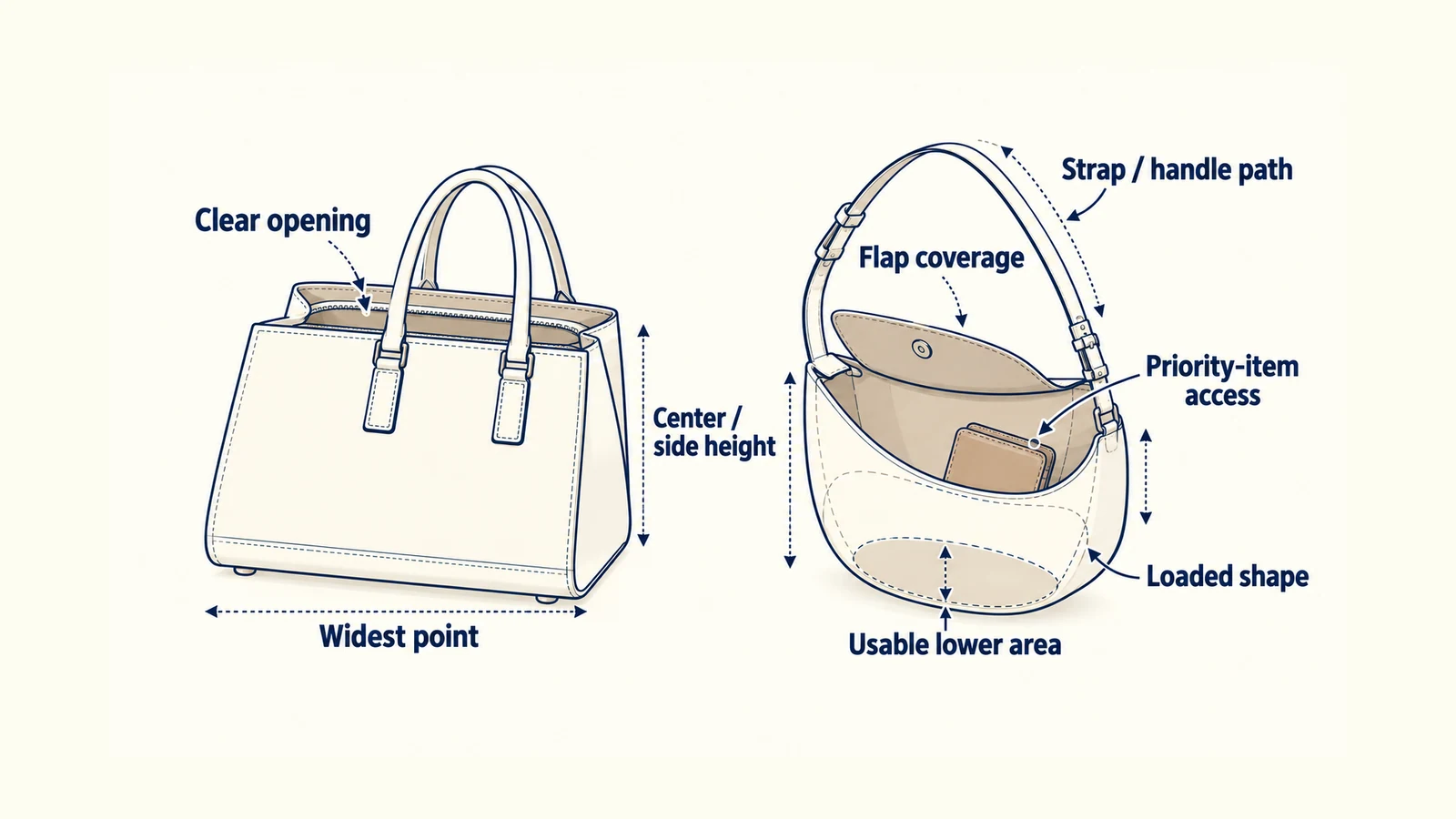
Concept illustration only: the shapes and checkpoints do not document a Celynora product, verified dimensions, loaded fit or test result.
| Record field | What to capture | Why it changes the project | Status |
|---|---|---|---|
| Format intent | Satchel / fashion saddle / still comparing | Prevents the name from silently changing the brief | Chosen / Open |
| Front and side silhouette | Widest width, relevant heights, side depth, top and lower profile | Curved and straighter edges change proportion and usable space | Measured / Open |
| Clear opening | Narrowest usable width/height along the actual access path | Maximum exterior width does not prove access | Measured / Open |
| Flap and closure | Flap shape/coverage, closure type, position and closed clearance | Access and alignment depend on actual load and construction | Specified / Open / N/A |
| Base and lower profile | Base length/depth/curve, usable flat area, edge/piping and reinforcement | Lower geometry affects standing, shape and interior use | Measured / Open |
| Structure record | Shell material, reinforcement, lining, piping/edge and intended hand feel | Style names do not prove soft or structured behavior | Specified / Open |
| Carry setup | Handle/strap dimensions, adjustment, attachment points and intended mode | Carry components can change balance and obstruct the opening | Specified / Open |
| Actual load | Named items, item dimensions and priority-access item | Capacity and access must be checked against real objects | Provided / Open |
How Should the Actual Load Change the Shape and Access Brief?
Work backward from what people will put in the bag, not from a nominal capacity attached to its style name. A buyer might identify a phone, wallet, keys, documents, a small notebook or a tablet; only items actually intended for this project belong on the load list. Add the outer dimensions of bulky or rigid items if known, and mark the priority item—the one the user needs to retrieve first. The same outer bag dimensions can lead to different access results when the flap, pocket placement or lower curve changes.
A satchel direction may offer a clearer geometric starting point for a specified base and interior, but a gusset, thick lining, reinforcement or inside pocket can reduce usable space. A fashion saddle direction may place less usable area at a curved edge, yet a particular design could still hold the buyer's intended objects. Do not declare either direction “larger” from the silhouette alone. Compare each named item's route through the clear opening, its resting position in the usable lower area, and what happens when all planned items are inside together.
Then check the use sequence. Can the priority item be reached without moving another object? Does the flap have to be folded back fully, and does a top handle or crossbody strap block that motion? Can a buyer operate the closure in the intended way with the full load, or does the body distort enough to shift alignment? If shoulder and hand carry are both requested, record whether the loaded shape and access change between modes. These are questions for a loaded sample, not promises inferred from a rendering.
Audience or material modifiers should refine this same brief, not replace it. “Mens satchel bag” does not establish a male customer's preferred size, color or structure, and “leather satchel” does not prove a particular feel or load performance. Record the intended user task, material specification and sample observations without inventing demographic rules.
What Should Buyers Check on a Loaded Satchel or Saddle Sample?
Tie each check to a sample ID, current brief and measurement version, named load list, handle/strap setting and review date. Put the planned objects—or buyer-approved dimensional equivalents—into the bag in the intended sequence. Note the exact point where an item catches at the opening, the flap or a pocket; a photograph of a closed bag cannot answer that question.
For both silhouettes, observe whether the full load changes the lower profile, closure alignment or carrying balance. For a curved saddle, pay attention to objects pushed toward the lower center or side edges and the path for getting them back out. For a satchel, check whether the base and gusset hold the chosen arrangement without forcing the opening or blocking an inner compartment. If standing is important, state the surface and load condition under which it was observed; if it is not important, mark it not applicable.
| Checkpoint | What to observe with the stated load | Record |
|---|---|---|
| Insert and remove | Whether each priority item passes the narrowest opening without an unintended sequence | Observed / Not checked / Open |
| Flap and closure | Alignment, coverage and closing condition with the full stated load | Observed / Not checked / Open |
| Base and body shape | Bottom/body deformation, usable lower space and whether standing is required or not applicable | Observed / Not checked / Open |
| Interior interference | Pockets, lining, seams, reinforcement or other items blocking access | Observed / Not checked / Open |
| Handle/strap interaction | Opening obstruction, attachment observation and balance in each intended carry mode | Observed / Not checked / Open |
| Recovery after load | Shape after the stated load is removed, under the agreed observation condition | Observed / Not checked / Open |
| Version evidence | Sample ID, brief/measurement version, load list and review date | Recorded / Open |
Use Observed, Not checked or Open for the current sample, and retain the observation conditions. If the opening, curve, base reinforcement, pocket, flap or strap attachment changes, repeat the affected checks on the revised sample. One loaded-fit observation does not verify every production unit, carrying-load limit, durability, water resistance or service life.
What Should a Buyer Send for a Satchel or Fashion Saddle Project Review?
A useful starting message can be short: say “satchel,” “fashion saddle,” or “still comparing”; attach one reference image or sketch; name the items to carry and the preferred hand, shoulder or crossbody mode. Add any known exterior and clear-opening measurements, base or curve details, flap and closure preferences, materials, branding and sample questions. Unknown values can remain Open. This is a way to begin a conversation, not a requirement to finish a tech pack before contacting Celynora.
If a sketch or tech pack exists, mark which parts of the reference to retain and which to change. If no drawing exists, a photo plus a load list still identifies the decisions to discuss. For development route questions, buyers may compare OEM and ODM starting points without assuming that a particular satchel or saddle construction, material, price or timing is already available. Estimated quantity, delivery country and target timing help frame the discussion when known, but are not prerequisites to asking.
Which measurements matter most for a curved saddle handbag?
Record the widest point, relevant center and side heights, side depth, lower curve and usable base area, narrowest clear opening, flap coverage and strap setting. Use the actual item path and loaded sample to check usable interior and access; an outside width × height × depth alone cannot establish capacity.
Planning a satchel or fashion saddle handbag project? Send the direction you mean, a reference image or sketch, the items it must carry, and any known opening, base, structure, strap, material, branding, quantity and delivery-country details. You can start with incomplete information; available options, samples, pricing, MOQ and timing are confirmed for the specific project. Discuss Your Satchel or Saddle Handbag Brief.
For reference, our current catalog includes styles such as the Commuter Satchel Tote Bag — useful as a specification baseline when briefing your own factory or sourcing agent.
B2B Buyer Checklist
Before you request a quote, prepare the information that affects MOQ, sample cost, lead time and final unit price.
- Target product category, size and reference images.
- Expected order quantity per style and per color.
- Material preference, lining requirements and hardware finish.
- Logo method, packaging items and delivery country.
- Target retail price or target factory price range.
Decision Table
| Buyer Question | Why It Matters | What to Send the Factory |
|---|---|---|
| What is my MOQ target? | MOQ affects material sourcing, production planning and unit price. | Quantity per style, per color and launch schedule. |
| Which material should I choose? | Material controls price band, durability and brand positioning. | Reference photos, desired texture and target market. |
| How much customization do I need? | Logo, lining, hardware and packaging change sample time and cost. | Logo files, packaging references and required details. |
| What is my delivery deadline? | Sampling, production and shipping need realistic planning. | Launch date, delivery country and preferred shipping method. |