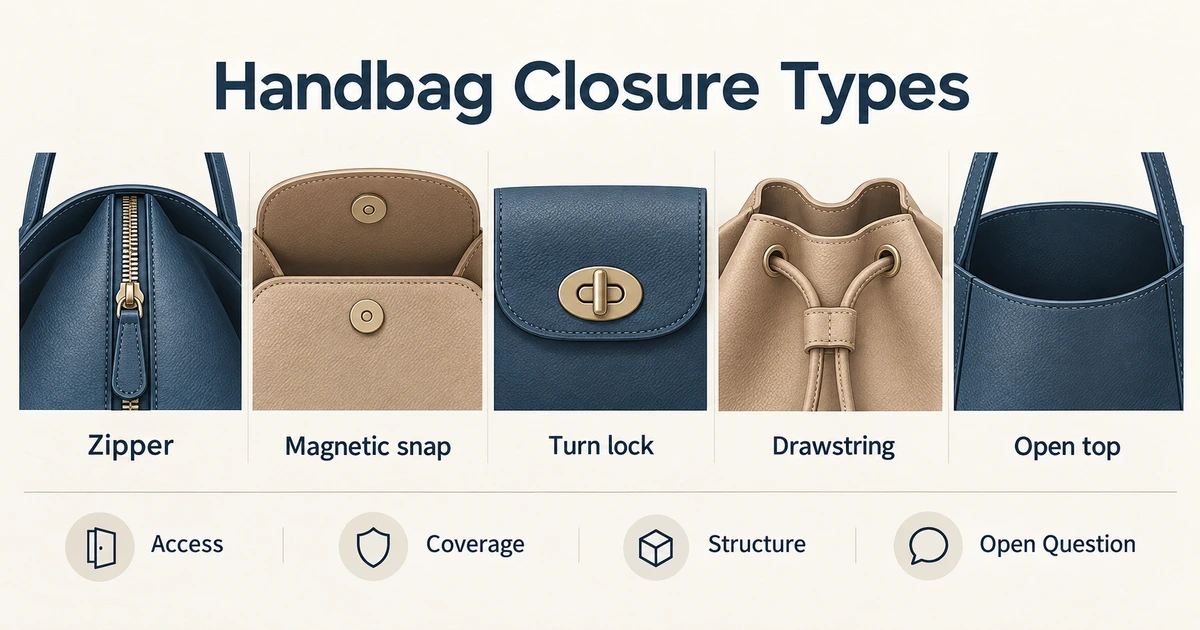
Choosing a handbag closure is a product-development decision about access, opening coverage and bag structure, not a shortcut to a universal performance ranking. Start with the intended use and an identifiable sample; leave component details and acceptance questions Open until the project can review them.
How Should Buyers Choose a Handbag Closure?
The right handbag closure depends on how the opening should be accessed and covered, the bag body and flap structure, material behavior, intended use and desired visual impact. Compare zipper, magnetic snap, turn lock, drawstring and open-top options on the actual sample, then record the selected direction and any unanswered performance or construction questions.
The closure family describes the opening concept. A specific zipper, snap or lock component is a separate selection, and its hardware finish is another decision. Approval scope is separate again: a decision about the identified sample and closure function does not approve every component, surface or future bag. To review zipper, clasp and lock component choices, use the hardware guide after the family and required operation are clear. No family is a default answer for every shape, material or use case.
What Must Be Defined Before Comparing Closure Types?
Record the bag shape and intended use first. Describe the opening's length and shape without guessing a size, the part that should be covered, and the body or flap structure around it. Add the material and lining direction, whether one-hand or two-hand operation matters, and the desired visible hardware or branding effect. If any of these are undecided, mark them Open.
Access asks how a user reaches the contents. Retention or security expectation asks what the opening is expected to keep in place or resist; neither question creates an anti-theft or safety rating. State the actual concern and the use condition so the project can decide what evidence it needs. A reference photo may communicate an opening or appearance direction, but it cannot prove the hidden structure, component strength, durability or production feasibility of a proposed bag.
How Do Zipper, Magnetic Snap, Turn Lock, Drawstring and Open Top Compare?
Use the same questions for each family: how the opening is accessed, what part is covered, what structure and appearance need review, what the identified sample should show, and which details remain Open. The table is a decision worksheet, not a ranking or a list of approved components. Magnetic snap and turn lock are family names here; the actual component, installation, fit and finish require project confirmation.
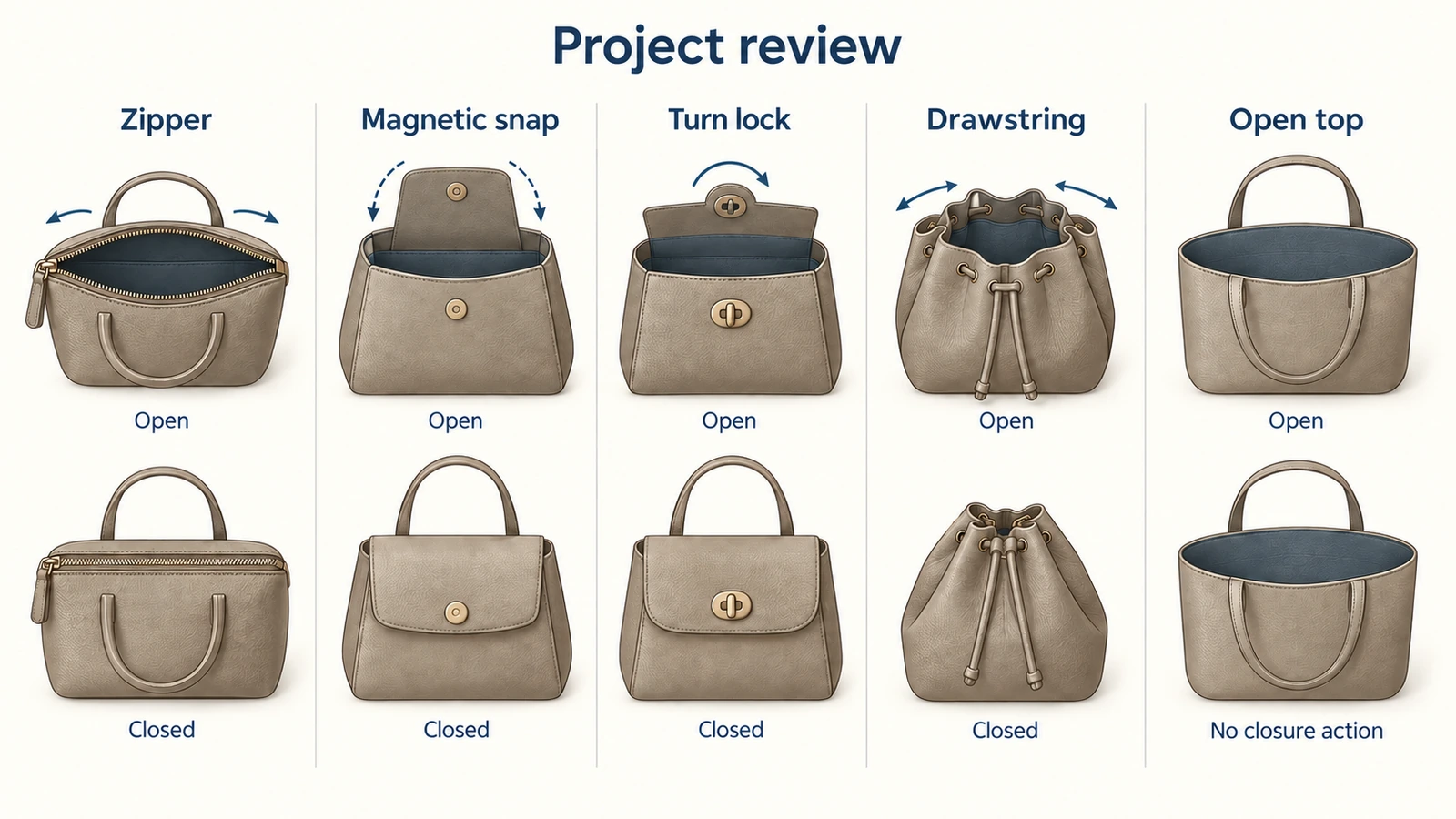
| Closure option | Access path to review | Opening coverage to define | Structure / visual points to review | Sample question | Open items |
|---|---|---|---|---|---|
| Zipper | Pull path, direction and available hand access | Which part of the opening is intended to close | Track route, ends, lining/body interaction, visible pull | Does the identified sample open and close as intended without interfering with the recorded opening structure? | Component, track/ends, installation, finish, performance/testing basis |
| Magnetic snap | Press/pull action and where the user reaches | Whether the opening remains partly exposed around the closure | Panel/flap alignment, support area, visible or concealed placement | Does the identified sample align and release in the intended use position? | Component, holding/release expectation, reinforcement, placement, test basis |
| Turn lock | Align, turn and release sequence | Coverage provided by the flap or panel around the lock | Flap/body alignment, support, visible hardware and branding role | Does the identified sample engage and release in the intended position without forcing the recorded structure? | Component, fit, reinforcement, finish, operating/test basis |
| Drawstring | Pull, gather, loosen and reach into the opening | How far the opening is intended to gather or remain accessible | Channel/path, body softness, gathered shape, cord/hardware direction | Does the identified sample gather and reopen to the intended shape and access path? | Cord/path, channel, end treatment, open/closed shape, test basis |
| Open top | Direct access without a primary closure | The intentionally uncovered opening and any shape retention | Opening shape, body support, lining edge and intended appearance | Does the identified sample keep the intended access and opening shape in the stated use condition? | Whether another retention feature is needed, support, use condition, approval scope |
How Do Opening Coverage and Bag Structure Affect the Choice?
A straight opening, curved opening or flap can change the motion and space a closure needs. So can a soft, semi-structured or firm body, the lining edge and any project-specific support or reinforcement. The buyer should describe what the chosen family must do on this bag rather than assume that a reference image supplies its construction.
For a zipper, identify the intended track route, ends, covered area and contact with nearby body material or lining. For a magnetic snap or turn lock, review where the flap or panels meet, the installation area, support behind it and the visible position when open and closed. For a drawstring, record the channel and cord path, gathered shape and access left when tightened or loosened. For an open top, say explicitly that no primary closure is intended and whether opening shape or contents retention calls for another design input. Component dimensions, tolerances, forces, materials and methods remain project questions, not default values from this guide.
What Should Be Checked on a Closure Sample?
Use an identified sample and a stated use condition so each observation has a reference. The checklist below is limited to closure-specific questions. To inspect the closure on the identified handbag sample within the broader bag review, use the separate sample guide for materials, stitching, finish and whole-bag checks.
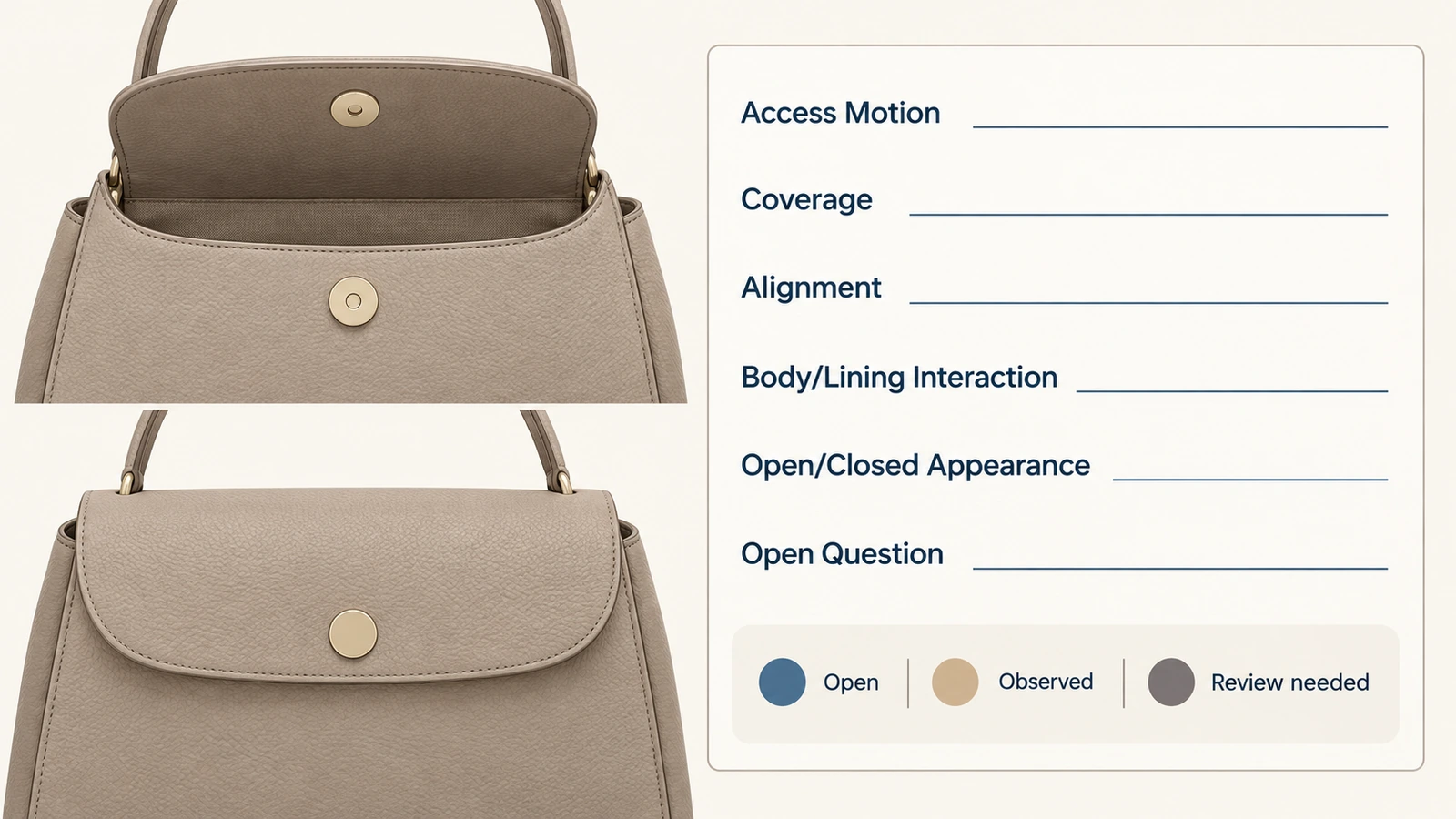
| Check point | Question for the identified sample | Evidence / reference to record | Status / next action |
|---|---|---|---|
| Access motion | Can the intended user action be completed in the recorded bag and contents condition? | Sample ID/version, open/closed views, stated use condition | Open / Observed / Review needed |
| Opening coverage | Does the closure cover the intended part of the opening? | Marked opening view and intended coverage | Open / Observed / Review needed |
| Alignment and position | Do the relevant parts meet in the intended position without assuming a universal tolerance? | Marked location, component/reference ID, sample version | Open / Observed / Review needed |
| Body, flap and lining interaction | Does operation affect the recorded structure, lining or material around the closure? | Photos/notes tied to the identified sample | Open / Observed / Review needed |
| Surface contact | Are there contact points that require project review when opening or closing? | Location and observation; no universal wear conclusion | Open / Observed / Review needed |
| Contents interaction | Does the intended opening path interfere with the project's stated contents/use case? | Use case and sample condition | Open / Observed / Review needed |
| Open / closed appearance | Does the identified sample match the stated visual direction in both states? | Authorized reference and sample views | Open / Observed / Review needed |
| Approval scope | What exactly is being approved, and what remains unresolved? | Style/sample/component version, approver/date, Open items | Proposed / Approved for stated scope / Superseded |
Observed means that a condition was recorded, not that function, durability or a future production batch has been approved. A sample observation applies to that identified sample and viewing or use condition only. The project must agree any relevant method, acceptance basis and next action; the checklist supplies no cycle count, service-life claim or automatic pass/fail threshold.
What Must Be Recorded Before Closure Approval?
Keep a project or style ID, closure family, specific component or reference ID, location, intended access and opening coverage, body/flap/material basis, and hardware finish reference where relevant. Record the sample version and the decision status separately from the approval scope, approver and date. An Open question should name its owner and next action rather than be treated as a settled specification.
Useful status labels are Open, Proposed, Approved for stated sample and scope, Review needed, and Superseded. Approval of operation on one sample does not approve its visible surface or all bags; separate closure function from hardware finish selection when color and finish direction need review. To review available handbag hardware directions, use the materials page as a conversation starting point, not evidence of inventory, testing or approval for this project.
Is a zipper always more secure than a magnetic snap?
No universal ranking follows from the family name. A zipper and magnetic snap may cover an opening differently and require different access motions, components and installation. First define what the buyer means by security for this bag and use condition. Then review the actual structure and identified sample; do not assign a security level without an applicable project-agreed evaluation.
When does a turn lock fit a handbag design?
A turn lock may be a candidate when the design calls for visible hardware and a particular flap or panel operation. Its fit depends on body structure, materials, support, alignment, access motion and the intended visual role. The exact component, installation and mating parts remain Open until the project reviews them on an identified sample. The family name alone is not approval.
What should buyers check on a drawstring closure sample?
On the identified sample, trace how the cord is pulled, how the opening gathers, and how it loosens for access. Check the channel's interaction with the body and lining, the open and closed appearance, and any question about retained opening or contents. Record the sample version and conditions. Cord specification, load, cycles and service life need separate project decisions, not assumptions here.
Is an open-top bag unfinished without a closure?
Not necessarily. An open top can be an intentional access and appearance direction. The buyer should still define the expected opening shape, stated use, coverage expectation and whether another retention feature is needed. If those inputs are missing, keep the decision Open and review an identifiable sample. Do not infer that an uncovered opening is automatically defective or suitable for every use.
What Should Buyers Send for a Closure Review?
Share the bag shape and intended use, plus front, top or side views or authorized reference images that show the opening. Describe the body and flap direction, preferred closure family and visible appearance if known, and the material, lining and hardware finish direction. Add any current sample or component reference and version, the expected access and coverage, and performance or construction questions that still need an answer. Estimated quantity, destination and project timing can help frame a discussion only if already known.
You can begin with an incomplete brief. Share the bag shape, intended use, opening reference, preferred closure direction and the sample or component reference you already have. Mark unknown component, construction, operation or testing requirements Open rather than assuming a specification. Available hardware, structure, sample scope, commercial terms and timing must be confirmed for the specific project.
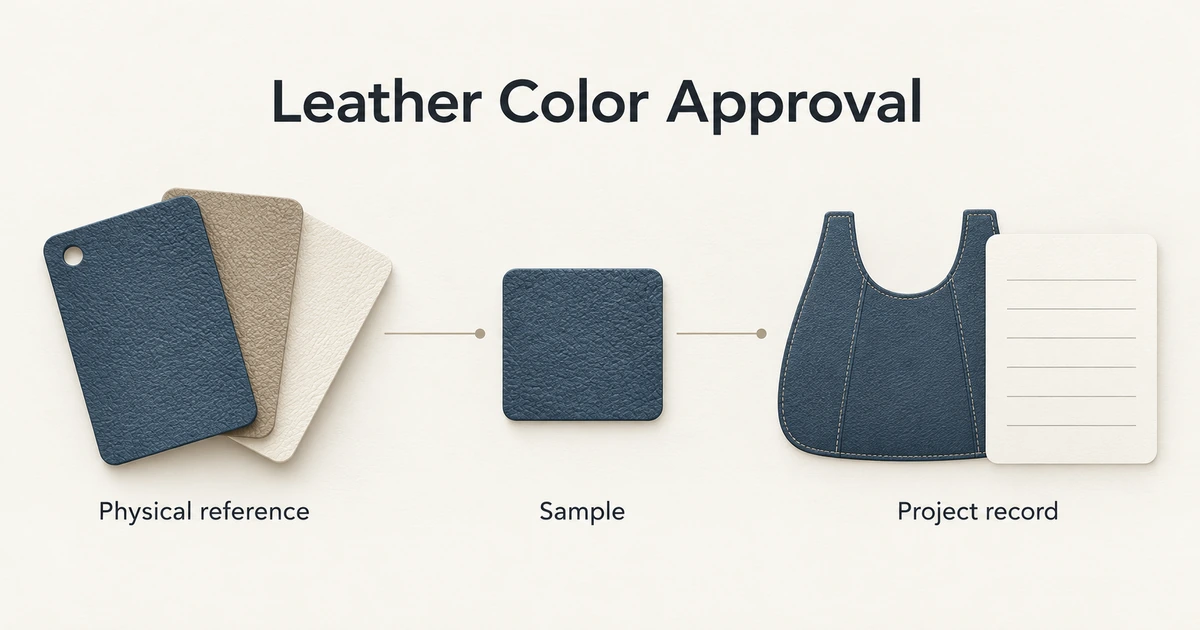
For related sourcing guidance, see OEM vs ODM Handbag Development, Moon Bag Sourcing Guide, Wallet on Chain Sourcing Guide and Leather Color Approval for Handbag Production.
Have a specific sourcing question on this topic? Share your project details and our team will respond directly.
For reference, our current catalog includes styles such as the Soft Boston Bag — useful as a specification baseline when briefing your own factory or sourcing agent.
B2B Buyer Checklist
Before you request a quote, prepare the information that affects MOQ, sample cost, lead time and final unit price.
- Target product category, size and reference images.
- Expected order quantity per style and per color.
- Material preference, lining requirements and hardware finish.
- Logo method, packaging items and delivery country.
- Target retail price or target factory price range.
Decision Table
| Buyer Question | Why It Matters | What to Send the Factory |
|---|---|---|
| What is my MOQ target? | MOQ affects material sourcing, production planning and unit price. | Quantity per style, per color and launch schedule. |
| Which material should I choose? | Material controls price band, durability and brand positioning. | Reference photos, desired texture and target market. |
| How much customization do I need? | Logo, lining, hardware and packaging change sample time and cost. | Logo files, packaging references and required details. |
| What is my delivery deadline? | Sampling, production and shipping need realistic planning. | Launch date, delivery country and preferred shipping method. |