What Must Buyers Confirm Before Sourcing an Embellished Bag?
Before sourcing a beaded, pearl-look or rhinestone bag, confirm what the decorative component is, whether it carries load or is decorative only, how the component is attached to its carrier, and how that carrier is attached to the bag. Then review the actual contact points, empty and loaded weight, surface appearance and packaging separation on the identified sample. A selling name or photograph does not prove natural pearl identity, stone composition, attachment strength, snag resistance or transport performance.
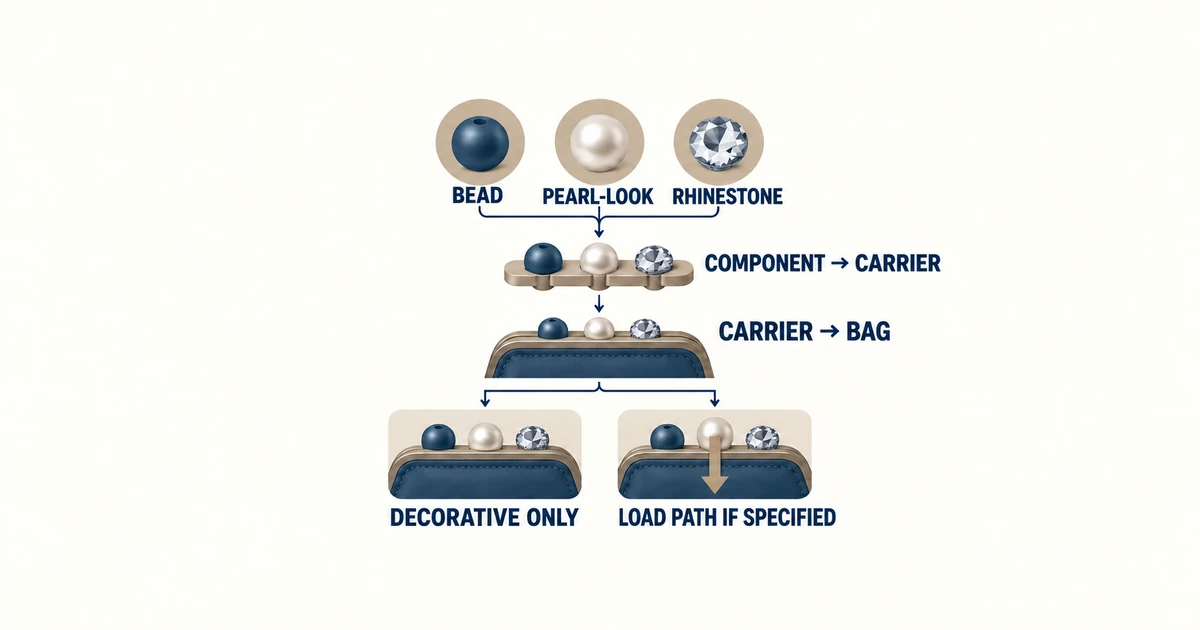
In this guide, beaded, pearl-look and rhinestone are directions for a purchasing conversation, not material certifications or performance grades. Start by marking each component and its job on a reference: a bead may form part of a strand or handle, sit on an embroidered panel, or be only surface decoration. The consequences of a loose ornament differ from a broken load-bearing connection. Record the component, carrier, attachment route, intended carry and contact surfaces as Confirmed, Proposed, Open or Not applicable. A photo may show distribution and appearance; an identified specification and sample are needed for the unseen construction.
The useful result is a reviewable map and a versioned sample record. A buyer can begin with one reference image and an open question about the attachment; the rest can be confirmed for the particular project rather than guessed from the selling name.
Are pearl bags always made with natural pearls?
No. “Pearl bag” may describe an appearance, not a verified material identity. Pearl-like beads can have different cores and coatings, while a natural or cultured pearl claim needs appropriate evidence. Record the component specification and supplier reference; do not identify it from a photograph.
How Do Beaded, Pearl-Look and Rhinestone Directions Differ?
A beaded bag might use strands or a bead net as part of the body or handle, with endpoints that matter to the carry path. Another bag may place individual beads or an embellished sheet on a fabric or hard-shell carrier, leaving the body structure elsewhere. Both can look “beaded” in a photograph, but they create different questions about bead holes, line material, knots, backing and the way the decorated carrier joins the bag.
A pearl bag should begin as a pearl-look direction until the actual bead identity is documented. GIA's imitation-pearl case describes imitation materials with different possible cores and pearl-like coatings; visual similarity alone did not settle identity in that jewelry case. It does not identify a bead on any handbag or prove its attachment performance. For a rhinestone bag, ask what the stone or supplied component actually is, including its back, coating or foil, hole or pre-applied adhesive if relevant, setting or mesh, and supplier reference. The word “rhinestone” is not evidence of diamond, natural crystal, a particular glass formulation or a named brand.
| Direction | Identity questions | Structural role questions | Evidence/status |
|---|---|---|---|
| Beaded | Bead core/material, coating, hole/edge, size, supplier code and line/thread if used | Does a strand or net form the body or handle, or is the bead attached decoration only? | Confirmed / Proposed / Open |
| Pearl-look | Natural, cultured or imitation; if imitation, core/coating and supplier code | Decorative bead, connected strand/net or part of a larger component? | Confirmed with evidence / Open |
| Rhinestone | Stone/component material, back/foil/coating, hole or pre-applied adhesive if applicable, size and supplier code | Individual decoration, mounted component or decorative sheet/net? | Confirmed / Proposed / Open |
| Carrier/backing | Fabric, coated surface, hard shell, setting, mesh or actual carrier | Does it support decoration, bag structure, the load path or more than one role? | Confirmed / Open |
| Contact/use | Body panel, flap, handle, chain area, opening, interior or packaging-facing surface | Which garments, hardware and packaging surfaces can touch it? | Mapped / Open |
For a pearl clutch or pearl clutch bag direction, this article addresses the embellishment and its evidence rather than redefining the bag format. Buyers can compare clutch bag formats separately; its format descriptions do not verify the materials, attachment or performance of a decorated project.
Buyers exploring silhouettes can also review evening bag and clutch references as a commercial starting point. A collection image is useful for discussing placement and overall direction, not proof of a particular bead, stone, construction, inventory or manufacturing option.
How Is the Embellishment Connected, and Does It Carry Load?
Map two stages even when the face of the bag looks like one continuous decorated surface. Stage A joins the bead, stone or supplied component to a carrier: a line, backing, setting, mesh, coated panel or shell. Stage B joins that carrier to the bag body or frame. A component may remain attached to its backing while the backing pulls away from a seam; a strong panel seam cannot rescue a bead whose own line or setting has failed. Record both stages for each decorated zone rather than labeling the whole bag merely “hand-beaded” or “glued.”
A strand or net that forms the body or handle requires an explicit load-path drawing: where the load enters, how it passes through line and junctions, and where it reaches the frame or handle endpoint. A bead sewn onto a non-load-bearing panel has a different role. Mixed construction should be split by location, because the handle, flap and front panel may not share the same component, carrier or connection. Nothing about a visible bead pattern establishes a carrying capacity.
| Route/location | Stage A: component to carrier | Stage B: carrier to bag/frame | Load role | Evidence to request |
|---|---|---|---|---|
| Threaded strand/net | Hole/line path, knots, endpoints or linked structure | Endpoint/frame/body connection | Load-bearing / Decorative / Mixed / Open | Material/line specification, path/end detail, sample record |
| Sewn bead or embellished panel | Individual/strip/sheet sewing to backing | Backing/panel seam or other connection to bag | Project-defined; never infer | Sewing/back view, reinforcement/coverage, current sample |
| Non-hotfix adhesive | Component back, named adhesive and carrier surface | Carrier/panel connection if separate | Decorative / Open | Adhesive/substrate compatibility and curing/sample record |
| Hotfix | Pre-applied adhesive component and heat application to carrier | Carrier/panel connection if separate | Decorative / Open | Component manual, substrate trial and sample result for this combination |
| Setting/rivet/decorative mesh | Stone to setting/mesh, or component as supplied | Setting/rivet/mesh to shell/frame/backing | Decorative / Structural only if specified and evidenced | Both connection details, back coverage and current sample |
The category names above describe different routes, not a strength ranking. Preciosa Components' application-manual index separately lists hotfix, gluing, sewing, stone setting, epoxy setting and rivets. That index supports the distinction among application categories only; it supplies no handbag-specific result, and it does not imply that this project uses Preciosa components or services. For a particular route, ask for the component and carrier identities, line/adhesive/setting details, back coverage, endpoints, applicable supplier instructions and a sample record for the actual combination. Do not import a temperature, curing time, pull value or cycle count from another material and substrate.
A project may need a wider material and substitution register. Buyers can build a handbag bill of materials for that general purpose, while keeping this article's two-stage map and load role visible as separate decision fields.
Which embellishment attachment method is strongest?
There is no universal answer from the method name alone. Threading, sewing, adhesive, hotfix, settings, rivets and decorative meshes use different component–carrier–bag combinations. First map both connection stages and any load path, then define the sample condition and evidence required for that exact combination.
How Should Buyers Review Shedding, Loose Parts and Snag Contact?
When something loosens, locate the stage before calling it a general “bead problem.” Is the surface of the component changing, a line broken at its hole, a stone lifting from its setting, an embellished backing separating from the bag, or a frame endpoint shifting? Mark the initial location and appearance on the identified sample, then record the exact location of any change after the agreed loading, opening, carrying or bending conditions. A missing decorative bead and a compromised handle path call for different decisions; neither should be hidden inside one pass/fail word.
Snag risk starts at actual contact, not at the most attractive front photograph. Look for exposed prongs, line ends, bead-hole edges, chain links, openings and the reverse side of settings. Mark where a garment or skin-facing surface might brush them in the proposed carry position. If fabric contact matters, use a buyer-approved representative swatch under agreed direction and conditions, not a customer's garment. Name the fabric and the observed change. An uneventful observation on one swatch cannot establish that all garments are safe from snagging.
If the project actually specifies natural or cultured pearls, GIA's pearl care guide notes vulnerability to scratching, high heat and some chemicals. That information should prompt material-specific contact questions, not a conclusion about every imitation coating or a cleaning, water-resistance or transport claim for the whole bag. A coated imitation, stone back, line end and metal setting may need different questions, all tied to the documented component.
For the wider sequence of requesting, revising and approving a project sample, buyers can prepare and review a handbag sample. The embellishment observations here remain tied to the actual BOM and attachment version; a prior sample result does not travel automatically to a changed bead, line, coating, backing or setting.
How can buyers check shedding and snag risk?
Map the initial decoration and both connection stages on an identified sample. Under agreed loading, handling and contact conditions, record loose components, broken lines, lifted edges, exposed prongs or line ends, and changes on an approved representative fabric. Keep the conditions and limits with the result; one observation cannot prove zero shedding or universal snag resistance.
How Should Weight, Carry Configuration and Surface Appearance Be Compared?
A weight comparison has meaning only when its state is named. Record the empty bag without packaging, the fitted or detachable chain and handle configuration, and the weight with the agreed contents. Packaging gross weight belongs in its own entry. If two decorated directions are being compared, hold bag dimensions, decorated coverage and carry setup as comparable as possible, or explain the differences. A bead or stone name alone cannot predict the weight of the assembled item; a light sample is not evidence of attachment durability.
Carry also changes what to inspect. When a bead strand or net forms the body or handle, identify the route from contents through the structure to the hand or shoulder, then record the loaded sample and the specific connection points observed. When beads or stones are only decoration, keep their retention question separate from the body's load path. Do not infer a rated carry load from a visual reference or a single wear observation.
Record the front, side and reverse under the same light, support and viewing angle, both empty and with the stated load. A panel may pucker around stitches, lift near adhesive edges, show uneven spacing, or interfere with the opening when its decorated face curves. A hard shell may reveal a different fit question than a soft backing. Three-dimensional texture can be an intended design feature, so judge the sample against the buyer-approved direction and identify the precise difference instead of calling every raised area a flaw. Any requested change to distribution, component or carrier should be versioned before the next comparison.
What Packaging Contact Points Must Be Separated?
A decorated bag can touch itself before it ever touches a carton: a loose chain can cross the decorative face, a clasp can press against a setting, and an uncovered back can meet the lining. In a multi-item pack, an adjacent bag or divider may press against a protruding component. Map these pairs on the packed sample, then decide where hardware should be fixed, surfaces separated or clearance left. Those are design questions to verify with the chosen packaging, not claims that a given separator prevents every scratch or loss.
The five judgments below form one sample evidence record. Each row belongs to an identified sample ID, component/carrier/fixing and BOM version, stated load and carry configuration, contact or packaging condition, and review date. Write down what was observed, what was not checked and what remains Open. No row supplies a universal threshold or a transport-test pass.
| Judgment | What to observe and record | Decision boundary | Record |
|---|---|---|---|
| Shedding / loosening | Initial location map; loose bead/stone, broken line, lifted edge, cracked setting and affected connection stage after agreed handling | Separate decorative loss from load-path failure; no universal force/cycle/pass rate | Observed / Not checked / Open |
| Snag / scratch contact | Prongs, line ends, bead-hole edge, chain/opening/back; named representative fabric and agreed contact direction/condition | One fabric result cannot support “snag-free for all garments” | Observed / Not checked / Open |
| Weight / carry | Empty bag, detachable chain/handle configuration, agreed loaded weight; packaging gross weight separately | Compare only like-for-like size, coverage and carry setup; lightweight is not durability | Measured / Not checked / Open |
| Surface appearance | Same light/support/angle; empty vs loaded; backing puckering, local lift, spacing, glue overflow, shell fit and opening interference | Approved dimensional texture may be intentional; judge against approved direction/sample | Observed / Not checked / Open |
| Packaging protection | Decoration contact with chain, hardware, adjacent bag, inner pack and carton; separation/fixation/clearance | No zero-loss or transport-test claim without agreed method and result | Observed / Not checked / Open |
| Version evidence | Sample ID, component/carrier/fixing/BOM version, load, carry configuration, fabric/contact and packaging version, date | Earlier sample result does not automatically transfer to changed combination | Recorded / Open |
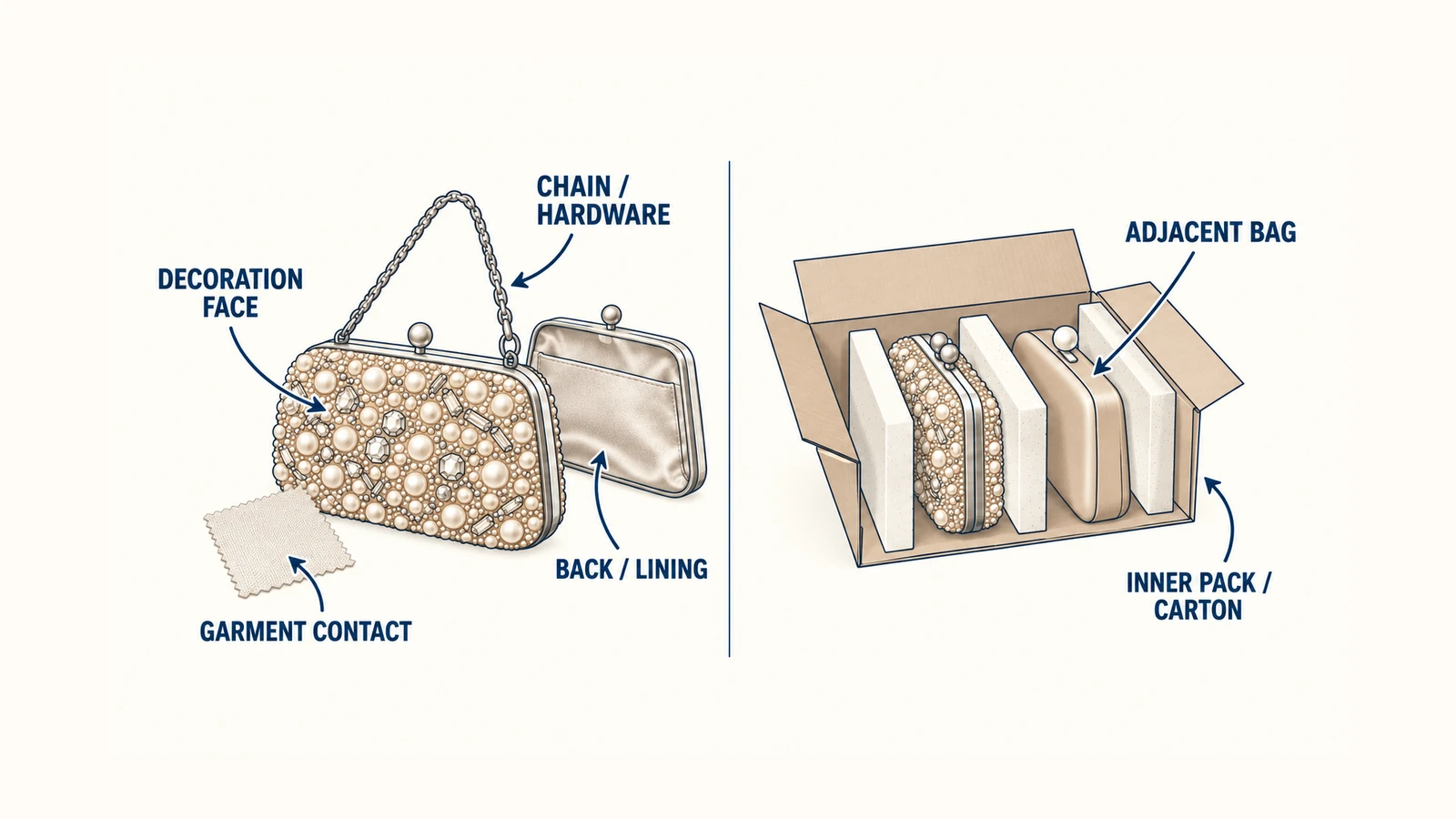
Conceptual contact map for discussion—not an existing CELYNORA product, verified packaging configuration or test result.
| Contact pair | What to map | Project question |
|---|---|---|
| Decoration ↔ garment/skin-facing area | Protruding edge, prong, line end, opening and carry position | Which representative surface and contact condition should be reviewed? |
| Decoration ↔ chain/hardware | Loose chain route, clasp, frame, zipper pull and decorative face | Must chain/hardware be fixed or separated during packing/use review? |
| Decoration ↔ lining/back | Rivet/setting/line/glue back and any cover layer | Is back coverage required for the actual construction and use? |
| Decoration ↔ adjacent bag | Product orientation, separator and pressure point | What prevents direct rub or point pressure in the chosen pack? |
| Decoration ↔ inner pack/carton | Protrusion height, cavity/clearance and movement route | What clearance and fixation need sample verification? |
Packaging material itself may transfer color, adhere to a coating or rub a raised surface, so the chosen combination needs its own review. Transport vibration, drop or compression methods and acceptance limits are separate project decisions; none has been performed by this guide. Buyers who need the broader choice among dust bags, boxes and retail packs can review handbag packaging options without treating any generic packaging type as proof of protection for this decoration.
What Should a Buyer Send for an Embellished Bag Project Review?
Start with the decorated direction—beaded, pearl-look, rhinestone or mixed—and one reference image or sketch that shows where the decoration sits. Say whether each area is merely decorative, forms the body or handle, or remains undecided. Mark the likely component-to-carrier and carrier-to-bag routes, even if some materials or endpoints are Open. Reference artwork and brand elements should be supplied only with the provider's rights or authorization; the goal is to discuss the intended features, not reproduce a protected design or logo.
If known, add component identity and supplier references, the backing, line, adhesive or setting direction, reverse-side coverage, intended carry and actual load, garment-contact surfaces, desired empty/loaded weight direction, and packaging arrangement. A preliminary photo plus a question about a prong, seam or chain route is enough to begin; a finished test report is not a prerequisite for contacting us. Estimated quantity, destination country and target date can frame a project discussion when available. Teams comparing development routes can compare OEM and ODM starting points without assuming a particular embellishment material, attachment method or production capability is already confirmed.
Planning a beaded, pearl-look or rhinestone bag project? Send the embellishment direction, where it sits, whether it carries load or is decorative only, the known backing and attachment details, intended carry and contact conditions, packaging needs, estimated quantity and delivery country if known. You can start with open questions; materials, attachment options, sample evidence, testing needs, pricing, MOQ and timing are confirmed for the specific project. Discuss Your Embellished Bag Brief.
B2B Buyer Checklist
Before you request a quote, prepare the information that affects MOQ, sample cost, lead time and final unit price.
- Target product category, size and reference images.
- Expected order quantity per style and per color.
- Material preference, lining requirements and hardware finish.
- Logo method, packaging items and delivery country.
- Target retail price or target factory price range.
Decision Table
| Buyer Question | Why It Matters | What to Send the Factory |
|---|---|---|
| What is my MOQ target? | MOQ affects material sourcing, production planning and unit price. | Quantity per style, per color and launch schedule. |
| Which material should I choose? | Material controls price band, durability and brand positioning. | Reference photos, desired texture and target market. |
| How much customization do I need? | Logo, lining, hardware and packaging change sample time and cost. | Logo files, packaging references and required details. |
| What is my delivery deadline? | Sampling, production and shipping need realistic planning. | Launch date, delivery country and preferred shipping method. |