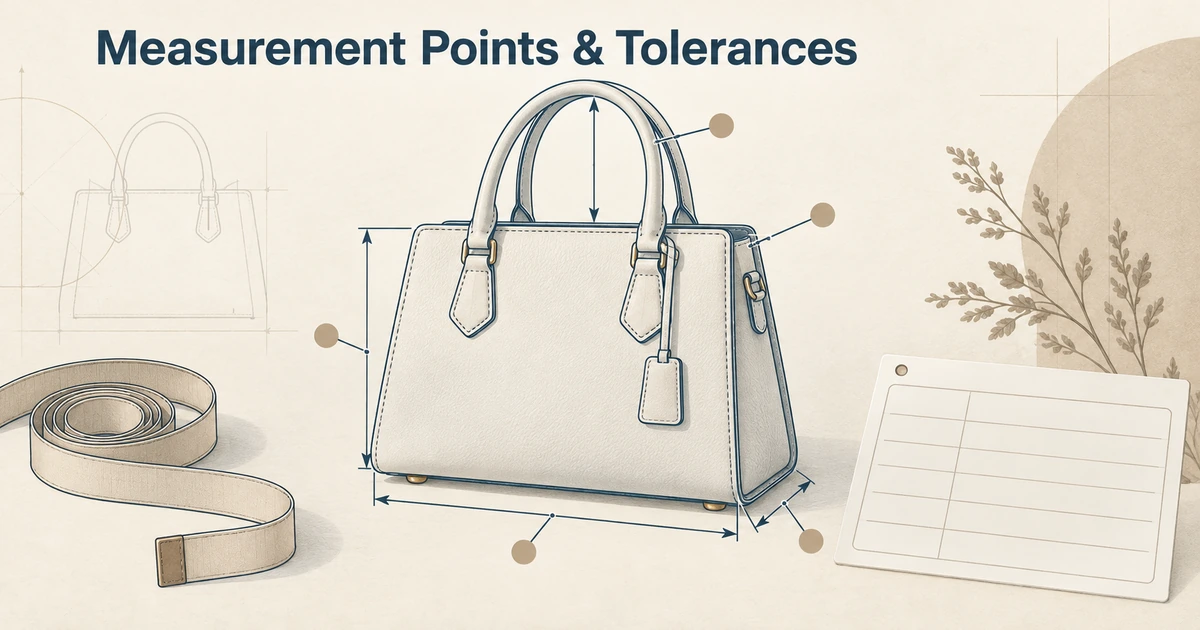
A bag can have a target dimension yet still lack a shared way to measure it. For sample review and later production discussions, buyers need a point-by-point record that states the method before anyone compares readings.
What Makes a Handbag Measurement Repeatable?
A repeatable handbag measurement defines the point being measured, the exact start and end references, whether the path is straight or follows a curve, the tool and unit, and the physical state of the bag. Each point also needs a controlling drawing or sample version, a project target and a project-agreed tolerance. An actual reading is meaningful only if it uses that same basis. If the method or state differs, review the mismatch before calling the reading a product deviation.
Keep target dimension, measurement method, project tolerance and actual result in separate fields. An arrow on a photo can identify an area, but without start and end references, path and bag state, two people may take different readings from the same style.
Which Points of Measure Belong on the Sheet?
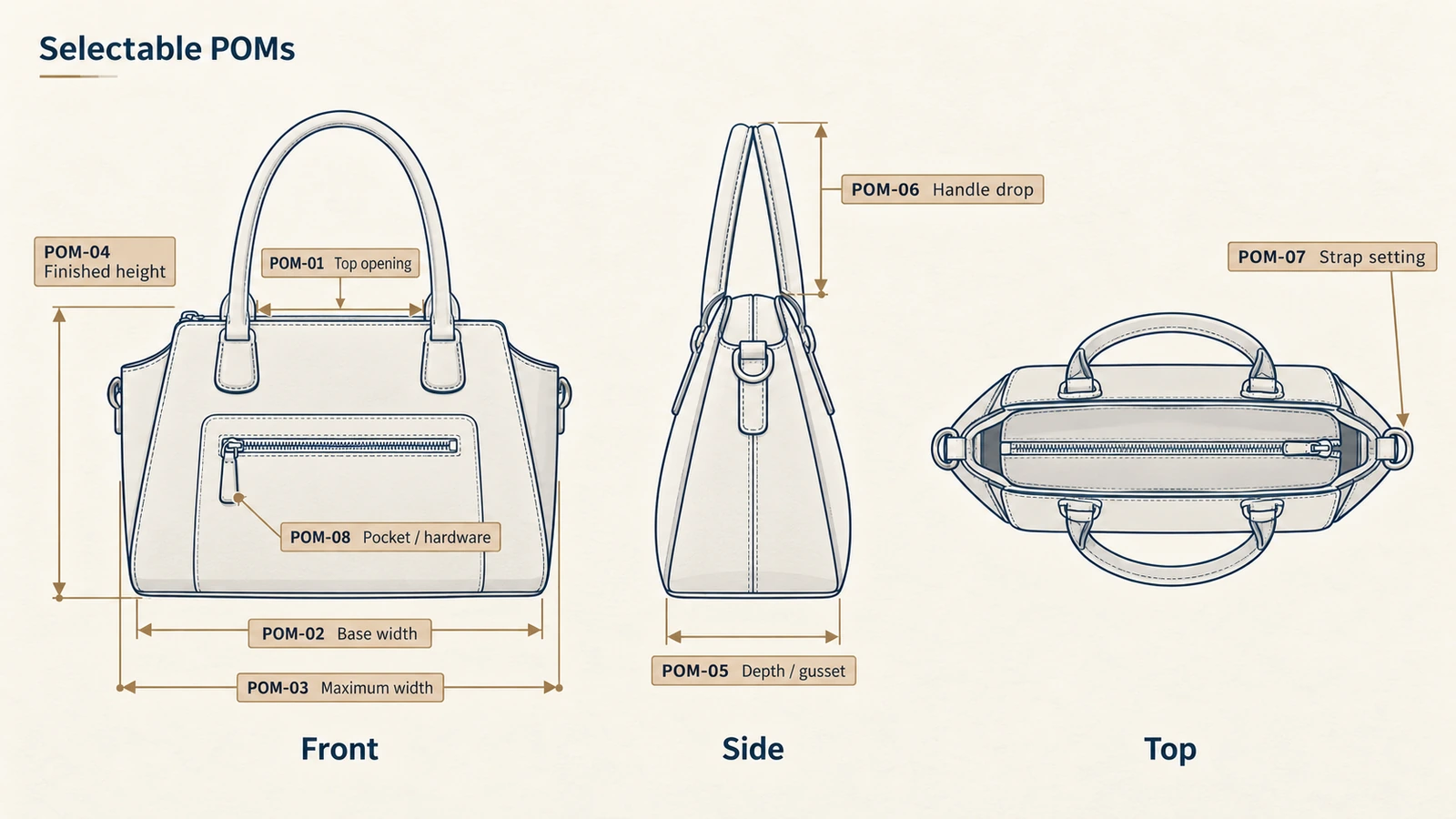
Choose points of measure (POMs) for the structure and function of this style. There is no complete POM list that suits every handbag. A top opening width, base width and maximum body width may each describe a different part of one tapered body. Finished body height needs its own named top and bottom references; depth or gusset width needs a named location rather than an unqualified “depth.”
Handle drop, handle length, strap length and an identified adjustment setting can matter, but they are not interchangeable. Define an opening, flap, pocket or hardware placement only where it affects the current design or function. Curved edges, tapered sides, soft bodies and left-right asymmetry each need a project-specific reference; do not infer one universal method from a sketch.
Give each selected point a stable ID, a plain-language name and a callout on the controlling view. “POM-01” is an empty ID example, not a specification or a measured value. For a crossbody direction, review crossbody size and strap inputs separately; the measurement sheet must still define its own references.
How Should the Measurement Method Be Written?
For each POM, write the start reference and end reference on the same marked view. State whether the path is a straight line, follows a contour or goes around a circumference, choosing only the path relevant to that point. Say whether piping, hardware, feet, edge paint or a seam boundary is included or excluded. Identify the tool and unit, whether one side, both sides or a named side is checked, and the controlling sketch, photo or sample revision.
A reading along a curved edge and a straight-line reading between its endpoints answer different questions. Record which path is intended before comparing the values. Put this defined measurement page into the wider specification: build the measurement page into your handbag tech pack. This guide covers the measurement page, not every part of a tech pack.
Why Does the Bag’s Measurement State Matter?
A soft bag may read differently when empty and unsupported, supported by a project-agreed insert, laid flat, upright or hanging. Closure position, a named strap hole or setting, and whether a part is relaxed or held straight can also change the reading. If a project uses a specific conditioning or rest period, name its before-or-after state in the method; this article does not supply a default period, force or fill.
Agree the state for each relevant POM and mark it Open until both sides confirm the method. The examples below show how to describe a state, not states that every bag must use.
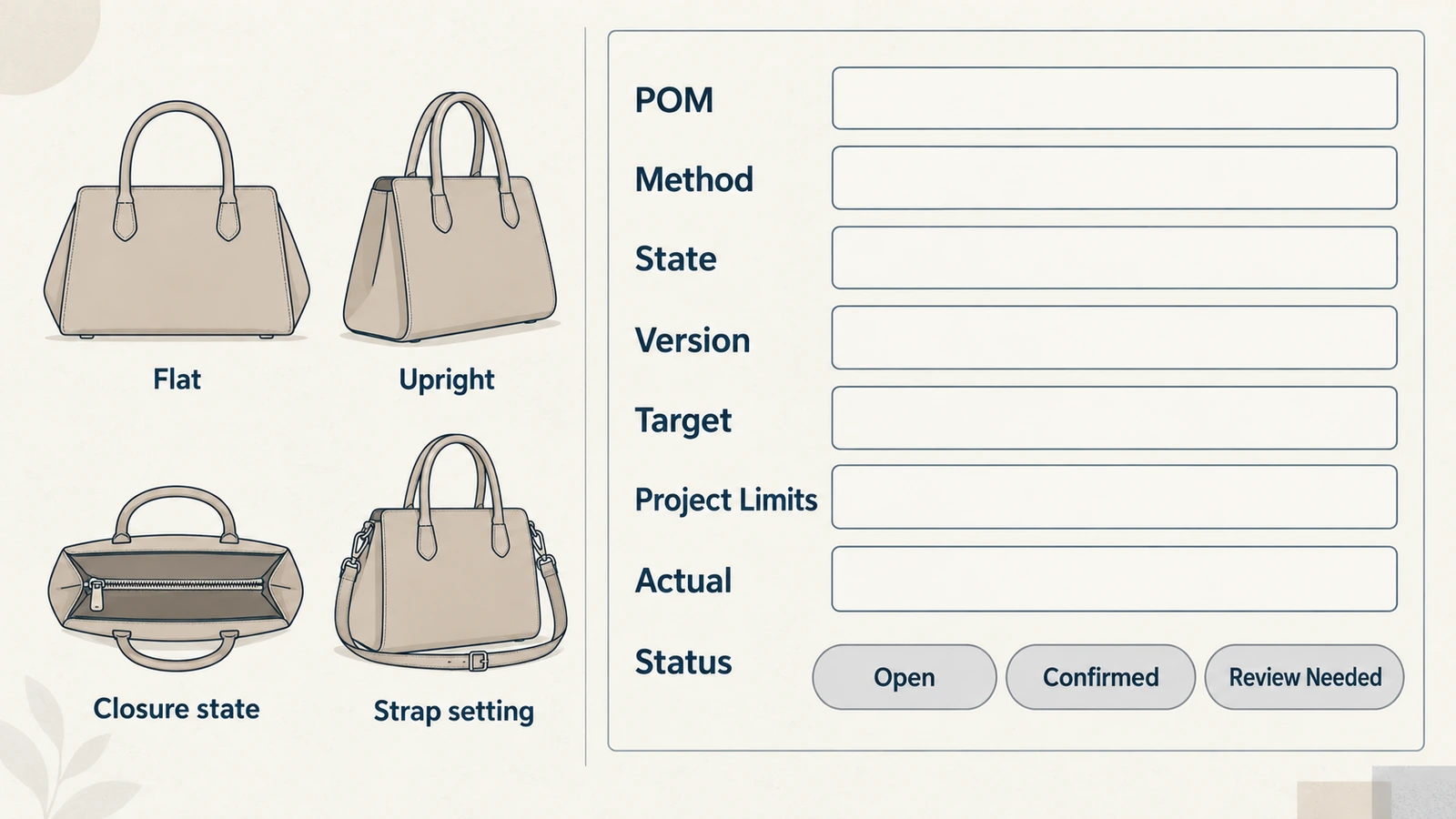
| State field | What the project must define | Example wording without a numeric promise | Status |
|---|---|---|---|
| Bag support | Unsupported or supported by a named insert/reference | Empty and unsupported | Open / Confirmed |
| Orientation | Flat, upright or hanging | Upright on the agreed base reference | Open / Confirmed |
| Closure | Open, closed or set to a named position | Main closure closed | Open / Confirmed |
| Strap or handle setting | Named hole, setting or attachment state | Strap at the identified setting | Open / Confirmed |
| Material/shape condition | Relaxed or held using the agreed method | Gusset opened using the marked reference | Open / Confirmed |
How Should Project-Specific Tolerances Be Set?
A tolerance is project-specific and depends on the material, construction, measurement method, sample findings, functional needs and confirmed buyer requirements. This guide offers no transferable numeric tolerance. Discuss each POM with the proposed supplier: Is it functionally critical? Is the target a single value or a pair of limits? Should the permitted difference be symmetric or should upper and lower limits differ? Which drawing or sample version supports the target? What change would require the target or limit to be reconfirmed?
Record the agreed answer beside that POM, including whether the specification is Open or Confirmed. A tighter limit is not automatically a better product decision, and its feasibility must be reviewed for the project. A POM within its confirmed range reports only that point's measurement result; appearance, materials, function and other checks remain separate.
How Do You Compare Sample and Production Measurements?
Use the same measurement basis at each agreed comparison point:
- Lock the POM definition and controlling drawing or sample version.
- Record the project target and the confirmed tolerance or limits; keep an unresolved specification marked Open.
- Measure the sample using that POM's defined references, path, tool, unit and bag state.
- Use that same basis for the agreed first-unit or production check, recording each actual value against its own reference.
- Separate an Outside project range result from a Method mismatch. Name the review owner and action before deciding whether the product or the measurement basis needs attention.
If a method, state, target or controlling version changes after approval, record a change after sample approval and keep the earlier record instead of overwriting it. Specification status and result status are different: recording an actual value cannot turn an Open specification into a Confirmed one.
The row below is a blank planning example, not a client record or a completed inspection. “Within project range” applies only to the individual POM with a confirmed basis; it does not approve the whole bag.
| POM ID | Point name | Start reference | End reference | Path / method | Bag state | Unit | Controlling version | Target | Project tolerance / limits | Actual | Result status / action |
|---|---|---|---|---|---|---|---|---|---|---|---|
| POM-__ | Open / Confirmed | Not measured / Within project range / Outside project range / Method mismatch / Review needed |
What Should You Send for a Measurement Review?
Share the clearest marked front, side, top or bottom view, or reference images available. Add a style or project identifier, the current drawing or sample revision, and what that reference controls. Include the POMs and methods or bag states you already know, any target values you have decided, and the tolerance or method questions still open. Intended use or fit requirements help when they change which point should be measured.
An incomplete sheet is a valid starting point for a question; do not invent missing values before asking. To discuss an OEM or ODM handbag project, share the available reference and open questions. Available measurement methods, project limits, sampling scope, commercial terms and timing must be reviewed for the specific project.
For related sourcing guidance, see Moon Bag Sourcing Guide, Drawstring Handbag Closures and Leather Color Approval for Handbag Production.
Have a specific sourcing question on this topic? Share your project details and our team will respond directly.
For reference, our current catalog includes styles such as the Laptop Backpack — useful as a specification baseline when briefing your own factory or sourcing agent.
B2B Buyer Checklist
Before you request a quote, prepare the information that affects MOQ, sample cost, lead time and final unit price.
- Target product category, size and reference images.
- Expected order quantity per style and per color.
- Material preference, lining requirements and hardware finish.
- Logo method, packaging items and delivery country.
- Target retail price or target factory price range.
Decision Table
| Buyer Question | Why It Matters | What to Send the Factory |
|---|---|---|
| What is my MOQ target? | MOQ affects material sourcing, production planning and unit price. | Quantity per style, per color and launch schedule. |
| Which material should I choose? | Material controls price band, durability and brand positioning. | Reference photos, desired texture and target market. |
| How much customization do I need? | Logo, lining, hardware and packaging change sample time and cost. | Logo files, packaging references and required details. |
| What is my delivery deadline? | Sampling, production and shipping need realistic planning. | Launch date, delivery country and preferred shipping method. |