Which Camera or Messenger Bag Does the Project Actually Need?
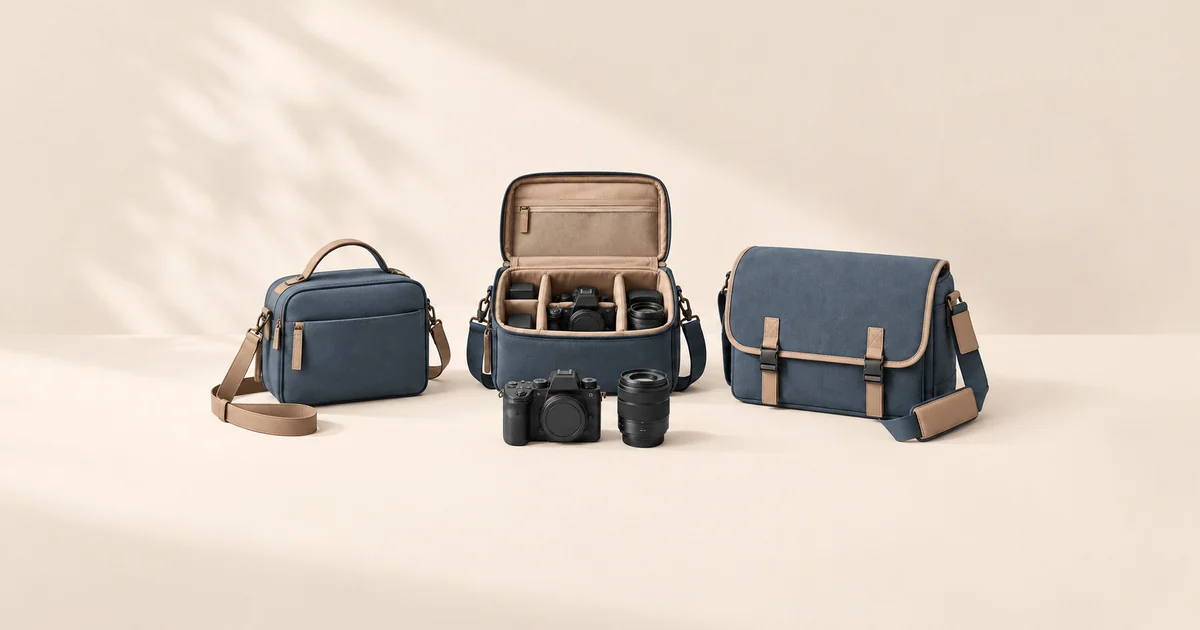
Choose a camera-style bag when the brief is a compact, boxy fashion handbag for personal items. Choose an equipment camera bag only when the product is being designed around a named camera body, lens configuration, accessories, usable internal space, dividers and an agreed access path. Choose a messenger or courier direction when a rectangular shoulder or crossbody format with a flap-led opening fits the carry job. A name, photo or silhouette alone does not prove padding, impact protection, water resistance or equipment fit.
“Camera-style bag” is an editorial shorthand in this guide to separate a handbag look from a gear-carrying requirement; it is not a regulated product class. The actual specification still comes from the buyer's load, project documents and current sample. Start by asking what the bag must carry: daily personal items, a defined photography setup, or documents and commuting items. That answer determines which measurements and sample observations matter.
A boutique may be choosing a camera bag purse for its compact profile and strap direction. A team developing a bag for camera gear has a different decision: whether the complete body-and-lens configuration can pass the opening, sit in the usable interior, remain separated as required and be reached in the intended order. Those are not consequences of the retail name. A messenger bag may serve either a general carry brief or a gear brief, but only an explicit gear brief establishes the latter.
How Do Camera-Style, Equipment Camera and Messenger Bags Differ?
A messenger bag is commonly described with a rectangular form, broad shoulder strap and flap; individual products can depart from that description. REI's camera-bag selection guide discusses gear quantity, internal organization and padding as selection considerations. Neither source proves the construction or protection of a specific Celynora item. Use the table to select a project direction, not to rank products.
| Direction | What the name means here | Load and access starting point | Structure to specify | Evidence boundary |
|---|---|---|---|---|
| Camera-style fashion bag | Compact, often boxy handbag silhouette; shoulder or crossbody carry may be requested | Personal items and the intended everyday access | Usable opening/interior, closure, lining/pockets, strap, body structure and target proportions | The silhouette does not prove photography use, padding or equipment protection |
| Equipment camera bag | Carrier brief built around a stated camera, lens and accessory set | Actual gear configuration, insertion/removal order and access priority | Clear interior, narrowest opening, dividers/padding if required, closure, pockets, carry and attachment points | Fit and any protection claim need an identified sample, project specification and agreed evidence |
| Messenger / courier bag | Rectangular shoulder or crossbody direction, often with a flap-led opening | Documents, device or other specified load; camera gear only when expressly included | Flap/closure, usable opening, interior layout, strap, body structure and access path | “Messenger” or “courier” alone does not prove gear architecture or protection |
A camera bag crossbody label describes carry direction, not the interior. The Crossbody collection can help a buyer review crossbody bag design references for a fashion silhouette; its camera and messenger labels are not evidence of photography-equipment suitability. Conversely, a messenger format can be developed around gear only after the load, access and construction requirements are supplied.
Is a fashion camera bag the same as a photography equipment bag?
No. A fashion camera-style bag describes a compact handbag look. An equipment camera bag requires a brief for the actual camera body, attached or spare lenses, accessories, usable space, dividers and the route for taking gear in and out. Neither the name nor the photographed shape establishes padding, fit or protection.
What Equipment and Load Information Should the Buyer Record?
For an equipment project, identify the real gear set before choosing the bag's external dimensions. A body model may be a starting reference, but the buyer should provide manufacturer dimensions or measured width, height and depth with units for the exact item being carried. If the camera is stored with a lens attached, measure or document that complete configuration—including any hood or cap state and the orientation used to insert it. A lens's focal-length label does not tell a bag developer its maximum outside diameter or stored length.
Use a gear/load map to show what goes together and what must be reached first. Do not invent missing measurements. A fashion camera-style or ordinary messenger project can mark gear rows “Not applicable” and continue with its own everyday load; the table is not a gate to contacting the team. The same principle of checking actual objects against the usable opening also appears in the work-bag fit method, but a laptop fit result cannot be reused as a camera fit result.
| Load item | Buyer-provided project input | What must be confirmed | Status |
|---|---|---|---|
| Camera body | Exact model or measured W × H × D with units | Stored alone or with an attached lens? Which orientation? | Provided / Open / N/A |
| Body with attached lens | Complete outside envelope, hood/cap state and insertion orientation | Does this exact configuration pass the opening and sit without unintended contact? | Provided / Open / N/A |
| Spare lens or lenses | Quantity, maximum diameter and length, cap/hood state | Divider space, removal clearance and contact with adjacent items | Provided / Open / N/A |
| Flash, charger and batteries | Only the actual items; dimensions where fit is material | Pocket or divider placement and interference with priority gear | Provided / Open / N/A |
| Cards, filters and cables | Items and organization preference for this project | Retention and access without loose contact if separation is required | Provided / Open / N/A |
| Other carried items | Phone, wallet, documents, bottle, small tripod/strap or another stated item | Separation, closure and loaded balance | Provided / Open / N/A |
| Access priority | Item needed first and the situation in which it is retrieved | Opening direction and removal sequence | Provided / Open / N/A |
A map becomes useful when it records relationships, not just a shopping list. For example, if the body stays assembled with a lens, its combined outside envelope and insertion direction control the opening question; if a spare lens sits in front of the body, it may block the planned retrieval path. Write those conditions into the brief and keep each unresolved item Open. The material and layout choice follows the load rather than an assumed number of cameras a named bag can hold.
How Should Usable Space, Dividers and the Access Path Be Specified?
Compare the load map with clear usable dimensions, not only the finished bag's outside width, height and depth. Lining, structure, padding and divider thickness can take space away from the interior. The narrowest point may be the opening under a flap or zipper, even when the gear would fit in the main cavity. Record the full insertion and removal path: how the body with attached lens turns through the opening, what must move first, whether a spare lens obstructs it, and whether the closure works with every planned item in place.
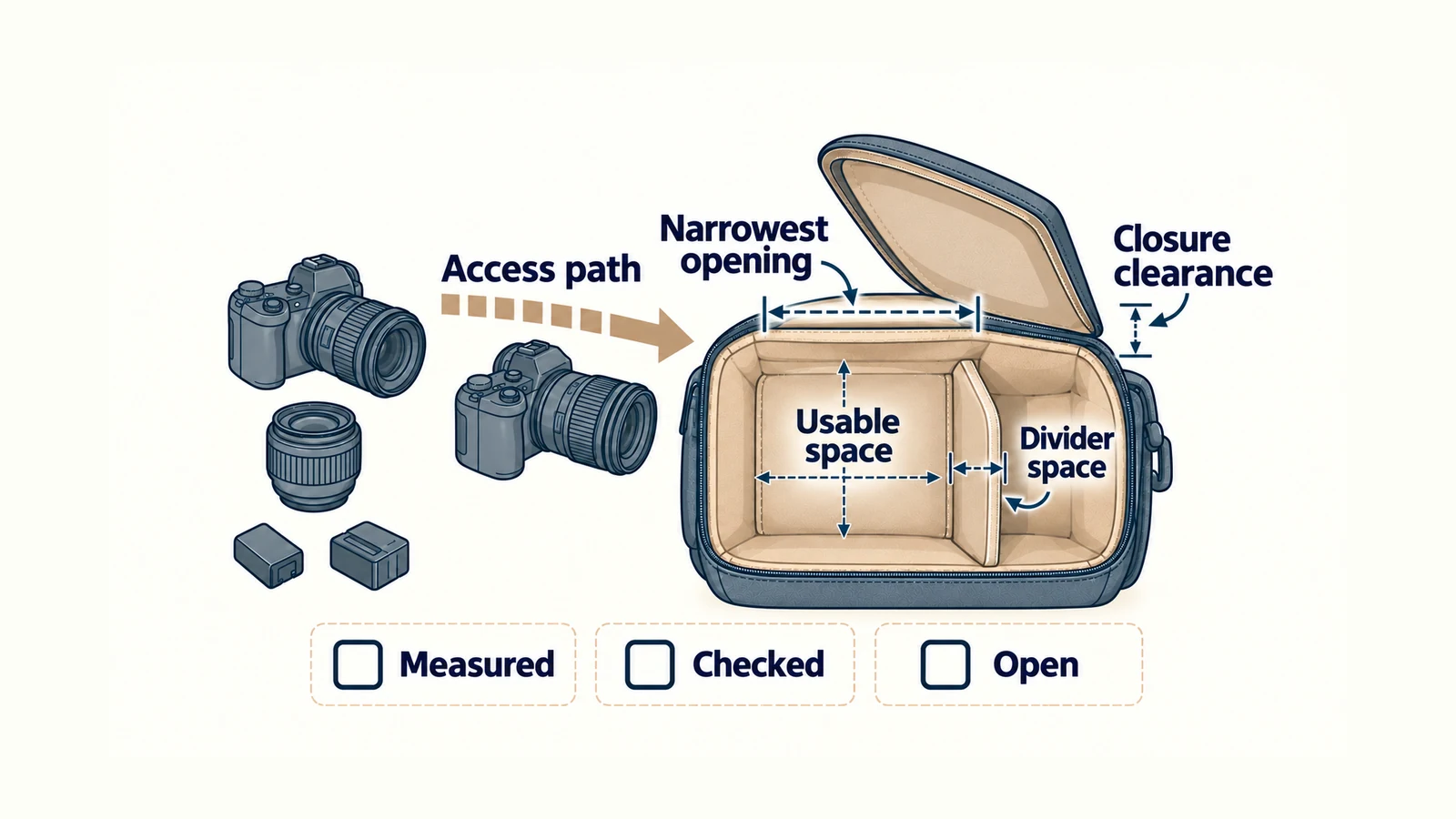
Concept illustration only: the drawn gear, clearances and unchecked states do not document a real product, equipment fit or protection test.
| Checkpoint | What to record for this project | Why it matters | Status |
|---|---|---|---|
| Usable internal space | Clear W × H × D after lining, structure, padding and dividers | Outside dimensions can overstate space available to gear | Measured / Open |
| Narrowest opening | Clear width and height along the actual insertion path | Gear may fit in the cavity but fail to enter it | Measured / Open |
| Closure clearance | Space below the closed flap, zipper or other closure with the full load | A nominal interior fit does not prove clean closure | Checked / Open |
| Divider and padding layout | Position, thickness, attachment/adjustability and space occupied, if specified | Internal components change fit, access and contact points | Specified / Open / N/A |
| Insertion/removal path | Orientation and sequence for the body-with-lens and priority items | Flap, zipper, divider or neighboring gear may obstruct retrieval | Checked / Open / N/A |
| Contact and separation | Where gear touches lining, divider or another item | Buyer decides the separation and acceptance criteria required | Observed / Open / N/A |
| Loaded carry | Balance, strap/handle direction and attachment observations under the stated load | Carry behavior belongs to the actual load and sample | Observed / Open |
| Sample/version record | Sample ID, gear-list and brief version, date and unresolved questions | Prevents old observations being assigned to a revised design | Recorded / Open |
There is a real tradeoff between a compact layout and easy access. A tighter interior may hold the intended set in less space yet make removal awkward or change what fits once a hood or accessory is added. A wider opening or adjustable divider may offer more arrangement options, but it still has to close as specified, keep the bag's intended structure and carry acceptably when loaded. Neither design direction is universally better. Crossbody dimensions and strap inputs can inform the general carry brief; the equipment-specific clearances above must still be established for this project.
A divider or padding visible in a picture is not a measured clearance or a protection result. If those parts are required, specify their materials and construction separately, their location and thickness, and which current sample is being evaluated. A change to either part should update the load map and usable-fit record before the next approval.
What Should Buyers Check on a Loaded Sample?
Mark the sample ID, gear-list version, brief version and check date. Use the planned camera and accessories—or buyer-approved equivalents with the same relevant outside dimensions—rather than a visually similar but unmeasured substitute. Try the full sequence: put the assembled body through the opening, place the spare lens and accessories, close the bag without forcing the closure beyond the agreed method, then retrieve the priority item in the intended use order.
Record what happens at each step: the tightest point, visible contact between items, divider movement, pocket interference, closure clearance, loaded balance and observations at the strap or handle attachments. If the brief calls for fast access, describe the actual use sequence rather than assigning a generic “quick access” label. A sample that can be packed after removing the lens is not proof that the attached-lens configuration also fits.
Use “Observed / Not checked / Open” for the current version. If the opening, divider, padding, lining or strap changes, repeat the affected checks with the revised sample; do not carry forward an earlier pass by name alone. Any test for impact, drop, water, dust or carrying load requires an agreed method, conditions, acceptance criteria and results for the particular project. A loaded fit check by itself cannot establish those protections, future-batch consistency or service life.
How Should Material and Audience Terms Affect the Brief?
A leather camera bag might mean a fashion silhouette made in a Leather direction or a gear-led bag with Leather components. State which one is meant. Likewise, a leather messenger bag or canvas messenger bag names a material direction plus a format; Leather or Canvas does not automatically supply padding, impact resistance, water resistance or equipment fit. Record the actual material, backing, lining and finish required for the project. Detailed Canvas weight, weave, coating or printing choices belong in a separate material specification, not a guess from “canvas messenger bag.”
Search labels such as “mens messenger bag,” “messenger bag for women” and “camera bags for women” can express a merchandising audience, but they do not set the interior clearances, opening, dividers or strap construction. A camera bag purse may be an ordinary fashion handbag; a camera bag crossbody may indicate only how it is worn. Neither label answers what it must hold. Establish those requirements from the buyer's intended items and current sample, without assigning fixed preferences to a gender.
If the team has a sketch or existing specification, prepare a handbag tech pack as the general project-document route, then add this article's gear map and access record only if equipment carry is actually part of the brief. A material term or audience label should refine a clear project direction, not replace it.
What Should a Buyer Send for a Camera or Messenger Bag Project Review?
Start with the direction being considered—camera-style fashion handbag, equipment camera bag, messenger/courier, or “still comparing”—plus a reference showing what to retain or change. A fashion project can describe personal items, shape, opening, closure, strap, interior pockets and material or branding direction without a photography gear list. An equipment project should add its exact body-with-lens configuration, spare lenses, accessories, access priority and known clear-space or divider questions. Either project can leave unknown values Open.
Estimated quantity, delivery country and target timing help frame a discussion if known; none is a precondition to reaching out. If the team is choosing between adapting a direction and developing a new specification, it can compare OEM and ODM starting points without assuming any particular camera-bag capability, material availability or commercial term.
What dimensions matter for an equipment camera bag?
Record the body alone or complete body-with-attached-lens outside envelope, the maximum diameter and stored length of each spare lens, clear usable interior W × H × D, the narrowest opening, clearance below the closed closure, space occupied by dividers/padding, and insertion/removal orientation. The bag's outside size or a lens focal-length label cannot substitute for those project measurements.
Does padding prove a camera bag will protect equipment?
No. “Padding” in a name or photo describes a possible design component, not verified protection. A protection claim would need the specified materials and construction, the exact gear and sample state, an agreed test method and conditions, and supporting results. Without them, record padding as a requirement and protection as unverified.
Planning a camera-style, equipment camera or messenger bag project? Send the direction you mean, reference images, items to carry, usable-space or opening requirements, divider and access questions, material and branding notes, estimated quantity and delivery country if known. You can start with incomplete information; Celynora can review the brief and discuss a starting point. Available options, equipment-fit requirements, sampling, testing, pricing, MOQ and timing are confirmed for the specific project. Discuss Your Camera or Messenger Bag Brief.
For reference, our current catalog includes styles such as the Camera Crossbody Bag with Buckle Detail — useful as a specification baseline when briefing your own factory or sourcing agent.
B2B Buyer Checklist
Before you request a quote, prepare the information that affects MOQ, sample cost, lead time and final unit price.
- Target product category, size and reference images.
- Expected order quantity per style and per color.
- Material preference, lining requirements and hardware finish.
- Logo method, packaging items and delivery country.
- Target retail price or target factory price range.
Decision Table
| Buyer Question | Why It Matters | What to Send the Factory |
|---|---|---|
| What is my MOQ target? | MOQ affects material sourcing, production planning and unit price. | Quantity per style, per color and launch schedule. |
| Which material should I choose? | Material controls price band, durability and brand positioning. | Reference photos, desired texture and target market. |
| How much customization do I need? | Logo, lining, hardware and packaging change sample time and cost. | Logo files, packaging references and required details. |
| What is my delivery deadline? | Sampling, production and shipping need realistic planning. | Launch date, delivery country and preferred shipping method. |