Which Format Fits the Actual Load: Coin Purse, Card Case or Compact Wallet?
Choose a coin purse when loose coins or other small items need a defined compartment and a stated retention method. Choose a card case when card access and a slim format lead the brief. Choose a compact wallet when the project must combine more than one load type—such as cards, folded notes, coins or receipts—within an agreed closed size. These are working directions, not universal product classes. Confirm the actual items, opening, closure, usable interior, folded thickness and branding on the current sample.
Start with what the buyer intends to carry, not the retail name on a reference photo. List each item, the quantity and relevant outline if known, then identify what must be reached first. A key or small loose item may need a different route from a card that must be drawn frequently; a folded note may change how a closure meets. Mark a supplied decision Confirmed, a suggested direction Proposed, and anything still to be tested Open. Mark a feature Not applicable only when the project deliberately excludes it.
The same selling name can describe different constructions in different catalogs. A sketch, load list and identified sample settle the project direction more reliably than the name alone. A buyer can begin with just a reference and a few intended contents; the record becomes more precise as choices are made.
Is a coin purse the same as a card case?
Not necessarily. In this guide, a coin purse starts with loose-coin or small-item retention, while a card case starts with card access and a slim profile. A specific product may combine both, but the actual load, opening, compartments, closure and sample determine that—not the selling name alone.
How Do Coin Purse, Card Case and Compact Wallet Briefs Differ?
The comparison below is a way to decide what to specify and test; it is not a rule that every product sold under one of these names has the same layout. A coin purse brief should describe the contents' path through the opening and where they remain when closed. A card case brief should prioritize card orientation, exposure and retrieval without assuming a coin area. A compact wallet brief has to reconcile several kinds of contents with the fold and fully loaded profile; the name does not promise a bifold, trifold or coin pocket.
| Decision point | Coin purse direction | Card case direction | Compact wallet direction | Must be confirmed |
|---|---|---|---|---|
| Leading load | Loose coins or named small items | Named cards and card-access sequence | A stated combination of cards, folded notes, coins and/or receipts | Actual items, quantities and relevant dimensions |
| Opening/closure | Opening and retention for small loose contents | Open card slots, main pocket and/or project-defined closure | Project-defined fold, flap, zipper, snap or other closure | Clear opening, closed state and access route |
| Interior | One or more compartments only as specified | Slot count/orientation and any main pocket only as specified | Compartments for the chosen load, not an assumed standard layout | Drawing/specification and usable interior |
| Thickness | Empty and loaded profile | Slimness versus access/retention | Folded and fully loaded thickness | Measurement points and stated load |
| Primary sample check | Small-item retention and retrieval | Card insertion, retention and retrieval | Combined-load access, fold and closure | Current sample ID and review conditions |
| Out of scope by name alone | Card/note fit, security or material | Coin/note fit, RFID or security | Bifold/trifold form, coin pocket or total capacity | Evidence from current project documents/sample |
This decision can guide assortment planning before a detailed drawing exists. Buyers can review wallets and small leather goods references for design directions, then specify the actual structure rather than reading capacity or materials from an image.
If the intended item needs a chain or strap and is meant to be carried independently, compare the wallet-on-chain format as a separate project direction, not a fourth synonym in this comparison.
What Actual Items and Usable Capacity Should Be Recorded?
Build the load list from representative items approved for this project. For cards, note the types, quantity, orientation and which must be easiest to retrieve. For coins or other small items, describe the set and whether it needs a separate zone. For notes and receipts, say whether they must remain flat or may be folded, and record the intended fold. A key, ticket or other small object belongs on the list only if the proposed product must actually hold it. These details make a capacity discussion testable without inventing a universal card count or coin volume.
Keep four measurements distinct: finished outside size in its stated state, the narrowest clear opening through which an item passes, usable space after the interior is built, and the closed profile with the stated load. A card-sized exterior does not prove a card will pass the opening or sit below a seam. A slim empty sample does not prove it stays slim after several compartments are occupied. Material, lining, folds, seam allowances and closure placement may change the usable result, so do not subtract a standard allowance from an exterior measurement. When sizes or methods are supplied, record repeatable measurement points and identify which sample or drawing version they describe.
A useful load description also records sequence. Can the priority card be reached without emptying another pocket? Can coins be retrieved without opening a note compartment, if separation matters? Does the intended note fold leave room for the closure? These are project questions to observe, not promises based on a format name. Keep any unknown quantity, dimension or priority Open until the buyer supplies it or an identified sample is reviewed.
How should buyers verify card, coin and note capacity?
List the actual items and quantities, record relevant dimensions when known, and test their insertion, arrangement, access and closure on the identified sample. Keep exterior dimensions, clear opening, usable interior and fully loaded closed thickness separate. A nominal size or slot count does not prove the combined load will work.
How Should Openings, Closures, Retention and Interior Layout Be Specified?
For loose coins or other small items, trace the route from the narrowest usable opening into the intended compartment. Identify corners and any gap that remains when the item is closed. A zipper, snap, flap or other closure can be proposed, but its name alone cannot establish that a particular small item stays inside under every handling condition. State the closed and access states that matter to this project, then observe the identified sample under those conditions.
For a card-led design, show whether each card enters a slot or a main chamber, its orientation and how much edge remains available to grip. Check whether a neighboring occupied slot changes insertion or removal, and whether the intended priority card remains accessible when the case is full. Card retention and easy retrieval can pull in opposite directions; the buyer should state which tradeoff is acceptable on the current sample rather than demand both without a review condition.
For notes or receipts, specify the intended flat or folded state and the compartment they use. A fold can add local thickness where a flap, zipper path or snap closes. Do not assume a note size from the buyer's destination market. If the project has more than one load type, examine how their positions interact at the fold and closure. For a broader overview of closure families, compare handbag closure types; the small-item path, card access and loaded interference still need a decision here.
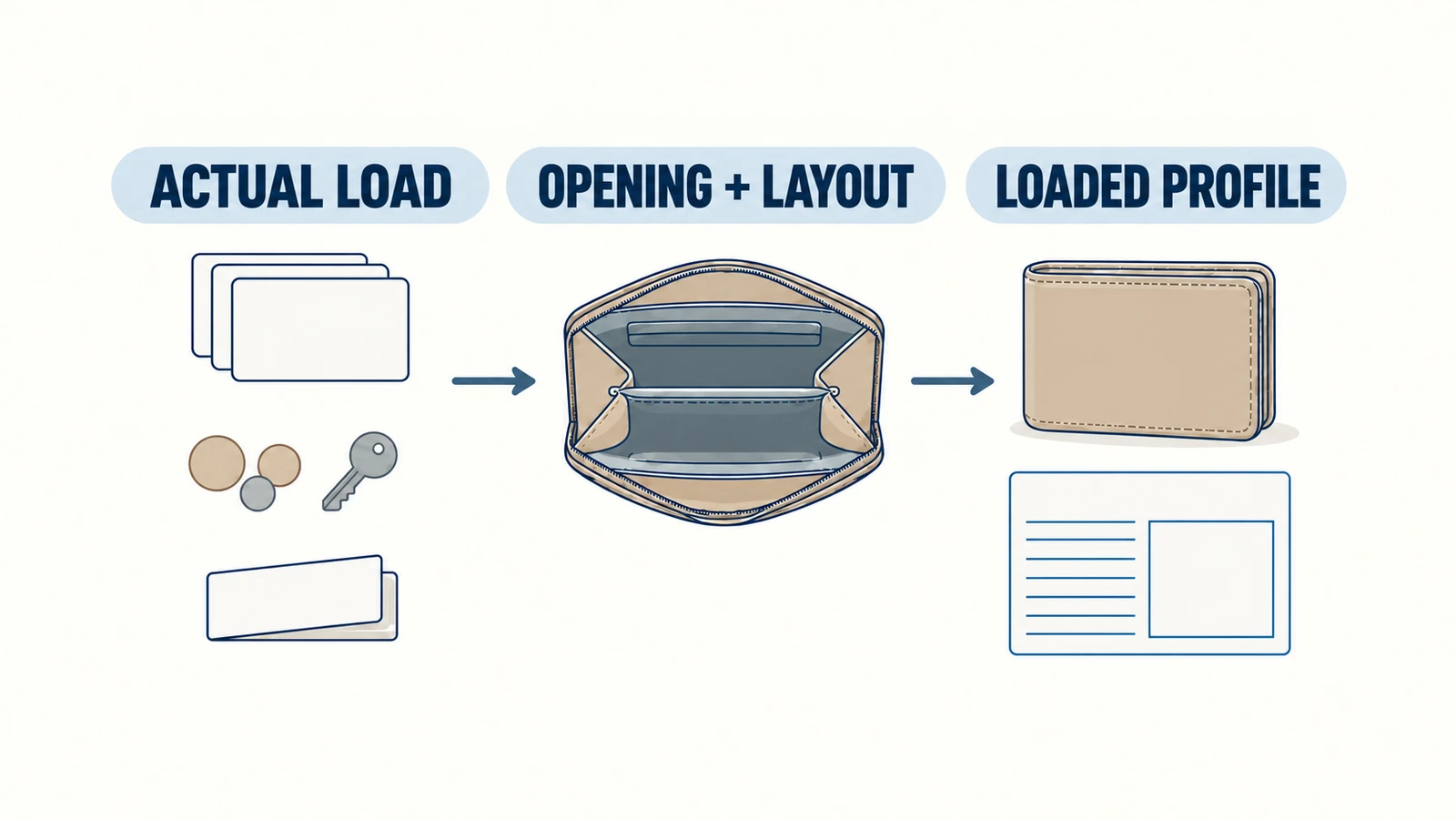
Concept illustration only: this load, opening and layout diagram does not document an existing Celynora product, confirmed capacity, materials, retention or test result.
The following single record brings the load, dimensions, interior and project finish together. Complete a field from a supplied drawing, brief or identified sample; leave an unknown Open. It is a decision record, not a ready-made product specification.
| Record field | What must be stated | Status |
|---|---|---|
| Format direction | Coin purse / card case / compact wallet / still comparing | Confirmed / Proposed / Open |
| Actual load | Card types/count, coin or small-item set, target notes/receipts and priority-access item | Provided / Open |
| Finished outside size | Closed W × H × D, measurement state and points, only when supplied | Confirmed / Proposed / Open |
| Clear opening | Narrowest usable route and how the intended item passes it | Measured / Open |
| Interior layout | Compartments, slot orientation/count, note/receipt fold, coin/small-item area | Confirmed / Proposed / Open / N/A |
| Closure and retention | Closure type/position, retention route and intended access sequence | Confirmed / Proposed / Open / N/A |
| Loaded profile | Actual stated load, closed thickness and any required fold/closure clearance | Measured / Open |
| Materials and layers | Shell, lining/backing, reinforcement if any, thread and edge construction/finish | Confirmed / Proposed / Open / N/A |
| Branding | Method, artwork, location, usable area and clearance from folds/openings/closures | Confirmed / Proposed / Open |
| Packaging/set | Single item or set direction, arrangement and known packaging requirements | Confirmed / Proposed / Open / N/A |
A card slot, coin area or fold may change after the first sample. If so, update the relevant field and drawing version before comparing samples; do not transfer a retention or capacity observation from an earlier layout as though nothing changed.
Is every compact wallet a bifold?
No. “Compact wallet” states a size or assortment direction, not one folding or closure construction. Record whether the current project is bifold, trifold, zip-around, flap-led or another specified format, then confirm the compartments, folds, closure and loaded thickness on the current sample.
What Material, Edge, Branding and Packaging Details Change the Brief?
A small item has little space for layers, edge construction and decoration to coexist, so name each rather than infer it from a photograph. Record the shell, lining or backing if present, reinforcement if required, thread and edge construction or finish. A proposed leather look does not identify the actual material or grade. If material choice remains open, buyers may compare genuine and vegan leather directions as an early discussion aid; availability and suitability still depend on the project.
Place branding on the current flat and loaded views. Record artwork and method, proposed position, usable area and clearance from a fold, slot mouth, opening, closure or edge. A mark that fits on a flat pattern may be distorted by a fold or hidden by a hand during card retrieval. Confirm appearance and feasibility on a sample rather than assuming that a small exterior face offers unrestricted branding space. The artwork or reference provider should confirm its rights; a reference is for discussing features, not copying another brand's protected design or logo.
If the item is intended as a gift or part of a set, describe what shares the packaging, the arrangement and any known packaging constraints. The loaded item—not only the empty item—should be checked against a specified package. A possible set direction does not imply an available box, a confirmed quantity, MOQ, price or lead time.
What Should Buyers Check on a Loaded Sample?
Use an identified sample and the actual agreed load. Record sample ID, specification version, load-list version, review date and which state is being observed. Insert and remove items in the intended order, then close and handle the item as defined for this review. Notes such as Observed, Not checked and Open keep an unperformed check from reading like a pass. A single sample observation is not evidence of batch consistency, cycle life, water resistance, theft protection or RFID performance.
| Checkpoint | What to observe with the stated load | Record |
|---|---|---|
| Insert and remove | Each named item passes the opening/slot in the intended sequence without an unapproved workaround | Observed / Not checked / Open |
| Card access/retention | Card insertion, exposure, adjacent-slot interference, retrieval and state after handling | Observed / Not checked / N/A / Open |
| Coin/small-item retention | Contents at corners/opening and under the stated closed/handled condition | Observed / Not checked / N/A / Open |
| Notes/receipts | Intended flat/folded state, placement, access and closure interference | Observed / Not checked / N/A / Open |
| Closure and loaded profile | Alignment/engagement and closed thickness with the full stated load | Observed / Not checked / Open |
| Interior and edges | Pocket/lining interference, seam/edge appearance and relevant fold condition | Observed / Not checked / Open |
| Branding and packaging | Position/appearance on the loaded item and fit in specified packaging/set | Observed / Not checked / N/A / Open |
| Version evidence | Sample ID, specification/load-list version, review date and unresolved points | Recorded / Open |
An observation should say what happened: which item snagged, which pocket became difficult to reach, where the closure met resistance, or how the loaded edge and logo appeared. That is more useful than a bare “approved.” If the opening, slots, coin area, lining, fold, closure, material, logo or package changes, repeat the affected checks on the new version. Specific retention or durability testing, if needed, requires a project-defined method, conditions, sample plan and acceptance criteria before any result can be claimed.
What Should a Buyer Send for a Small Leather Goods Project Review?
Start with the format under consideration—or say that the three are still being compared—and a reference, sketch or existing project file. Indicate which features you want to keep or change, and which recognizable brand elements must not be copied. An approximate list of cards, coins, notes, receipts or other small items and the priority access order is enough to begin a useful discussion. Known outside dimensions, opening, slot arrangement, note fold and desired loaded thickness can be added; unknowns can remain Open.
Add any closure or retention direction, material and edge preferences, logo artwork and placement, and packaging or set idea. If available, include expected quantity, delivery country and target timing as planning context, not a request for a fixed public quote or schedule. Buyers comparing a new design with an existing brief can compare OEM and ODM starting points; no specific small leather goods option, material or production timing is implied by that link. A polished technical pack is helpful but not required before first contact.
Planning a coin purse, card case or compact wallet project? Send the format you are considering, a reference image, the cards, coins, notes or small items it must hold, and any known closure, interior, material, branding, packaging, quantity and delivery-country details. You can start with open questions; available options, specifications, samples, pricing, MOQ and timing are confirmed for the specific project. Discuss Your Small Leather Goods Brief.
B2B Buyer Checklist
Before you request a quote, prepare the information that affects MOQ, sample cost, lead time and final unit price.
- Target product category, size and reference images.
- Expected order quantity per style and per color.
- Material preference, lining requirements and hardware finish.
- Logo method, packaging items and delivery country.
- Target retail price or target factory price range.
Decision Table
| Buyer Question | Why It Matters | What to Send the Factory |
|---|---|---|
| What is my MOQ target? | MOQ affects material sourcing, production planning and unit price. | Quantity per style, per color and launch schedule. |
| Which material should I choose? | Material controls price band, durability and brand positioning. | Reference photos, desired texture and target market. |
| How much customization do I need? | Logo, lining, hardware and packaging change sample time and cost. | Logo files, packaging references and required details. |
| What is my delivery deadline? | Sampling, production and shipping need realistic planning. | Launch date, delivery country and preferred shipping method. |