Tote bags are the highest-volume category in wholesale leather goods — but they are also the category most frequently ordered in the wrong size. A buyer selects a sample, approves it, places a production order of 300 units, and then discovers at retail that the bag is three centimeters too narrow to fit a laptop, or so large that customers find it unwieldy for everyday carry. Both problems are entirely preventable with a systematic approach to size specification before sampling begins.
This guide defines the four standard tote bag size categories used in wholesale production, explains what each format is designed to carry, and gives you the dimension ranges you need to specify correctly for your target customer and retail channel.
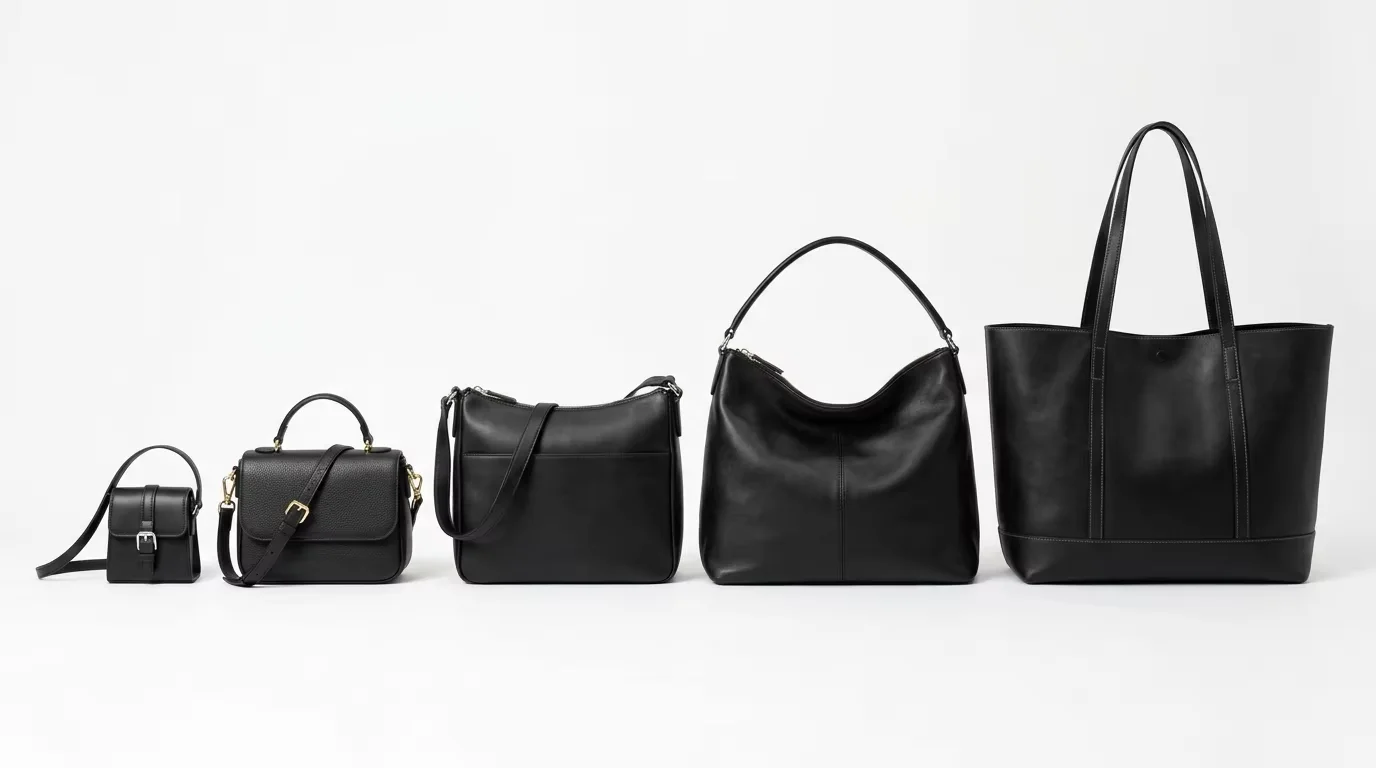
The Four Tote Size Categories
All dimensions below are finished outside measurements in centimeters (W × H × D), measured at the widest, tallest and deepest points of the main bag body, excluding hardware, handles and base feet.
Mini Tote — W20–28cm × H18–24cm × D8–12cm
The mini tote sits at the intersection of tote and top-handle bag. It is too small to be a practical workhorse bag, but too structured to be a clutch. Its commercial role is as a statement piece — a bag whose visual impact and design are more important than its carrying capacity.
What fits inside a mini tote: phone, slim wallet, keys, small cosmetics pouch. What does not fit: a paperback book, an A5 notebook, most standard wallets if folded.
Mini totes perform best in premium and accessible-luxury positioning, where the compact format justifies a price point that might seem high for the bag's functional utility. The format is also the top performer in gifting, occasion wear and brand-statement contexts where the bag is purchased for how it looks rather than what it carries.
Handle drop specification for mini totes: 18–22cm is standard. Handles shorter than 15cm are uncomfortable to carry for extended periods. Handles longer than 25cm on a mini tote create visual proportion problems — the handles look oversized relative to the bag body.
Small Tote — W28–35cm × H25–32cm × D10–14cm
The small tote is the most commercially versatile format. Large enough for genuine daily carry — phone, wallet, keys, cosmetics, a paperback, and a water bottle — while small enough to read as intentional rather than utilitarian. This is the format that drives the highest volume across mid-market tote bag collections globally.
Key functionality threshold: a W28cm × H28cm × D10cm tote will fit an A5 notebook, a standard-size phone in portrait orientation, a bifold wallet and a 500ml water bottle simultaneously. This is the minimum specification for a bag marketed as a daily carry tote.

Handle drop specification for small totes: 22–28cm is the commercial standard. A 25cm handle drop allows the bag to be comfortably carried in the crook of the arm on most women. Drops below 20cm limit the bag to hand carry only. Drops above 30cm allow shoulder carry — a functional upgrade worth specifying if your target customer carries the bag during a commute.
Depth (gusset) specification: 10cm depth is functional but snug. 12cm depth adds approximately 20% carrying volume and allows a 500ml bottle to stand upright in the bag. The difference in production cost between 10cm and 12cm depth is minimal — it is worth the upgrade for any tote marketed as a commuter or work bag.
Medium Tote — W35–42cm × H30–38cm × D12–16cm
The medium tote is the work bag format. Large enough to carry a 13-inch laptop in a padded sleeve, an A4 notebook, daily essentials and a lunch box. The format appeals primarily to working professionals who need genuine carrying capacity without the bulk and visual statement of an oversized tote.
Laptop compatibility is the key specification threshold for this format. A 13-inch laptop in a standard sleeve is approximately 33cm × 23cm × 2cm. The tote must be at least 34cm wide and 24cm tall internally to accommodate it flat. Account for lining thickness (typically 3–5mm per side) when specifying interior dimensions from exterior measurements.
Weight management is critical for the medium tote. A fully loaded medium work tote can reach 3–4kg. Leather at 1.2–1.4mm thickness across all panels will push the empty bag weight to 700–900g. For brands marketing a work tote, consider specifying thinner leather (0.8–1.0mm) for the back panel and interior dividers, or using a split leather or microfibre for the base, to reduce empty weight without compromising surface quality where the customer sees and touches the bag.
Oversized Tote — W42–55cm × H38–48cm × D14–20cm
The oversized tote is the weekend bag, the beach bag, the travel day bag. It is not designed for daily professional use — it is designed for maximum carrying volume in a tote silhouette. The category is dominated by open-top or minimal-closure designs that maximize the speed and ease of access.

Oversized totes require careful handle specification. Twin shoulder straps (rather than a single pair of short handles) are standard for this format — the weight of a loaded oversized tote makes hand carry uncomfortable for extended periods. Strap width of at least 3cm is recommended for shoulder comfort under load. Strap length should allow the bag to be carried over the shoulder with a comfortable drop of 20–25cm below the armpit.
Material specification for oversized totes: the bag's own structural weight becomes significant at this scale. Full-grain leather at standard thickness across all panels can produce an empty bag weight of 1.2–1.5kg, which is heavy before anything is placed inside. Many brands use lighter materials — canvas, nylon, or suede — for the base panel, or specify a lighter leather weight throughout, to keep the empty bag below 800g.
How to Specify Tote Dimensions in a Production Order
When placing a production order, tote bag dimensions should be specified as a range with tolerances rather than exact numbers. Leather goods manufacturing involves natural material variation that makes exact dimensions unachievable at production scale.
Standard tolerances for tote bags:
- Width, height, depth: ±5mm from target dimension
- Handle drop: ±5mm
- Strap length (if adjustable): ±10mm across the full adjustment range
Always specify both exterior and interior dimensions for any functional element — particularly height and width — because lining thickness reduces the interior dimensions relative to the exterior. A bag specified at W30cm exterior will have an interior width of approximately W28–29cm after lining. If your design requires fitting a specific object (a laptop, a document portfolio, a water bottle in a side pocket), specify the interior dimension as the binding constraint and let the factory derive the exterior dimension from there.
Size by Market
North American buyers consistently prefer totes at the larger end of each size range — the small tote they want is typically what European buyers would call a medium. This reflects broader cultural preferences around carrying capacity and the prevalence of larger phones and thicker wallets in the North American market.
Japanese and South Korean buyers tend to prefer the smaller end of each range, with particular emphasis on bags that look proportional when carried by a smaller average frame. A bag that reads as "small tote" when carried by a 170cm European consumer may read as "medium tote" when carried by a 158cm Japanese consumer.
Building a tote range that works across multiple markets often means offering the same design in two sizes — a standard and a mini — rather than trying to find a single dimension that satisfies all markets simultaneously.
B2B Buyer Checklist
Before you request a quote, prepare the information that affects MOQ, sample cost, lead time and final unit price.
- Target product category, size and reference images.
- Expected order quantity per style and per color.
- Material preference, lining requirements and hardware finish.
- Logo method, packaging items and delivery country.
- Target retail price or target factory price range.
Decision Table
| Buyer Question | Why It Matters | What to Send the Factory |
|---|---|---|
| What is my MOQ target? | MOQ affects material sourcing, production planning and unit price. | Quantity per style, per color and launch schedule. |
| Which material should I choose? | Material controls price band, durability and brand positioning. | Reference photos, desired texture and target market. |
| How much customization do I need? | Logo, lining, hardware and packaging change sample time and cost. | Logo files, packaging references and required details. |
| What is my delivery deadline? | Sampling, production and shipping need realistic planning. | Launch date, delivery country and preferred shipping method. |