Are Straw, Raffia, Rattan, Wicker and Woven Bags the Same?
No. Raffia and rattan name material families, while woven and wicker describe how flexible elements may be interlaced or worked. “Straw bag” and “basket bag” can also be broad retail labels rather than complete material specifications. For sourcing, record the supplier-declared material, the construction method, where each material is used, and what the current sample actually shows.
A product name, photograph, color or natural-looking texture cannot establish the plant species, fiber composition, natural origin, performance, sustainability or whether a particular material is available for a Celynora project. If the evidence is missing, write “Not provided / To be confirmed” instead of guessing. A “woven straw tote,” for example, combines a selling name, a construction direction and a tote format; it still leaves the actual body, handle and trim materials open.
A useful buyer brief separates four fields: selling name, declared material, construction, and bag format/use. Keeping them separate lets a supplier answer a precise question without turning “basket style” or “handmade look” into an unsupported material claim.
What Does Each Term Tell a Buyer—and What Does It Not Prove?
In its literal sense, straw refers to cereal-grass stalks remaining after the grain is removed. Raffia identifies fiber or strips from Raphia palm leaves; rattan identifies a climbing-palm material family (see also the FAO rattan introduction). By contrast, wickerwork names interlaced work, while weaving describes interlacing as a construction method. These definitions help decode a listing, but none authenticates the material in a particular bag.
| Term used in a listing or brief | What it can indicate | What it does not prove | Buyer follow-up |
|---|---|---|---|
| Straw bag | Literally, straw is dried cereal-grass stalk; in retail the name may also signal a straw-look direction | Exact plant, composition, used part, origin, construction or performance | Request the declared material and composition for each part, with a specification or identified sample |
| Raffia bag | A raffia-fiber or raffia-look design direction | That every visible strand is natural raffia, or a particular treatment or environmental result | Confirm whether each part is declared natural or synthetic, its color/finish and the sample reference |
| Rattan bag | A rattan-material direction, potentially worked as cane, narrower splint/strip or another specified form | That the bag is wicker, or that every component is rattan | Record the declared form, dimensions if specified, used parts, connections and other materials |
| Wicker bag | Interlaced work made with flexible material | One fixed raw material; wicker is not proof of rattan | Ask what is interlaced and how joints, loose ends and edges are finished |
| Woven bag | An interlaced surface or structure, or a woven-look selling description | Natural straw, raffia, rattan or even physical interlacing | Check whether the effect is actually interlaced, Leather strips, or embossed/printed, and on which parts |
| Basket bag | A basket-like silhouette, structure or retail category | A particular fiber, rattan, wicker or construction | Specify silhouette separately from declared material and construction |
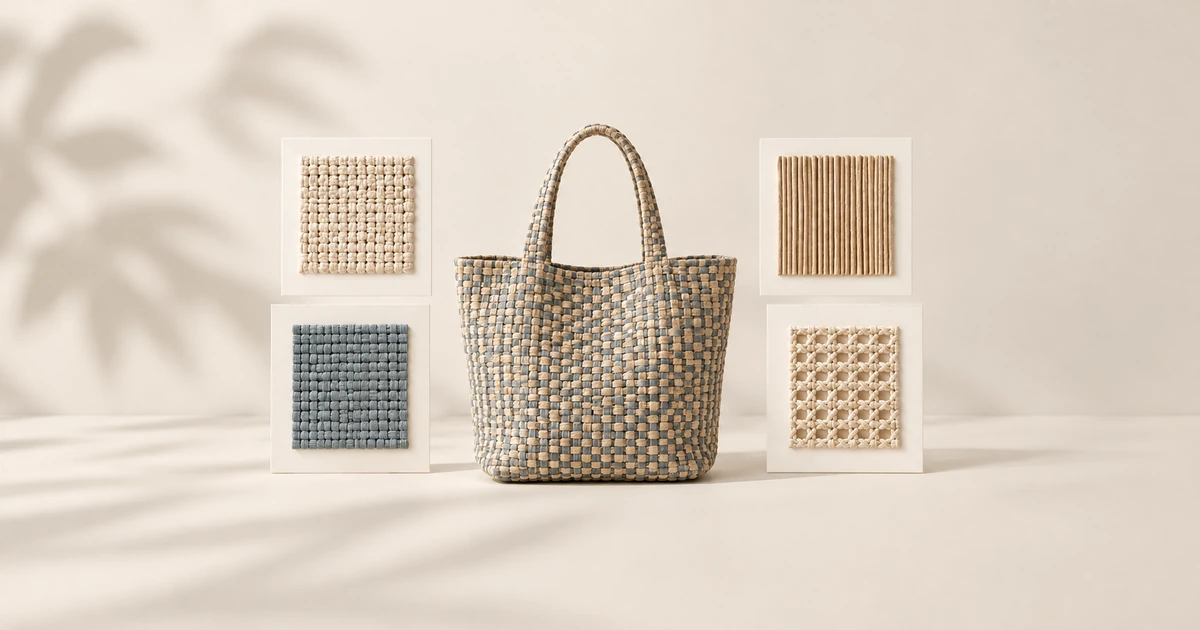
For handbag development, “woven” can refer to interlaced strips, a textile, Leather strips or a visual embossed/printed effect. A basket silhouette might be supported by a rigid frame, a backing or another construction. Ask what is present in the current project rather than applying a generic natural-fiber label to either.
Is wicker the same as rattan?
No reliable one-to-one equivalence follows from the words. Rattan names a material direction; wicker names interlaced work or an associated product description. A wicker bag's actual material, form and used parts need the supplier's project declaration and a matching specification or sample.
Does “woven bag” mean natural straw?
No. Woven may describe construction, a surface direction or a sales label across different natural, synthetic or Leather materials; a bag can also have an embossed woven look. Record the declared composition, the parts using it, whether the surface is physically interlaced, and the evidence for each claim.
How Should Buyers Turn a Selling Name into a Material-and-Construction Record?
Make one record for the current project rather than asking a selling name to carry every specification. Identify the body, base, handles or strap, edges, joints, lining, backing, reinforcement and decoration separately. A bag can combine materials; an image of one panel cannot identify the other parts. Supplier declarations, a specification, a handbag bill of materials and labeled swatches or samples are more useful for a project decision than a retail caption.
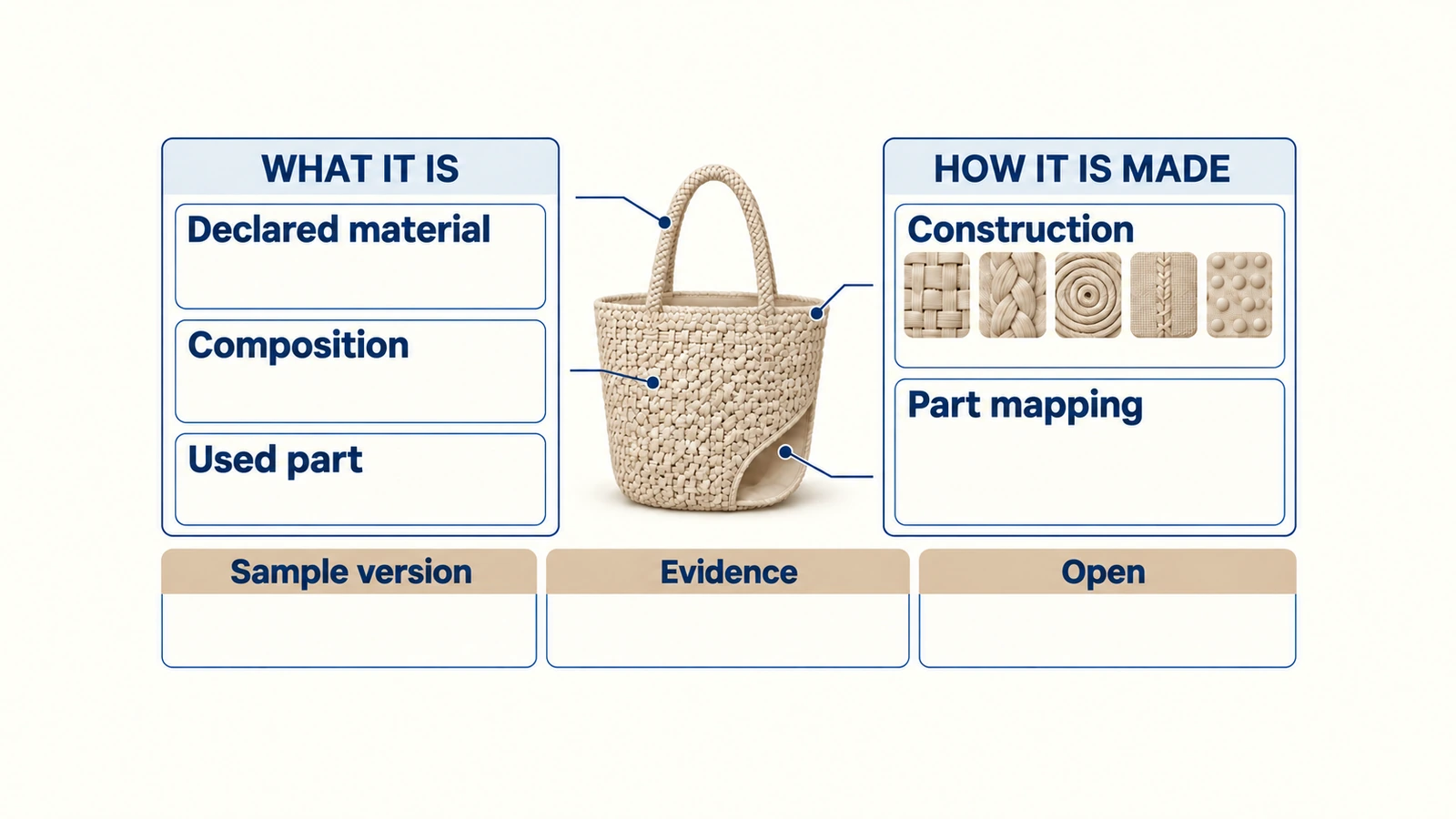
Concept illustration only: the pictured textures and blank record fields do not identify a real material, supplier sample or test result.
| Record field | What to capture | Evidence / status |
|---|---|---|
| Selling name | Straw, raffia, rattan, wicker, woven, basket or another buyer-facing label | Buyer brief or reference; label only |
| Declared material and composition | Supplier-declared material for each relevant component, including any blend or synthetic component | Specification, BOM or declaration / Not provided |
| Material form and used part | Strand, strip, cane, splint, yarn, panel, sheet or surface effect; body, handle, trim, edge and so on | Identified swatch or specification / To be confirmed |
| Construction | Actual woven, braided, coiled, crocheted, stitched or embossed/printed direction, where declared | Supplier/process statement and current sample / Open |
| Bag format and use direction | Tote, crossbody, shoulder, beach/resort or basket silhouette; intended contents and conditions | Buyer brief / Open |
| Supporting parts | Base, lining, backing, reinforcement, edge finish, handles/straps, connections, hardware and closure | BOM/specification and current sample / Open |
| Color and finish | Target color, approved visual variation, and declared dye, coating or other finish if relevant | Identified reference or swatch / Open |
| Sample version and observations | Sample ID, version and date; what was checked and under which conditions | Observed / Not checked / Open |
| Claims needing separate proof | Origin, natural content, performance, environmental or certification claim | Evidence reference / Not provided—do not publish as fact |
This is a record of what is known, not a form the buyer must complete before contact. For the construction field, distinguish a supplier statement from a visual observation: a photograph may show a pattern but cannot prove how it was made. If a material or method changes, update the BOM and sample version so the old observation is not silently applied to the new design.
What Should Buyers Check on a Material Sample and Bag Sample?
First tie each swatch or bag sample to its supplier-declared material, intended component, sample ID, version and date. Then examine the current item in the intended light and with the planned contents. Record color and texture range, strip or fiber width and visible consistency, interlacing and joint placement, loose ends, edge treatment, handle/strap attachments, opening and closure, lining or backing, the loaded silhouette and the condition after the proposed packaging method. A variation seen on one sample is a question for the agreed acceptance criteria, not a batch-wide conclusion.
Flexibility versus shape retention is a real design tradeoff. A body built with flexible strips or fibers may suit a softer, compressible silhouette, while a thicker cane form, frame, backing or reinforced panel may support a more defined outline. Neither is universally better. Decide how the opening and base should behave when loaded, whether the bag may be folded or nested for packing, and which changes after packing are acceptable. Check the actual sample and package combination before approving a shape claim.
Ends, joints and corners deserve their own inspection. An end that looks neat from outside may face the lining or contents; a handle connection may look different when the bag is filled. Note whether ends are secured by the proposed method, where joins appear, whether a lining or backing separates rough areas from contents, and what happens at the attachment points under the buyer's planned sample load. These observations guide a revision; one inspection does not establish service life or a fixed carrying weight.
Lining, backing, edge wrapping and local reinforcement can alter translucency, hand feel, opening and shape. If one is added or substituted after a sample review, revise the component record and recheck the new sample. Specify any test method, conditions and acceptance threshold from the product use, destination requirements and written project agreement; do not infer water resistance, mold resistance, colorfastness, durability or environmental performance from appearance.
How Do Tote, Crossbody, Beach and Basket Formats Change the Brief?
A straw tote bag and a straw crossbody bag may use the same selling vocabulary but need different component questions. For a tote, specify the usable opening, base, handle attachments, lining or reinforcement and the actual load used in sample review; check tote dimensions and usable space separately if size is part of the decision. A tote label alone does not specify any measurement.
For a crossbody direction, identify the strap material separately from the body, then review its connection points, edge finish and how the loaded bag hangs. A “straw crossbody bag” name does not establish that the strap shares the body's material or that a pictured connection is suitable for the intended use.
“Straw beach bag” or resort styling changes the buyer's questions about use conditions, but it does not promise that the item tolerates water, sand or damp storage. Treat those as project-specific requirements to confirm, not properties supplied by the name. For a basket bag, first decide whether “basket” means silhouette, a visible surface effect or a specific interlaced construction; then record the actual material and supporting structure. A basket shape does not prove rattan.
What Should Be Confirmed Before a Quote or Sample Revision?
Ask the supplier to distinguish what is quoted to the current version from a proposed alternative and what remains Open. A short version box is enough here: Quoted — declared composition and used parts, construction, lining/backing/reinforcement, color/finish, packaging method and identified sample version; Proposed alternative — any different natural or synthetic material, strip/cane form, structure, lining or strap/handle approach; Open — missing composition, approvals, observations or project terms. This prevents an attractive alternative from being mistaken for the approved specification.
Attach a reference image to explain which look or construction to retain and which to change; do not ask a supplier to copy a third-party brand. A reference or handbag tech pack can carry dimensions and component notes, while OEM and ODM starting points can help frame whether the buyer is developing a new specification or adapting an existing direction. Neither link proves availability of any named plant material.
Once an alternative is accepted, update the BOM, quote scope and sample version, then repeat the checks affected by that change. Material availability, price, MOQ, sampling arrangements and timing depend on the actual project and must be confirmed in the current response; an unanswered field should remain Open rather than becoming an assumed promise.
What Should a Buyer Send for a Straw- or Woven-Look Bag Project Review?
A first message can be brief: name the tote, crossbody, shoulder, beach/resort or basket direction and intended use; attach a reference and identify what to keep or change; state the material or construction words being compared and the parts where they matter. Add color/finish, sample questions, branding and packaging notes, estimated quantity, delivery country and target timing if known. If the team is still choosing a format, it can review tote bag references for silhouette ideas; that collection is not evidence that natural straw, raffia or rattan is available for this project.
What should a buyer ask before ordering a raffia or straw-look bag?
Ask for the supplier-declared material and composition, where each material is used, the actual construction, supporting components, color/finish, sample version and which observations or tests the intended use requires. Keep unresolved items Open; a photograph cannot answer them.
Planning a straw- or woven-look bag project? Send the format, references, material or construction terms under consideration, the parts that need each material, color and finish direction, sample questions, branding notes, estimated quantity and delivery country if known. You can start with incomplete information; Celynora can review the brief and discuss a starting point. Material identity, available options, pricing, MOQ, sampling and timing are confirmed for the specific project. Discuss Your Material and Construction Brief.
For reference, our current catalog includes styles such as the Commuting Genuine Leather Large Capacity Woven Tote Bag New Arrival — useful as a specification baseline when briefing your own factory or sourcing agent.
B2B Buyer Checklist
Before you request a quote, prepare the information that affects MOQ, sample cost, lead time and final unit price.
- Target product category, size and reference images.
- Expected order quantity per style and per color.
- Material preference, lining requirements and hardware finish.
- Logo method, packaging items and delivery country.
- Target retail price or target factory price range.
Decision Table
| Buyer Question | Why It Matters | What to Send the Factory |
|---|---|---|
| What is my MOQ target? | MOQ affects material sourcing, production planning and unit price. | Quantity per style, per color and launch schedule. |
| Which material should I choose? | Material controls price band, durability and brand positioning. | Reference photos, desired texture and target market. |
| How much customization do I need? | Logo, lining, hardware and packaging change sample time and cost. | Logo files, packaging references and required details. |
| What is my delivery deadline? | Sampling, production and shipping need realistic planning. | Launch date, delivery country and preferred shipping method. |