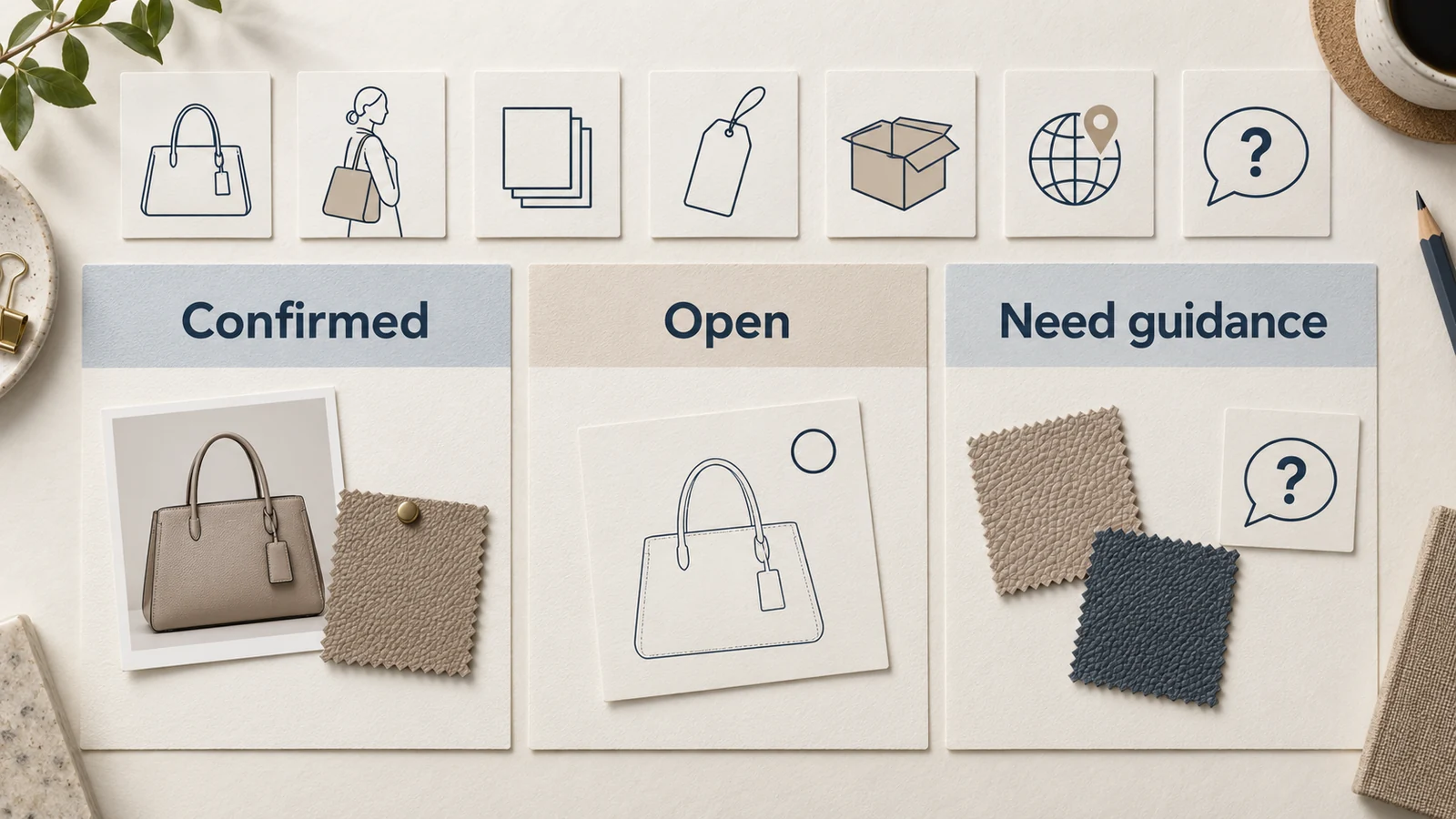
You do not need a complete tech pack to start a useful custom handbag RFQ. Send the clearest product reference you have, explain the intended use, give an estimated quantity, and identify branding, packaging, destination and open questions. Mark each item Confirmed, Open or Need guidance so the supplier can review what is known without treating a blank field as approval.
An RFQ starts a project review; it is not a quote, purchase order, production approval or result commitment. Material availability, specifications, commercial terms, timing and later sample requirements still need to be confirmed for the specific project.
What Information Makes a Handbag RFQ Reviewable?
A reviewable handbag RFQ does not require every answer to be complete, but it must show the product reference, intended use, estimated quantity, branding and packaging direction, destination, and the questions that remain undecided. Clear enough to review is not the same as complete enough for production. A blank field does not mean included, approved or not applicable.
Start by separating what you know from what you want to discuss. A reference image or sample can begin the conversation, while dimensions, material hand feel, construction, logo application or packaging may still need clarification. The seven information areas below give a supplier a usable project frame without turning an early inquiry into a finished tech pack or order document.
How Do Confirmed, Open and Need Guidance Work?
Use Confirmed when you have a clear, identifiable reference or direction. Use Open when you know a decision is needed but have not made it. Use Need guidance when you want the supplier to explain which options or questions may help define the project. Select the status that best describes the current position; do not describe the same field as both approved and awaiting advice. Any supplier suggestion still needs buyer confirmation before it becomes a project requirement.
| RFQ field | Confirmed | Open | Need guidance |
|---|---|---|---|
| Product reference or design | Identify the current file, image, link or sample reference. | Note which views or details are missing. | State what kind of reference or clarification is needed. |
| Intended use and target buyer | Describe how the bag is expected to be used and by whom. | List use cases or market details still being decided. | Ask which use questions should be clarified for review. |
| Approximate size and material direction | Record known dimensions, material family or visual direction. | Mark dimensions, hand feel, color or construction points not yet fixed. | Ask which options or samples may help define the direction. |
| Estimated quantity and color split | State the current estimate and any known split. | Mark style, color or quantity allocation still open. | Ask what quantity information is needed for a reviewable basis. |
| Branding | Identify available artwork, placement or application direction. | Mark logo details not yet decided. | Ask which branding inputs or sample checks should be discussed. |
| Packaging | State the packaging items already requested. | Mark format, artwork or packing details still open. | Ask which packaging details affect the project review. |
| Destination and target timing | State the delivery country or target market and buyer target date. | Mark delivery details or timing questions not yet fixed. | Ask what destination or scheduling information must be confirmed. |
| Open questions | Name the question, owner and next decision point. | Keep unresolved points visible. | Ask for the specific clarification needed; do not treat advice as approval. |
This table is a communication framework, not a downloadable contract, quotation template, technical specification or supplier confirmation.
What Product Reference and Intended Use Should You Share?
When you do not have a complete design file, send the clearest reference available: a reference image or link, a simple sketch, photographs of an existing sample, or a partial specification. Identify the file, link or sample version so the supplier knows which reference is being reviewed. Explain what you want to keep and what you may change; a picture alone should not be treated as proof of material hand feel, internal structure, finished dimensions or manufacturability.
Intended use adds context that an image cannot provide. Describe the expected carry situation, the items the bag may need to hold, the target buyer or market, and the details that matter most in use. Approximate dimensions or a material family can be marked Confirmed, Open or Need guidance. If the project is still being defined, say so directly and identify the questions that would help narrow the direction.
Which Quantity, Branding, Packaging and Destination Details Matter?
Estimated quantity, any known color split, logo or label direction, packaging scope, delivery country or target market, and buyer timing help define which questions need attention. They do not mean that a supplier has accepted those conditions. Write quantity as an estimate and state whether the figure is per style or per color when known; leave the allocation Open if it is not decided.
For branding, note whether artwork exists and whether placement or application direction is settled. For packaging, record the items you want to discuss, such as a dust bag, hang tag or carton instruction, without assuming that every format is included. A destination can be stated as a country or target market without turning the RFQ into customs, tax or shipping advice. Target timing is a buyer objective only; availability and timing require project confirmation.
Can You Request a Quote Without a Complete Tech Pack?
Yes, you can begin project review without a complete tech pack, but the precision and comparability of any later quote depend on which key fields remain Open. Do not fill unknown material, dimension or packaging fields with guesses just to make the RFQ look complete. Mark the uncertainty and ask what information is needed next.
If the project needs exact technical definition, build a detailed handbag tech pack as the specification work develops. The RFQ can start with what is known and show what needs guidance. Any details needed for production must still be defined and confirmed.
What Happens After the Supplier Reviews the RFQ?
After review, the next steps may include clarification questions, a proposed scope with assumptions, quote discussion, and sampling or specification development. The order depends on the project and on which items were Confirmed, Open or marked Need guidance. A response to an RFQ is not automatically project acceptance, a fixed price, a material-availability confirmation, sample approval or a production slot.
When a quote is available, compare handbag factory quotes on one basis using the same known scope and clearly marked assumptions. If the project moves toward order preparation, review the handbag purchase order checklist so later references and open items can be reconciled. If the starting point is still unclear, compare OEM and ODM starting points and keep the route decision separate from facts that still need confirmation.
To begin, send the product reference or design, intended use, estimated quantity, branding direction, packaging direction, destination and open questions you already have. Mark each item Confirmed, Open or Need guidance, then let the project discussion identify what should be clarified next. You can start with partial information without presenting unknowns as approvals.
For related sourcing guidance, see Ready Stock, ODM or Full Custom, Evaluating Seasonal Handbag Trends, Handbag Repeat Order Checklist for B2B Buyers and Handbag Packaging Artwork Approval Checklist for B2B Buyers.
Have a specific sourcing question on this topic? Share your project details and our team will respond directly.
For reference, our current catalog includes styles such as the Retro Messenger Postman Shoulder Satchel — useful as a specification baseline when briefing your own factory or sourcing agent.
B2B Buyer Checklist
Before you request a quote, prepare the information that affects MOQ, sample cost, lead time and final unit price.
- Target product category, size and reference images.
- Expected order quantity per style and per color.
- Material preference, lining requirements and hardware finish.
- Logo method, packaging items and delivery country.
- Target retail price or target factory price range.
Decision Table
| Buyer Question | Why It Matters | What to Send the Factory |
|---|---|---|
| What is my MOQ target? | MOQ affects material sourcing, production planning and unit price. | Quantity per style, per color and launch schedule. |
| Which material should I choose? | Material controls price band, durability and brand positioning. | Reference photos, desired texture and target market. |
| How much customization do I need? | Logo, lining, hardware and packaging change sample time and cost. | Logo files, packaging references and required details. |
| What is my delivery deadline? | Sampling, production and shipping need realistic planning. | Launch date, delivery country and preferred shipping method. |