Once you have selected the packaging items for a handbag project, artwork review becomes a version-control task. A dust bag, tag, label, box and carton mark may use related brand assets, but each has its own surface, data and proof. This checklist helps buyers identify what has been reviewed, what remains Open and exactly which item and version an approval covers.
What Should a Handbag Packaging Artwork Approval Confirm?
A handbag packaging artwork approval should identify each packaging item, the exact artwork file and version, its size and placement, the responsible owner for every text or data field, and the current review status. Buyers should consolidate feedback into one controlled proof, keep unresolved details Open, and approve only the stated item and version before sampling or printing.
Start with the packaging items already selected for this project. If the selection itself is still unsettled, choose the packaging items before approving artwork. A packaging specification identifies the item and intended construction; an artwork file contains the buyer's design or content; a supplier proof shows a proposed layout; a physical sample can help review a different, agreed set of characteristics; and an approval record identifies the decision and its scope. None automatically substitutes for another. Approval for one item, file version or panel does not extend to a different item or later revision.
Which Files and Owners Belong in the Approval Pack?
Create one row or folder entry per packaging item. Identify its item ID or name; artwork filename, version and date; relevant dieline or size-and-position reference; stated color and material direction where relevant; supplier proof version; owner of every text or data field; status; reviewer and decision date when a decision actually occurs; and any Open question. The record should make it possible to tell which file a reviewer saw without guessing from an email attachment named final.
The buyer or its designated brand owner should provide or confirm the logo, copy, address, product and market data, and permission to use those assets. If the logo or placement direction is not settled, prepare the logo file and placement direction before treating a packaging layout as ready. A supplier may provide a dieline, proof or project-specific feasibility feedback. That contribution does not by itself confirm trademark rights, label law, barcode validity or destination-market requirements. Leave a missing owner or source Open rather than filling the field from an earlier job.
How Should Dust Bags, Hang Tags, Labels, Boxes and Carton Marks Be Reviewed?
Review the five common project items with the same columns, even if different people supply their files. The worksheet below contains prompts, not approved buyer data. Duplicate or adapt a row for each item and version in the actual project; do not use another item's approval as a shortcut.
| Packaging item | Artwork file / version | Size and position reference | Text / data owner | Proof review point | Status / next action |
|---|---|---|---|---|---|
| Dust bag | Record current file and version | Item dimensions and logo/artwork area from project reference | Name buyer or brand owner | Check placement, scale, orientation and stated color/material direction | Open; record reviewer and next action |
| Hang tag | Record current file and version | Tag dieline and front/back fields | Name owner for logo, copy and product data | Check sides, hierarchy, placement and missing data | Open; record reviewer and next action |
| Brand, care or other label | Record current file and version | Label type, dimensions and intended location | Name data owner; adviser where applicable | Check text, layout, legibility question and approval scope | Open; record reviewer and next action |
| Box | Record current file and version | Dieline panels and artwork areas | Name buyer or brand owner | Check panel mapping, orientation and stated finish direction | Open; record reviewer and next action |
| Carton mark / identifier area | Record current file and version | Carton panel and marked data area | Name buyer, logistics or project owner; adviser where applicable | Check data source, placement and validation owner—not identifier validity | Open; record reviewer and next action |
For each row, change Open to In review, Revision needed or Approved for stated item/version only when that status is supported by a real review. Keep dimensions and positions tied to the project's file or supplier proof; there is no universal value to copy into this table. A stated artwork approval is not a guarantee of printed color, material, barcode performance or legal compliance. Keep superseded versions in the history rather than mixing them with the current proof.
How Should Feedback and Versions Be Controlled?
Use a visible sequence: Proof received → Consolidated feedback → Revised proof → Approved for stated item/version. Identify the item, filename and proof version on every comment round. If a question remains unanswered or a change is required, return that item to Open or Revision needed instead of describing the whole pack as approved. One consolidated response to one identifiable proof is easier to follow than edits scattered across an old PDF, screenshots and chat messages.
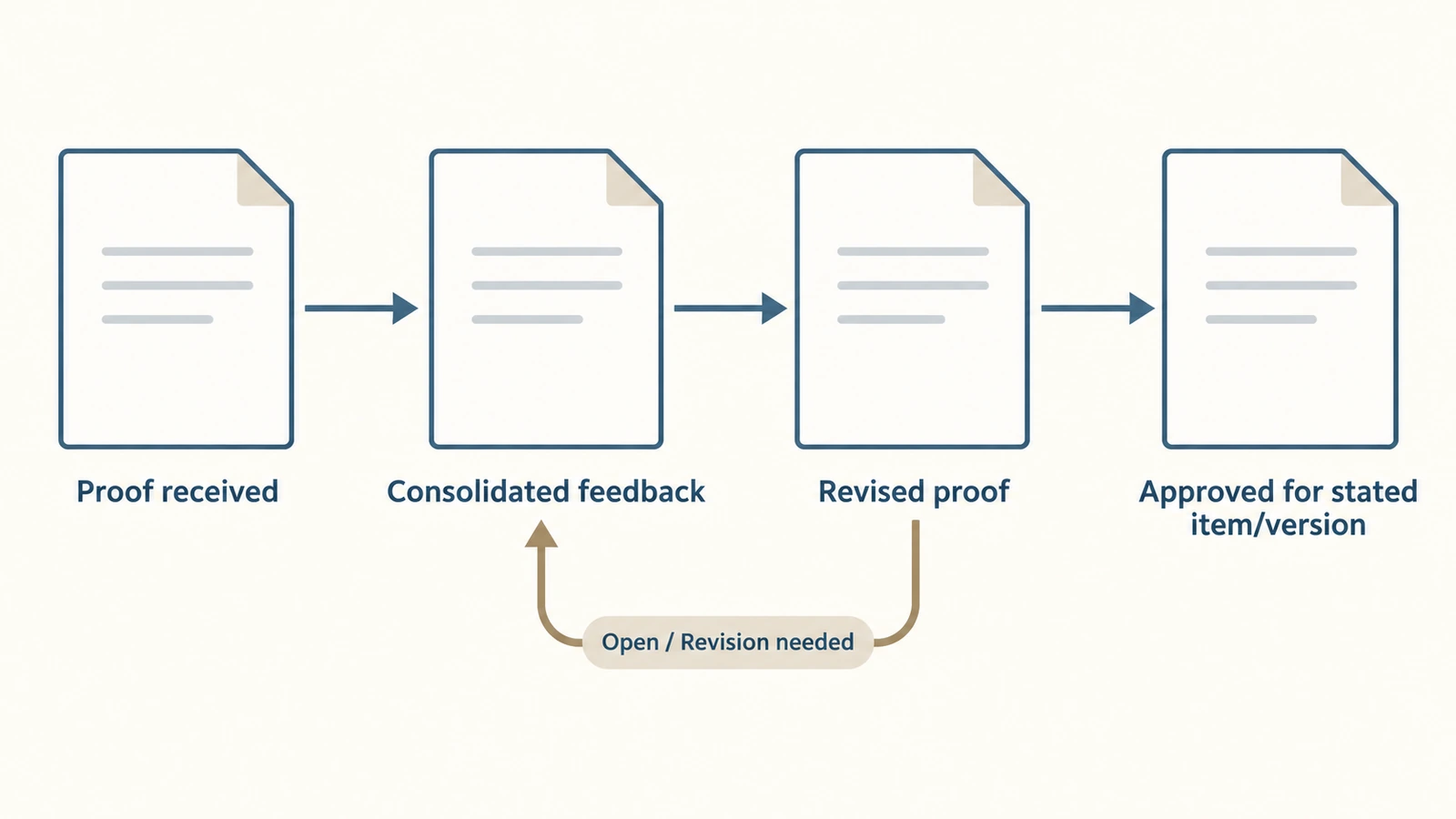
When a revised proof arrives, record what changed and retain the superseded file for comparison. Fill in the approver and date only after a real decision; a file sent for review is not a sign-off. Once the stated item and version are approved, attach the approved packaging proof to the current order pack as a controlled attachment. That handoff does not replace the other specifications and decisions the order pack needs.
What Must Stay Open for Text, Barcodes and Market Requirements?
Ask the buyer or its designated owner to confirm the supplied names, logo rights, addresses, claims, product data and intended markets. A proof can show where those fields appear, but the layout is not evidence that the underlying wording or rights have been checked. Refer legal, regulatory and trademark questions to the buyer and an appropriately qualified adviser when needed.
For a barcode, QR code or other identifier, name who supplies the data and who will confirm its source, ownership, validity and intended use. The supplier's placement proof is not a scan test or identifier validation. Treat carton-mark and destination requirements the same way: show the proposed location, leave the substantive rule or data check with a named owner, and keep it Open until that owner responds. If only layout, size or placement has been agreed, record Artwork layout approved for stated item/version—not compliant or ready for every market.
Is a logo file enough to approve packaging artwork?
No. A logo file is one input. The buyer still needs the packaging item and surface, dieline or size-and-position reference, current proof version, text or data owner, feedback and stated approval scope. The logo alone does not establish that its placement has been reviewed or that the proposed construction is feasible.
Does an approved digital proof guarantee the final printed color or finish?
No. A digital proof may document the agreed layout, content and placement for a stated item and version. Material, printing method, finish and physical appearance need the project-specific sample or proof review the parties agree to use. Record those decisions separately instead of treating a screen image as a production guarantee.
Who verifies label text, barcode data and market requirements?
The buyer's named data owner and, where needed, an appropriately qualified adviser or applicable service should confirm those matters. A supplier can arrange supplied data in a proof, but that layout does not verify legal wording, trademark rights, barcode validity or destination-market compliance. Keep the responsible check and its status explicit.
What Should Buyers Send for an Artwork Review?
Share the selected packaging items, current artwork files and versions, and any dielines or size-and-position references available. Add the intended color or material direction, the owner of each text or data field, estimated quantity, destination and the questions you want the supplier to assess. Mark unresolved wording, identifiers, dimensions, placement or approval decisions Open. You can start a discussion with partial materials; the list helps organize a review, not impose a complete-file prerequisite.
To discuss a custom handbag packaging project, send the items and file versions you have and identify what is still Open. Available materials, printing methods, proof scope, commercial terms and timing should be confirmed for the specific project. An artwork review is a practical next step toward a clearer brief, not a promise that every design or requirement is already approved.
Have a specific sourcing question on this topic? Share your project details and our team will respond directly.
For reference, our current catalog includes styles such as the Woven Hobo Bag — useful as a specification baseline when briefing your own factory or sourcing agent.
B2B Buyer Checklist
Before you request a quote, prepare the information that affects MOQ, sample cost, lead time and final unit price.
- Target product category, size and reference images.
- Expected order quantity per style and per color.
- Material preference, lining requirements and hardware finish.
- Logo method, packaging items and delivery country.
- Target retail price or target factory price range.
Decision Table
| Buyer Question | Why It Matters | What to Send the Factory |
|---|---|---|
| What is my MOQ target? | MOQ affects material sourcing, production planning and unit price. | Quantity per style, per color and launch schedule. |
| Which material should I choose? | Material controls price band, durability and brand positioning. | Reference photos, desired texture and target market. |
| How much customization do I need? | Logo, lining, hardware and packaging change sample time and cost. | Logo files, packaging references and required details. |
| What is my delivery deadline? | Sampling, production and shipping need realistic planning. | Launch date, delivery country and preferred shipping method. |