Cotton describes a fiber; canvas is a fabric direction that still needs its fiber content, mass per unit area, weave or construction, color and finish defined. “Cloth bag” is broader selling language, not a material specification. For a canvas bag or canvas tote, record the outer fabric, handles, lining and reinforcements by component, then connect the actual fabric and finish to the artwork, print location, finished construction, intended load and an identified sample. Neither a material name nor a single GSM number proves carrying strength, durability, water resistance, shrinkage, colorfastness, washability, environmental credentials or a supplier's ability to make this particular version.
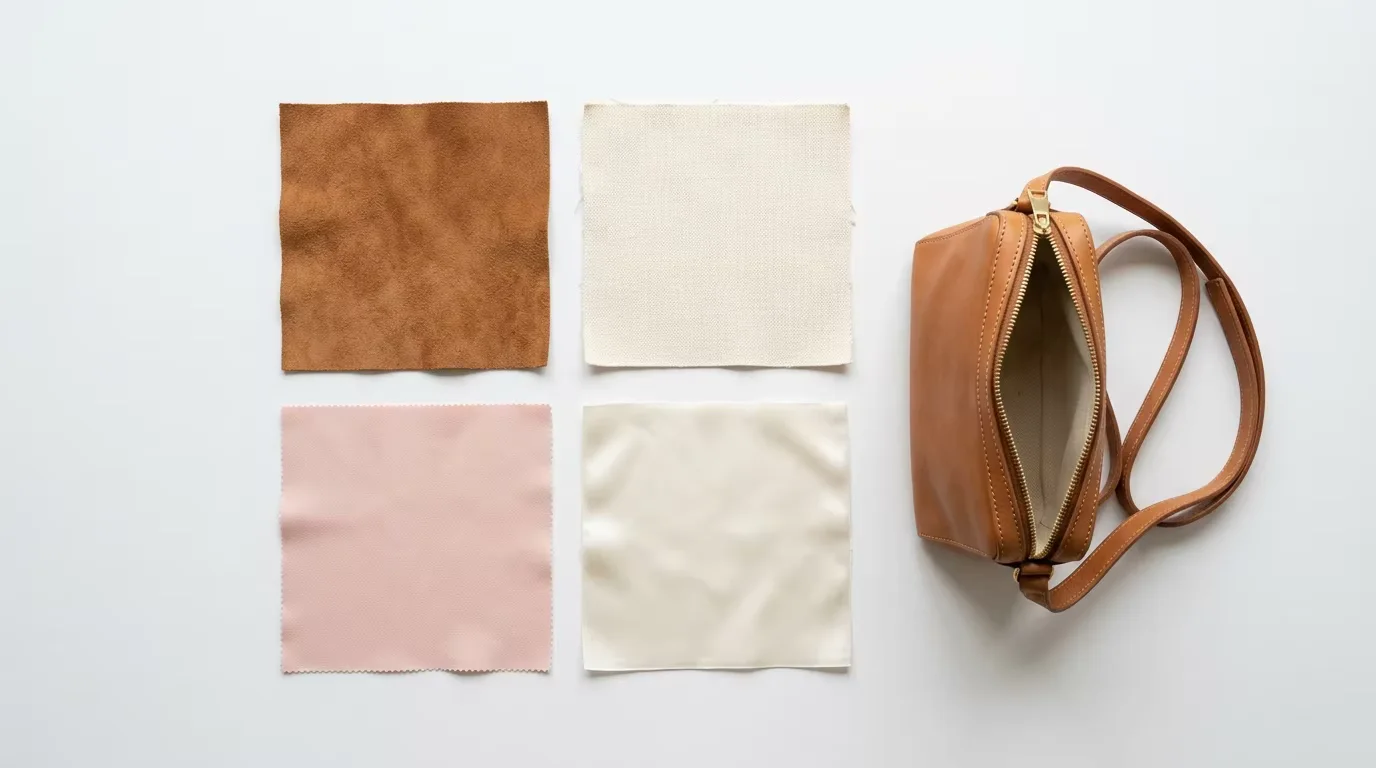
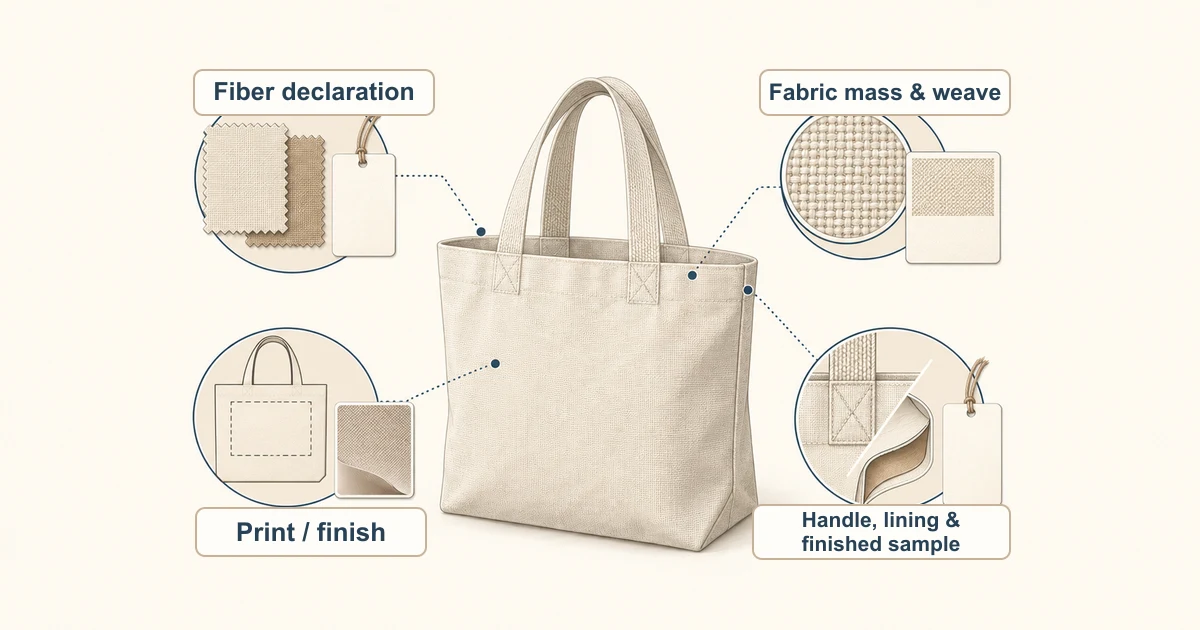
The cover and sample-path images are conceptual specification diagrams, not existing CELYNORA materials, products, processes, test results or customer projects.
Are Canvas, Cotton and Cloth Bags the Same?
No. A canvas tote is a bag format plus a fabric description; it is not automatically a 100% cotton bag. Cotton is a fiber claim that needs a supplier declaration and, where necessary, supporting evidence for the actual component. Canvas describes a fabric direction but leaves fiber composition, yarn and weave, mass, surface and finish unresolved. “Cloth bags” can refer to many textile constructions. If a buyer searches for cotton bags but receives a canvas proposal, the fiber claim and exact fabric reference still need to match.
Separate three decisions in the brief: what each component is declared to contain, which fabric version is proposed, and what the finished bag must do under the intended use. A photo or hand feel cannot settle the first two. A phrase such as “canvas tote bags for women” may describe an audience or merchandising category, but it cannot set the fabric, color, handle drop, size or load requirement. Ask the intended buyers what they carry and how the bag will be used instead of inferring a technical specification from that label.
The existing canvas material page is a starting point for discussing options, not evidence of a particular material in stock. Labeling duties also depend on the actual product and destination; the FTC textile-labeling guide is a US reference with product exclusions, not a universal handbag-label rule. Have the responsible party check the current requirements for the target market before making a label claim.
What Fabric Record Should a Canvas Bag Buyer Request?
Request a component-by-component record, not one line saying “canvas bag.” The outer body, base or side panel, handle or shoulder strap, anchor reinforcement, lining, pocket, binding and print or label contact area may differ. For each relevant part, ask for the supplier-declared fiber or material and proportion if stated; a fabric reference, color and batch or version; face and back; weave or construction; mass per unit area and its evidence status; and any finish, coating, preshrinking or laundering condition that applies.
Keep the evidence status beside the claim: Supplier-declared, Document received, Swatch observed, Measured to stated method, Tested to stated method, or Open. These are different states. A declaration describes what was supplied in a document; an observed swatch shows that swatch; a measurement applies to the specified specimen and method. None alone establishes the whole production batch or the finished bag. The handbag BOM guide can organize generic components, while the table below keeps the canvas-specific questions visible.
| Component | Declared fiber or material | Fabric reference | Mass and method status | Weave, face and finish | Color | Print or branding | Evidence status | Open question |
|---|---|---|---|---|---|---|---|---|
| Outer body | To confirm | To confirm | Open | To confirm | To confirm | Artwork/area to confirm | Open | Does the quoted fabric match the sample? |
| Base or side panel | To confirm | Same as body or separate: Open | Open | To confirm | To confirm | Contact with print: Open | Open | Is a different structure needed at the base? |
| Handle or strap | To confirm | Fabric/webbing/other: Open | If textile, Open | Surface and finish: Open | To confirm | To confirm | Open | What connects it to the body? |
| Anchor reinforcement | To confirm | To confirm | If applicable, Open | Layer and placement: Open | To confirm | Usually not a visible print field: confirm | Open | Which version is inside the anchor? |
| Lining or pocket | To confirm | To confirm | If applicable, Open | Face, finish and coverage: Open | To confirm | Print reverse contact: Open | Open | Full, partial or unlined? |
| Edge or binding | To confirm | To confirm | If applicable, Open | Fold/binding route: Open | To confirm | Edge contact: Open | Open | How will the exposed edge finish? |
| Print, label or patch contact area | Underlying material: Open | Exact panel/version: Open | Inherit only if verified | Surface and finish: Open | Actual ground color: Open | Process, size and position: Open | Open | Was this combination sampled? |
This is a blank project worksheet, not a list of CELYNORA materials or standard specifications. Mark an unknown field Open and name the person or document needed to resolve it before treating alternatives as equivalent.
How Should Fabric Mass, Weave and Finish Be Specified?
Use mass per unit area for the measurable fabric property often expressed as GSM. Record a value only when the unit, specimen source, method or option, conditioning or material state, and report scope are known. The public scope of ASTM D3776/D3776M-20(2025) describes fabric mass-per-unit-area methods with different sampling options; a small swatch result applies to that specimen and cannot automatically stand for a lot or finished bag. This article does not reproduce the paid method, specify a universal GSM, or claim CELYNORA has performed it.
Ask for a reference swatch or sample alongside any numeric mass. Record the proposed weave or construction, yarn or warp-and-weft description if provided, face and back, color, finish or coating, and fabric-version identifier. “Heavy canvas” or “tight weave” without a reference can lead two factories to quote different cloth. A changed coating or preshrink condition may alter the surface presented to a printer and the behavior seen during assembly; review the affected sample rather than assuming the name still defines it.
More mass is not automatically more strength or a better canvas tote. Fiber and yarn, construction, finishing, seam route, reinforcement, handle anchor, base, lining and actual load all matter. If two quotes propose different mass values, compare them against the same intended use and finished construction, then ask what each proposal changes at the print, sewing and sample stages. Do not use an unsupported “best GSM” range as a substitute for that decision.
How Should Printing and Branding Be Matched to the Actual Canvas?
Bind artwork approval to a named fabric version: reference code, color, face, texture and finish or coating. Then state the artwork revision, color targets, coverage, size, position, one or both sides, and distance from seams, folds, pocket edges and handle attachments. A print approved on a white, unfinished swatch is not approval on a dark or finished production panel.
Screen printing, a transfer or digital route, embroidery, a woven label and a patch are candidate routes, not a promise that any one is available or best for every canvas. Compare the route against the actual artwork and fabric: can fine details be retained on that surface; how does the print feel; will a fold cross it; does a seam or lining change the visible position? Ask for a strike-off, panel or identified bag sample at the level needed for the decision. Review color appearance, edge definition, registration or placement, touch, and the relationship with handles and lining under the agreed viewing conditions.
If fabric, ground color, finish, artwork, process, ink or transfer version, or location changes, reopen the affected approval. A clean-looking panel does not establish permanent color, wash durability, absence of cracking or migration, or environmental status. Those results require a defined method and specimen if they matter to the project.
How Do Handles, Straps, Seams and the Base Change the Brief?
The canvas body does not define how the bag carries its contents. For a tote, record handle material, width and length or drop direction, fold or reinforcement, anchor path and the opening shape before and after the intended load. Compare tote dimensions and usable fit for measurement language; this material guide does not replace its size decisions.
For a canvas crossbody bag or canvas messenger bag, record strap material and adjustment range, anchor location, contact against the body, opening or flap interaction, and lining at the anchor. Device protection, compartment layout and messenger-format choice belong to the separate format brief, not to the word “canvas.” Webbing, leather, synthetic trim or another handle material may be discussion options; none is implied to be a stocked CELYNORA construction.
Trace the load path on an identified finished sample: handle or strap to anchor, anchor through reinforcement and seam, seam into side and base panels. Note corner folds, binding, hardware interfaces and what changes when the bag is loaded with the actual items in their intended order. An observed carry of one sample is useful feedback, but it is not a rated capacity, cycle-life result or proof of batch consistency. If those claims are required, define the load, carry mode, duration or cycles, acceptance criteria and responsible test before making them.
When Should a Canvas Bag Be Lined or Unlined?
There is no universal answer. An unlined version may expose seam and print backs; a partial lining may cover selected contact areas; a full lining may change the interior appearance, usable space, pockets and opening behavior. Choose from the intended look and touch, contents, edge finish, structure, cleaning questions and the way the finished sample behaves—not from an assumption that lining always makes a bag better.
Record lined, partial or unlined, the lining material and color if proposed, coverage, pocket position, attachment points, top edge, base and turnback. Mark unknowns Open. On the identified sample, check whether lining shifts near the handle anchor, obscures an opening, rubs the print reverse or changes the shape under load. The lining specification guide offers material questions, but its generic cost or performance statements cannot establish the answer for this canvas version.
What Shrinkage, Color Transfer, Load and Environmental Claims Need Separate Evidence?
Specify a claim only when the buyer actually needs it and the test or document would apply to the named material or finished-bag version. “Canvas,” “cotton,” “coated” and “waxed” are not results. A supplier declaration, a fabric test and a finished-bag observation support different conclusions.
For dimensional change, first decide whether home laundering is an intended use at all. If it is, name the specimen, initial length and width, washing and drying procedure, cycles, measured directions and acceptance threshold. The public scope of AATCC TM135-2025 concerns dimensional change of suitable fabrics after home laundering; it does not make a finished bag machine washable. For color transfer, AATCC TM8-2016e(2022)e describes controlled dry and wet rubbing of colored textiles against a white test cloth. State the fabric, finish, treatment and test condition if this evidence is needed; do not invent a grade or extrapolate a fabric result to every contact in the bag.
For load, name the finished version, actual contents and weight, packing sequence, handle or strap setting, motion or cycle, and pass criterion. Without those conditions, leave the capacity question Open. Canvas or a coating name also cannot prove a finished bag waterproof, easy to clean or washable; material, seams and openings would need their own defined evidence. This article is not a waterproof-performance guide.
For environmental language—organic, recycled, recyclable, biodegradable, plastic-free, “eco-friendly” or similar—ask what component or product the claim covers, for which market, and which current documents or chain of custody support it. Natural-fiber appearance is not proof. Tie every test or claim to material or bag version, sample, method, conditions, date, result and scope; repeat the affected review after a relevant change. No CELYNORA test, certification or compliance outcome is asserted here.
What Should Buyers Check on an Identified Canvas Bag Sample?
Start with an empty finished bag, then load the items the intended buyer would actually carry in the planned order. Record opening and closure, shape, base response, handle or strap and anchor behavior, lining movement, and what happens where print meets folds, pockets or seams. Keep the sample ID and fabric, artwork and construction revisions together; otherwise a “good sample” cannot be matched to the quoted version.
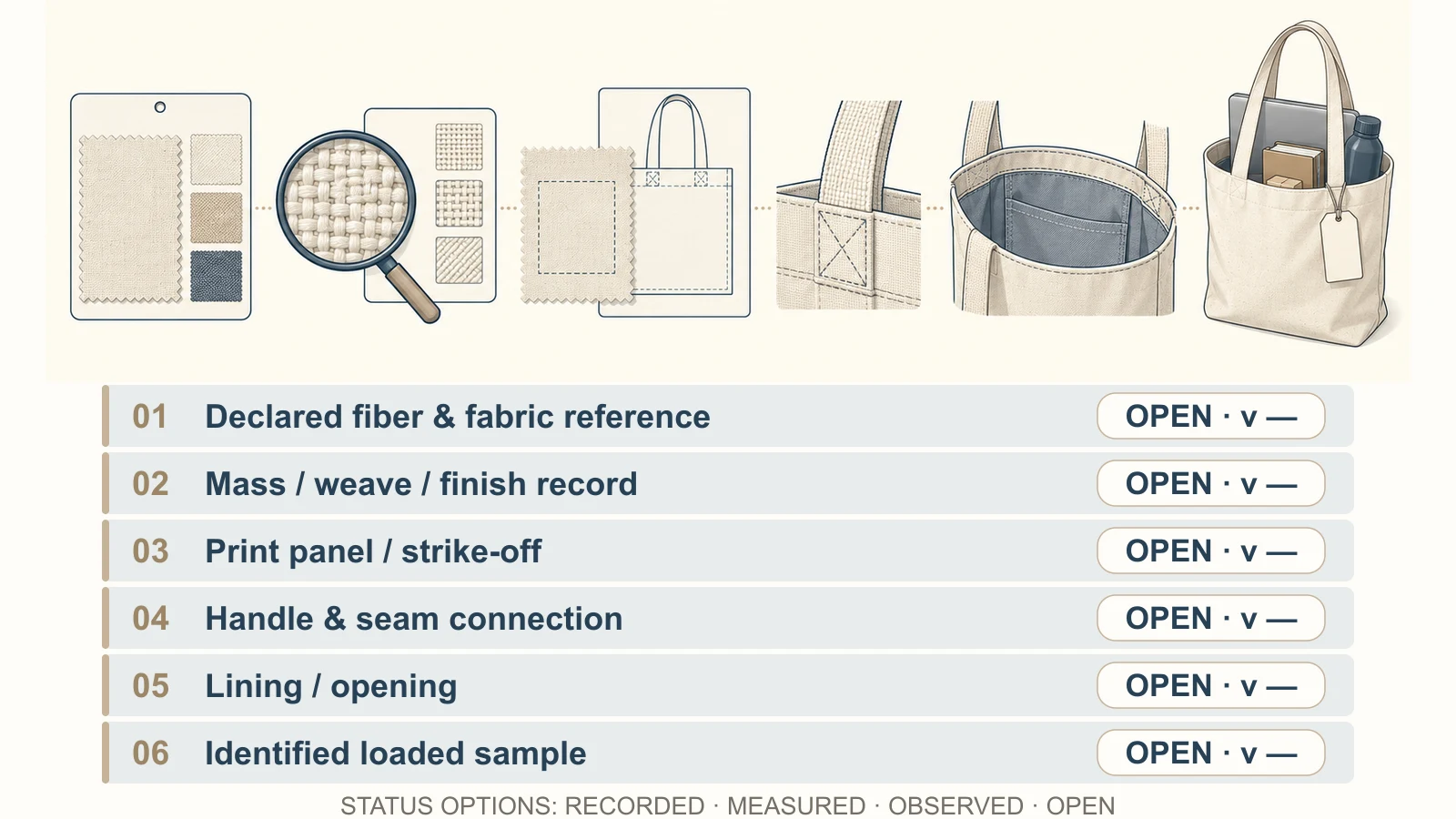
| Checkpoint | Version and condition | What to observe or measure | Status | Action owner |
|---|---|---|---|---|
| Sample and fabric identity | Sample/spec ID, supplier declaration, fabric reference, batch or color version | Match actual body, base, handles, lining and reinforcements to the record | Open / Recorded | To assign |
| Mass, weave and finish | Named swatch, face/back, condition and method if measured | Value with unit and sample scope; construction and finish match | Open / Measured to stated method | To assign |
| Print strike-off or panel | Artwork, process, ground fabric, color and finish versions | Detail, edges, target color, hand and placement reference | Not checked / Observed under stated condition | To assign |
| Finished print position | Identified bag, empty and filled | Distance to seam, fold, pocket and handle; appearance after loading | Open / Observed under stated condition | To assign |
| Handle or strap anchor | Material, attachment route and stated carry setting | Connection and visible change under defined contents and action | Not checked / Observed under stated condition | To assign |
| Seam, reinforcement and base | Construction version and stated load | Fold, corner, base shape, seam and reinforcement behavior | Open / Needs change | To assign |
| Lining, opening and pockets | Full/partial/unlined version; empty and filled | Coverage, access, edge finish, pocket and print-reverse interaction | Open / Recorded | To assign |
| Actual load and closure | Item list, packing order, weight if known, duration/action | Access, closing, shape and carry-mode behavior | Not checked / Observed under stated condition | To assign |
| Conditional claims | Only the required fabric/finished version, method and target market | Dimensional change, crocking, cleaning or environmental evidence as applicable | Open / Not checked / Tested to stated method | To assign |
The sample-request guide explains the general sample process; this record keeps canvas fabric, print, handle and lining decisions attached to one identified bag. One swatch, one lift or one sample cannot establish carrying rating, wear life, shrinkage, colorfastness, waterproofing, washability, batch consistency or legal compliance. Recheck the affected fields when fabric or batch, color, finish, artwork, print route, handle, seam, base, lining, load or packaging changes.
What Should a Buyer Send for a Canvas Bag or Tote Project Review?
Start with the format—tote, crossbody, messenger or still comparing—the intended use and actual items to be carried. A reference photo or sketch, known dimensions, desired canvas look or hand, color, artwork and logo position, handle or strap direction, lining and pocket wishes, estimated quantity, delivery country and target timing (if known) help make alternatives comparable. Mark unknown fabric identity, mass, print route or sample conditions Open rather than guessing. Say which details must stay and which may change.
If you have a swatch, BOM, tech pack or previous sample, identify its version. If you do not, you can still prepare an incomplete custom handbag RFQ with a reference and questions. Material and printing availability, sample scope, testing needs, price, MOQ and timing can only be confirmed for the specific project after its options and commercial terms are reviewed.
Planning a canvas bag or canvas tote project? Send the format, intended load, reference, artwork and any known fabric, color, handle, lining, quantity and delivery-country details. Open questions are welcome; a complete tech pack is not a prerequisite to start. Discuss Your Canvas Bag Project.
B2B Buyer Checklist
Before you request a quote, prepare the information that affects MOQ, sample cost, lead time and final unit price.
- Target product category, size and reference images.
- Expected order quantity per style and per color.
- Material preference, lining requirements and hardware finish.
- Logo method, packaging items and delivery country.
- Target retail price or target factory price range.
Decision Table
| Buyer Question | Why It Matters | What to Send the Factory |
|---|---|---|
| What is my MOQ target? | MOQ affects material sourcing, production planning and unit price. | Quantity per style, per color and launch schedule. |
| Which material should I choose? | Material controls price band, durability and brand positioning. | Reference photos, desired texture and target market. |
| How much customization do I need? | Logo, lining, hardware and packaging change sample time and cost. | Logo files, packaging references and required details. |
| What is my delivery deadline? | Sampling, production and shipping need realistic planning. | Launch date, delivery country and preferred shipping method. |