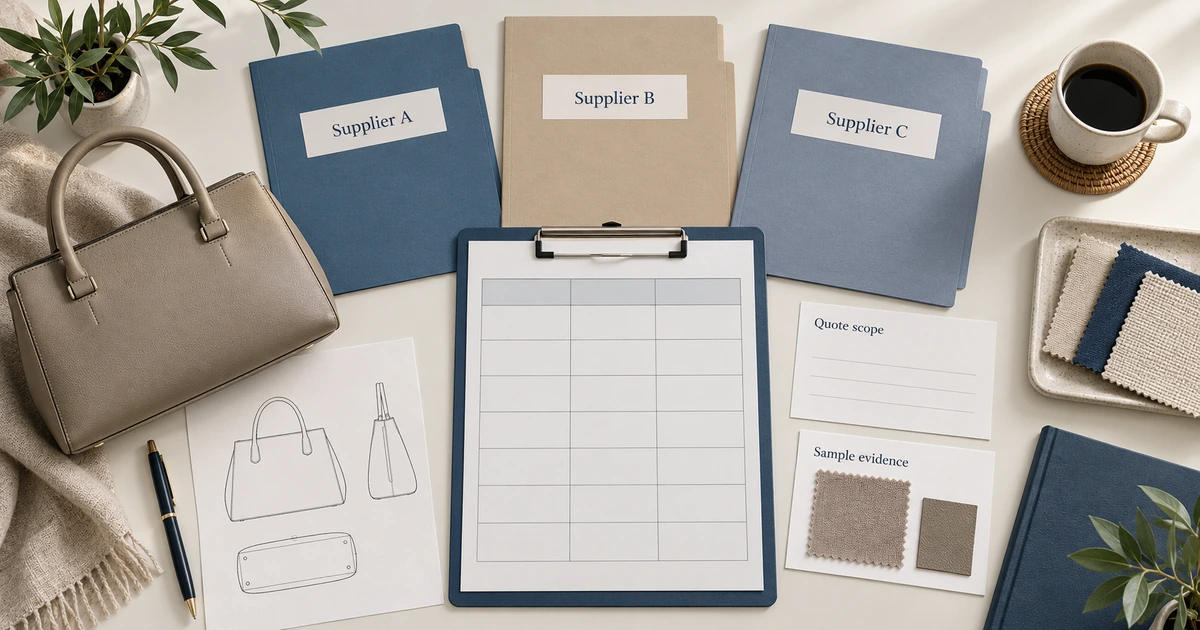
A useful handbag supplier scorecard does not rank factories with a universal total. It records what each supplier understood, what its quote includes, what sample evidence exists, how changes were handled and which risks remain open. Buyers can then choose the next step for their own project without treating a low price, fast reply or single document as proof of overall suitability.
This article uses anonymous Supplier A, Supplier B and Supplier C examples against the same buyer brief. Each cell should record a supplier-stated point or evidence the buyer has actually reviewed. The scorecard helps form a next step; it does not claim that one candidate is better for every project.
What Should a Handbag Supplier Scorecard Decide?
Use a scorecard after two or three candidates have entered a real project review. It is for deciding what to do next, not for searching the internet for a supplier list or publishing a public ranking. The same brief, specification version, quantity split and open questions should be the starting point for each candidate. If the inputs differ, record the difference before comparing the responses.
A practical next step may be to:
- clarify a requirement or an unanswered question;
- request a revised quote scope;
- request or review a sample against the current specification;
- provide missing buyer information;
- hold the decision while a dependency is resolved; or
- stop a route when the current project requirements cannot be reconciled.
Factory systems and production capability are a separate layer of work. For that assessment, evaluate factory systems separately rather than turning this matrix into another factory audit.
Which Five Decision Areas Belong in the Scorecard?
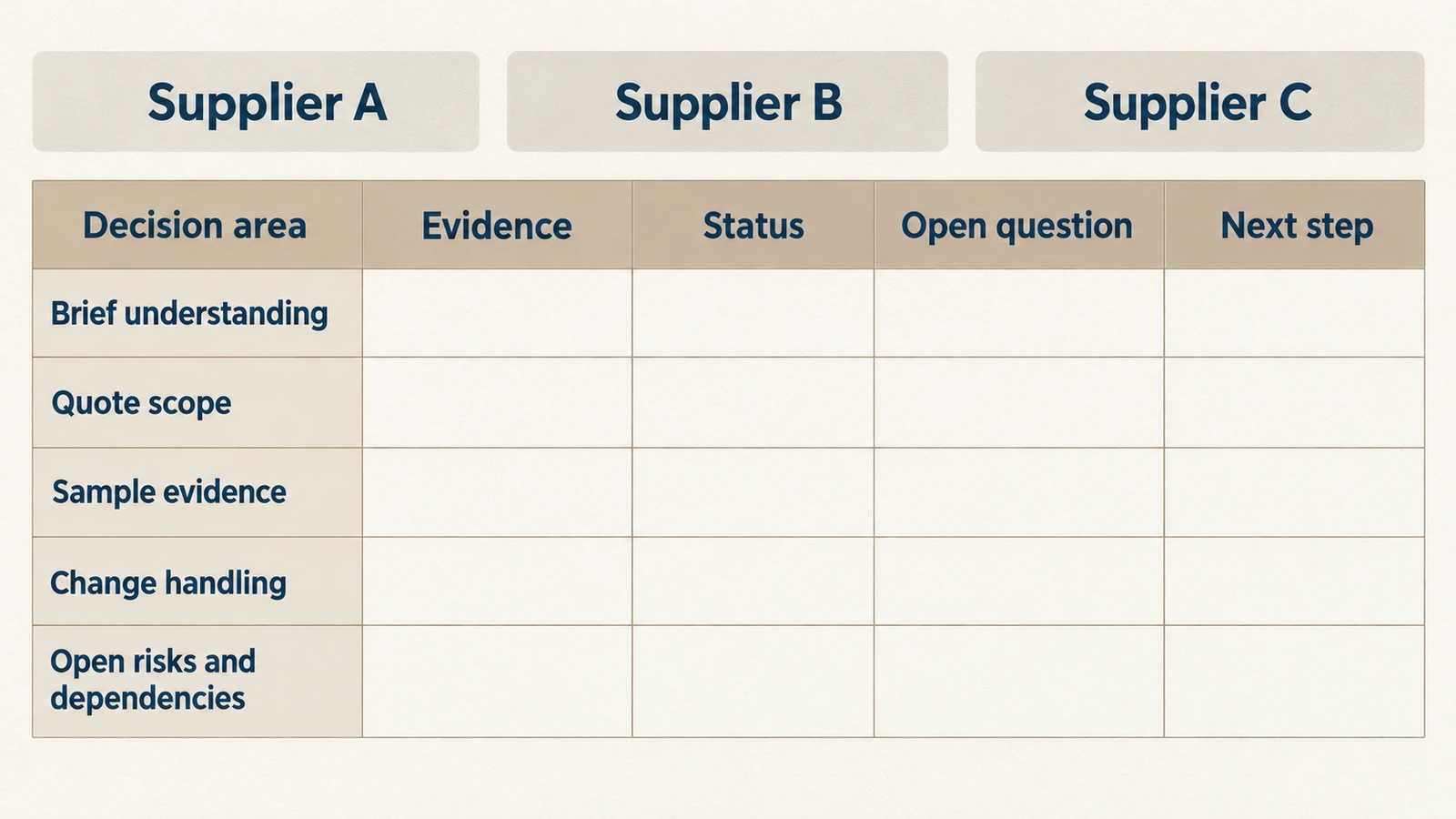
Repeat the same five decision areas for each anonymous candidate. The purpose is to keep the buyer's requirement, the supplier's stated scope, the evidence reviewed and the remaining question visible in one place.
1. Brief understanding
Record whether the candidate has understood the intended use, fixed requirements, flexible options and open questions in the same buyer brief. Note what the supplier repeated or clarified; do not turn a polished reply into proof that every requirement is feasible. If the starting material is still incomplete, prepare one reviewable handbag RFQ to keep the same project frame visible to each candidate.
2. Quote scope
Record the specification or reference version used for the quote, quantity and color split, branding, packaging, inspection or testing direction, and the commercial basis that was actually stated. A quote that omits a field needs a question, not a guessed inclusion. When comparing documents, compare handbag factory quotes on one basis before treating a difference as meaningful.
3. Sample evidence
Identify whether the evidence is a catalog or reference sample, a development sample or a project reference already reviewed by the buyer. State what it shows about the current material, structure, hardware, function or finish, and what it does not show. A sample can support a focused review without proving a future production outcome. Where needed, review a handbag sample against the current specification rather than relying on a general impression.
4. Change handling
When the buyer changes one condition, record whether the candidate identified the changed item, the protected requirements, the new reference version and the scope that still needs confirmation. This records the project exchange; it does not judge personality or predict how the supplier will behave in every later situation.
5. Open risks and dependencies
List assumptions, substitutions, availability questions, approvals, missing files, scope dependencies and owners that are still open. Turn each risk into a question someone can answer. Do not replace a specific open point with a general label such as “high risk” or “low risk.”
How Do You Complete the Matrix Without Inventing a Score?
Use the same five rows for each candidate and write what the current record supports. Do not write “more professional,” “safer” or “best factory” from an overall impression. The scorecard is deliberately non-numeric: use only Aligned, Different, Not stated or Needs review in the Status column.
Copy or summarize supplier-stated wording with a source marker such as a quote revision, message date, sample reference or internal file ID. A blank response is not evidence of approval, and evidence available to the buyer is not the same as independent certification of that evidence.
If the quote basis is different, first identify which cost driver changed the quote basis. Then record the difference and the question it creates instead of comparing unlike scopes as if they were one product.
| Supplier ID | Decision area | Buyer requirement / reference | Supplier-stated scope | Evidence reviewed | Status | Open risk or question | Next step / owner |
|---|---|---|---|---|---|---|---|
| Supplier A | Brief understanding | ||||||
| Supplier A | Quote scope | ||||||
| Supplier A | Sample evidence | ||||||
| Supplier A | Change handling | ||||||
| Supplier A | Open risks and dependencies |
Copy these five blank rows for Supplier B and Supplier C, or replace the anonymous IDs with your own internal codes. Lock the same brief or specification version before filling the matrix. If the input differs, record that difference first rather than forcing the candidates into a common ranking.
- Write only the information already stated or reviewed; use Not stated for a missing field.
- Use the four status words without mapping them to points, stars, colors or a total.
- Turn every Different, Not stated or Needs review entry into one question and one owner.
- Choose the next step from the project's important fixed requirements and unresolved evidence, not from a combined champion score.
- Save the brief, quote, sample and change-record versions used for the decision so the matrix can be reviewed later.
The scorecard is a planning record. It is not a contract, audit report, supplier certification or guarantee of a purchasing result.
How Should Open Risks Change the Shortlist?
An open risk is a decision condition, not an automatic deduction. If a candidate's response conflicts with a fixed buyer requirement, the quote scope cannot be aligned, a sample does not support a key requirement or a change may affect the project but remains undefined, the practical next step may be to hold the route until the question is resolved.
Smaller uncertainties can move to clarification, a revised quote or a sample review when the owner and question are clear. That action does not mean the candidate has won. It means the buyer has chosen a controlled next step for the current evidence.
Do not decide the shortlist from the lowest price, fastest reply, number of certificates, appearance of one sample or one smooth conversation. Each may be relevant to a particular project, but none independently proves overall suitability. Do not set one universal elimination line for every handbag project; the fixed requirements and unresolved dependencies determine what matters next.
What Should You Share When Discussing Supplier Fit?
Bring the current project materials that you own or are authorized to share:
- the current brief or product reference and its version;
- intended use plus Fixed, Flexible and Open requirements;
- estimated quantity and style or color split, when known;
- branding, packaging, destination and the inspection or testing direction that actually applies; and
- the unresolved questions you want help discussing.
Do not upload or forward another supplier's complete confidential quote, client list, contract, audit report, private contact details or other material protected by a confidentiality obligation. An anonymous summary of where a quote scope or sample record differs is enough to explain the question. The scorecard should help organize a buyer's own project information, not expose another party's private documents.
Want to discuss supplier fit for your own handbag project? Bring your current brief, product reference, fixed requirements, estimated quantity and unresolved questions. Use the quote request below to discuss a practical starting point.
For related sourcing guidance, see OEM vs ODM Handbag Development.
Have a specific sourcing question on this topic? Share your project details and our team will respond directly.
For reference, our current catalog includes styles such as the Doctor Box Handbag — useful as a specification baseline when briefing your own factory or sourcing agent.
B2B Buyer Checklist
Before you request a quote, prepare the information that affects MOQ, sample cost, lead time and final unit price.
- Target product category, size and reference images.
- Expected order quantity per style and per color.
- Material preference, lining requirements and hardware finish.
- Logo method, packaging items and delivery country.
- Target retail price or target factory price range.
Decision Table
| Buyer Question | Why It Matters | What to Send the Factory |
|---|---|---|
| What is my MOQ target? | MOQ affects material sourcing, production planning and unit price. | Quantity per style, per color and launch schedule. |
| Which material should I choose? | Material controls price band, durability and brand positioning. | Reference photos, desired texture and target market. |
| How much customization do I need? | Logo, lining, hardware and packaging change sample time and cost. | Logo files, packaging references and required details. |
| What is my delivery deadline? | Sampling, production and shipping need realistic planning. | Launch date, delivery country and preferred shipping method. |