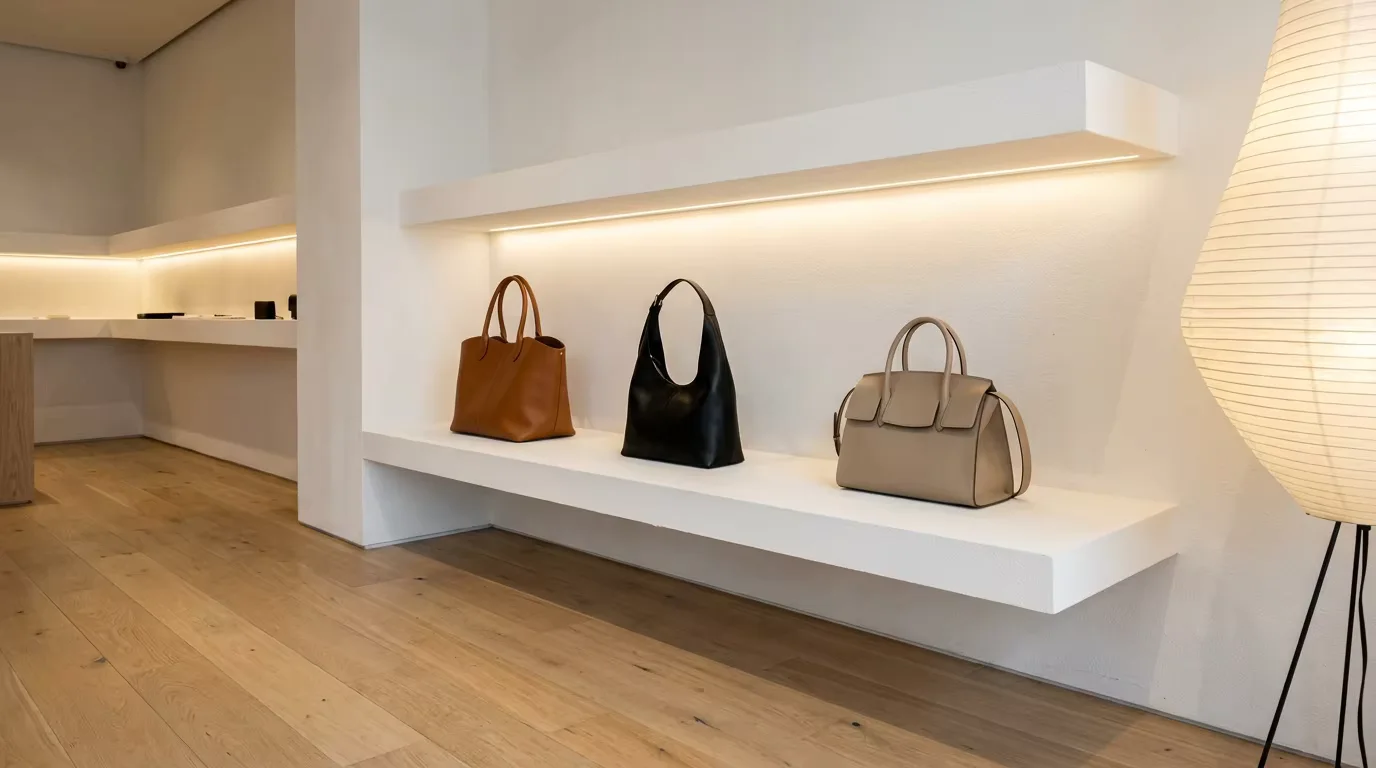
A minimalist bag hides nothing — with no decorative overlay, hardware cluster or logo treatment to distract the eye, every seam line, edge finish and structural detail is fully visible and magnified. That exposure is exactly why a clean, unadorned design is often harder to manufacture well than a heavily decorated one, and why a few specific construction choices determine whether a minimalist bag looks architectural or simply looks unfinished.
Why Does Minimalist Design Demand More From Internal Structure?
Without external hardware, trim or paneling to visually reinforce a bag's shape, the internal structure has to do all of that work on its own. A minimalist tote or shoulder bag depends on interlining choice — the stiffening material placed between the leather's outer and lining layers — to hold a sharp, architectural silhouette rather than slouching after weeks of daily use. A high-resilience interlining, correctly matched to the leather's own weight and flexibility, is what keeps a structured minimalist silhouette looking crisp over time; an undersized or mismatched interlining is one of the most common reasons a clean-lined bag develops visible slouching and creasing well before it should.

Specifying interlining weight and type explicitly on the tech pack — rather than leaving it to a factory's default — is the single most effective lever a buyer has for controlling how well a minimalist silhouette holds its shape over the product's working life.
How Should Hardware Be Specified When There Is Very Little of It?
A minimalist bag typically uses far fewer hardware pieces than a heavily detailed one, which means each remaining piece carries disproportionate visual weight. A single buckle, zipper pull or clasp becomes a focal point by default simply because it has no competing detail to share attention with — a cheap or poorly finished piece of hardware stands out more starkly on a minimalist bag than the same piece would on a busier design.

Matte and brushed hardware finishes — brushed metal, satin gold, matte gunmetal — pair particularly well with minimalist design because their subdued finish does not compete with the clean leather surface the way a high-polish, reflective finish can. Specifying a named hardware finish and requesting a physical sample of that exact finish before approving a production sample avoids the common mismatch between how a finish is described in a quote and how it actually reads in hand.
Why Is "Simple" Often Harder to Manufacture Than "Decorated"?
A bag with multiple panels, trims, contrast stitching or decorative hardware has more surface area where small construction variances blend into the overall design and go unnoticed. A minimalist bag has the opposite problem: with one continuous leather surface and minimal seaming, there is no decorative detail to disguise an uneven edge paint line, an inconsistent stitch gauge, or a slightly misaligned seam — every one of these becomes immediately visible against the bag's clean lines.
This is why edge finishing deserves specific attention on a minimalist spec. Edge paint (or edge burnishing, depending on the leather and desired finish) needs to be applied in even, consistent layers with no visible buildup or thin spots, since an exposed edge on a minimalist bag is rarely covered by piping, binding or an overlapping panel the way it might be on a more decorated design. Requesting a close-up sample photo of the edge finish specifically, not just the overall bag, is a practical way to verify this detail before approving a full production run.
What Should Be Specified on a Minimalist Design Tech Pack?
Beyond the standard material and dimension specs, a minimalist design tech pack benefits from a few details that matter disproportionately for this category: interlining weight and type for every structural panel, named hardware finish with a physical reference sample where possible, edge finish method (paint or burnish) and the number of coating layers expected, and stitch gauge (stitches per inch) for the visible topstitching, since stitch consistency is one of the most visible quality signals on a design with very little else competing for attention.
Celynora's standard terms for custom development: genuine leather starts at an MOQ of 100 units per style; non-leather materials start at 300 units per style. Sample lead time runs 7–10 days from spec confirmation; bulk production lead time runs approximately 15 days after sample approval.
Minimalist design is not an absence of specification — it typically requires more precise specification than a more detailed design, because there is nowhere for a construction shortcut to hide. Share a reference image and the structural details that matter most for the project and the factory can confirm interlining, hardware finish and edge treatment options before sampling begins.
How Does Leather Selection Change for a Minimalist Design?
With no decorative treatment to carry visual interest, the leather's own surface quality becomes the design's primary visual element — a role it does not have to play on a more detailed bag with other focal points to share attention with. This makes grain consistency and surface quality a higher-priority consideration for a minimalist order than it would be for a heavily structured or paneled design with more forgiving material tolerances. A hide with natural variation or minor surface marks that would go unnoticed under a decorative overlay becomes considerably more visible on a single continuous minimalist panel.
For a minimalist design specifically, requesting a tighter grain-consistency tolerance from the factory, or specifying a particular leather grade known for more uniform surface quality, is worth the added material cost given how exposed the leather's own appearance is in the finished product. This is a case where top-grain leather's more uniform, treated surface can be a practical advantage over full-grain's natural variation, depending on how much surface consistency a specific minimalist design calls for — a tradeoff worth discussing directly against the project's specific aesthetic goals rather than defaulting to one grade automatically.
How Should Color Be Approached in a Minimalist Collection?
Color carries more weight in a minimalist collection than in a more detailed one, since there is less competing visual information to balance a color choice against. A minimalist collection built around a tight, disciplined color palette — a core neutral range with perhaps one or two signature accent colors — tends to read as more intentional and cohesive than one that spreads a wide color range across similarly unadorned silhouettes, where the lack of other design variation can make an overly broad color range feel scattered rather than curated.
This is a strategic choice worth making deliberately at the collection-planning stage, before individual style colors are finalized, so that the finished range reads as a considered palette rather than an arbitrary assortment of available dye options.
Should a Minimalist Design Avoid Branding Entirely?
A genuinely unbranded minimalist bag can still carry brand identity through construction choices alone — a signature stitch pattern, a specific hardware finish, or a particular proportion ratio that becomes recognizable without a visible logo. This is worth considering explicitly for a brand building a minimalist line, since relying purely on construction-level signatures to carry brand identity raises the bar for execution consistency across every unit produced, in a way that a visible logo mark does not.
For related sourcing guidance, see Genuine Leather vs Synthetic, Material Sourcing, Digital Prototyping and Transparency, Handbag Packaging Specification and Leather Bag Color Planning.
For reference, our current catalog includes styles such as the Crescent Underarm Bag with Wrist Strap — useful as a specification baseline when briefing your own factory or sourcing agent.
B2B Buyer Checklist
Before you request a quote, prepare the information that affects MOQ, sample cost, lead time and final unit price.
- Target product category, size and reference images.
- Expected order quantity per style and per color.
- Material preference, lining requirements and hardware finish.
- Logo method, packaging items and delivery country.
- Target retail price or target factory price range.
Decision Table
| Buyer Question | Why It Matters | What to Send the Factory |
|---|---|---|
| What is my MOQ target? | MOQ affects material sourcing, production planning and unit price. | Quantity per style, per color and launch schedule. |
| Which material should I choose? | Material controls price band, durability and brand positioning. | Reference photos, desired texture and target market. |
| How much customization do I need? | Logo, lining, hardware and packaging change sample time and cost. | Logo files, packaging references and required details. |
| What is my delivery deadline? | Sampling, production and shipping need realistic planning. | Launch date, delivery country and preferred shipping method. |