One of the most common points of friction between brand buyers and Chinese leather bag factories is the tech pack — or the absence of one. A buyer sends a reference photo and a verbal description. The factory interprets it. The sample arrives, and it is not quite right: the strap is too long, the pocket is in the wrong position, the hardware finish is different from what was intended. Two rounds of sampling later, the launch window is missed.
The fix is not complicated, but it requires discipline: every custom bag order needs a proper tech pack before sampling begins. A tech pack is a structured technical document that gives the factory unambiguous instructions for every dimension, material, and construction detail of your bag. It is the single most leverage-able investment a brand can make in production quality and speed.
This guide covers exactly what a leather bag tech pack needs to contain, how to communicate each element clearly, and how to send it to a Chinese factory in a way that minimizes interpretation errors.
What a Tech Pack Is (and Is Not)
A tech pack is not a mood board, a Pinterest collection, or a reference photo with annotations. Those are inputs to a tech pack. A tech pack is a complete specification document that could theoretically be handed to any competent leather goods factory in the world and produce an identical result without further explanation.
In practice, no tech pack is truly complete on the first attempt — sampling is always required to resolve ambiguities and achieve the exact aesthetic and functional result you are targeting. But a well-prepared tech pack dramatically reduces the number of sampling rounds required and eliminates the most common and expensive production errors: wrong dimensions, wrong hardware finish, wrong material grade, wrong construction method.
The Seven Components Every Leather Bag Tech Pack Must Include
1. Technical Drawings with Dimensions
Every view of the bag must be drawn and dimensioned: front, back, side (both sides if they differ), top, and bottom. Interior views showing pocket placement and lining details are also required for any bag with functional interior organization.
Dimensions must be in millimeters, not centimeters or inches. Factories work in millimeters, and any unit conversion introduces error. All dimensions should be given as finished dimensions — the size of the completed bag, not the cut panels before assembly.
The drawing does not need to be a professional CAD illustration. A clean, measured hand drawing scanned at high resolution is acceptable to most factories. What is not acceptable is a freehand sketch without measurements, or a photograph of a reference bag with estimated dimensions. Photographs distort proportions. Estimates compound through production.
Key dimensions to always specify:
- Overall width, height, and depth at widest/tallest/deepest points
- Strap width, length (both shortest and longest adjustment), and attachment point position
- Handle drop height (distance from top of handle to top of bag)
- Flap depth (how far down the flap extends on the front panel)
- Pocket dimensions and placement (distance from top, sides, and bottom of the bag)
- Hardware placement (distance from edges, center alignment)
2. Material Specification
The material section of your tech pack needs to specify leather grade, hide type, tannage method, thickness, finish type, and color for every leather panel in the bag. Body panels, straps, handles, trim pieces, and lining may all be different specifications — document them separately.
For color, always provide a Pantone reference from the Leather Color palette (not the standard Pantone Fashion Home Interiors palette — they are different). If you do not have access to Pantone leather references, provide a physical swatch. Never describe color in words only: "tan," "camel," and "cognac" mean different things to different people and in different lighting conditions.
Hardware must also be specified by material (zinc alloy vs. brass), plating finish (gold-tone, silver, antique brass, matte black), and surface treatment (shiny, brushed, sandblasted). If you have a specific hardware reference you want to match, include a photograph or a physical sample.
3. Stitching Specification
Stitching defaults vary by factory. Without a specification, the factory will use whatever thread color, weight, and stitch density they normally use for similar bags. This is often fine — but when it is not fine, it is difficult and expensive to correct post-production.
Specify: thread color (Pantone reference or physical swatch), stitches per inch (SPI) for body seams and decorative topstitching, thread weight (typically #69 for lightweight bags, #92 for medium, #138 for heavy), and whether any seams should be hand-stitched (saddle stitch) or machine-stitched.
4. Hardware Bill of Materials
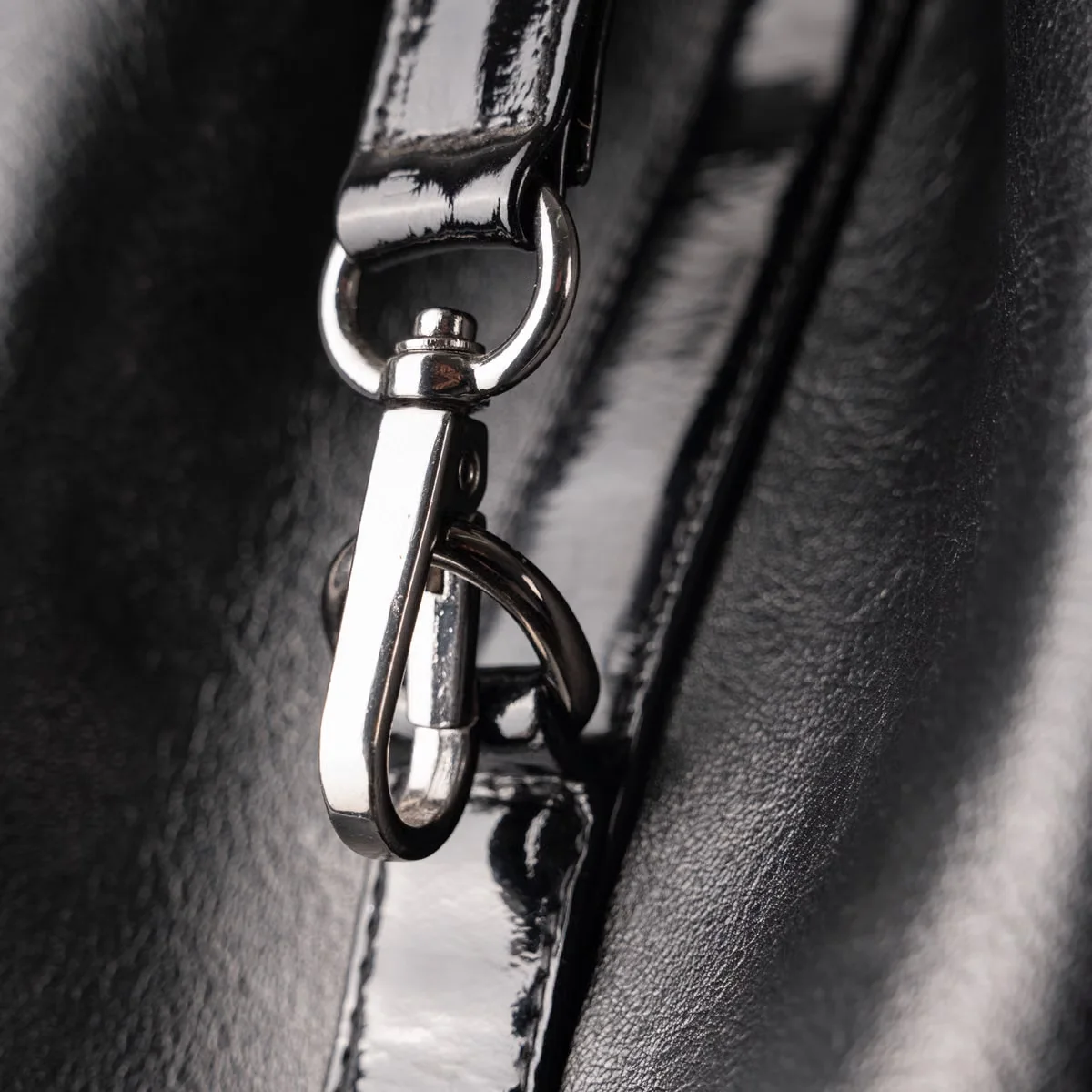
Create a complete hardware list that itemizes every metal component in the bag: quantity, type, finish, and approximate size. For standard hardware (D-rings, swivel clasps, O-rings, rivet sets, zippers), specify the standard size designation where applicable.
For zippers, specify: YKK vs. generic (YKK should be specified explicitly if required — factories default to domestic Chinese zipper brands unless YKK is called out), zipper gauge (size 3, 5, or 8 are most common for handbags), and zipper slider style (standard, locking, teardrop pull, etc.).
For custom hardware — a logo plate, a branded clasp, a non-standard pull shape — include 3D renders or a physical sample. Custom hardware development typically adds 4–6 weeks to your timeline and has its own MOQ (usually 200–500 pieces per component). Nail down custom hardware specifications before starting bag sampling so the two development timelines run in parallel rather than sequentially.
5. Interior Layout Specification
The interior of a bag is often under-specified and is frequently the source of unpleasant sample surprises. Document the complete interior layout: lining material and color, pocket count and type (open slip vs. zipper vs. phone-specific), pocket dimensions, card slot count and dimensions (if applicable), key clip position, and any structural elements (base board, frame, internal structure).
If you have a specific lining fabric in mind, include a swatch or a fabric specification. If you are open to the factory's standard lining, state that explicitly — it removes ambiguity and speeds up production.
6. Construction Method Notes
Construction notes cover the "how" of production rather than the "what." These include: how handles and straps are attached to the bag body (riveted, stitched through, D-ring loop), how panels are joined (glued and stitched, stitched only), how the lining is attached (glued at edges, stitched around perimeter), how base feet are installed (pronged through the base, recessed into the bottom panel), and how edges are finished (painted, burnished, fabric tape, folded and stitched).
Factories have standard answers to all of these questions. If your preferred construction method matches their standard, say nothing — they will do it correctly by default. If your preferred method differs from standard practice for any element, specify it explicitly. "Standard edge finish" and "hand-burnished edge finish" are significantly different in production time and cost.
7. Branding Placement
If your brand identity needs to appear on the bag — a debossed logo on the front panel, an embossed plate on the strap, a branded interior label — specify the placement in millimeters from specific reference points (e.g., "centered horizontally, 65mm from the bottom edge of the front panel"), the deboss/emboss dimensions and depth, the label type (woven, printed, leather, metal), and the label placement inside the bag.
How to Send a Tech Pack to a Chinese Factory
Format matters more than most buyers realize. A 40-page PDF with everything in one document is harder to work with than a well-organized folder. The most factory-friendly tech pack format is:
- A single PDF with numbered pages: cover sheet, views and dimensions, material spec sheet, hardware BOM, interior layout, construction notes, branding spec
- Separate high-resolution image files for any reference photos or swatch photos
- A concise cover email that states the style name, the purpose of the document (initial sampling request), the timeline you are working toward, and a clear question list for anything you know is ambiguous
Send the tech pack to your factory contact and ask them to confirm receipt and flag any elements that are unclear or that they anticipate will require clarification before sampling begins. A factory that reads your tech pack and returns a list of questions is a factory that is taking the job seriously. A factory that reads it and says "no problem, we understand everything" without any questions has almost certainly not read it carefully.
What to Do When You Do Not Have All the Information Yet
A common mistake is waiting until you have a "complete" tech pack before engaging a factory. In practice, your tech pack will never be complete on the first version — and waiting for completeness delays the sampling timeline by weeks or months.
The right approach is a staged document. Send the factory what you have, with clear annotations on the sections that are still being finalized. Ask them to begin sampling based on the confirmed elements and flag the pending decisions so both parties know what needs to be resolved before production can proceed.
A staged tech pack also helps you identify which decisions are actually on the critical path for sampling. Often, the factory can begin cutting and assembling with 80% of the specification confirmed, while the remaining 20% (typically hardware finish and branding) is finalized in parallel. This approach can save several weeks on the overall development timeline without introducing additional risk to the finished product quality.
B2B Buyer Checklist
Before you request a quote, prepare the information that affects MOQ, sample cost, lead time and final unit price.
- Target product category, size and reference images.
- Expected order quantity per style and per color.
- Material preference, lining requirements and hardware finish.
- Logo method, packaging items and delivery country.
- Target retail price or target factory price range.
Decision Table
| Buyer Question | Why It Matters | What to Send the Factory |
|---|---|---|
| What is my MOQ target? | MOQ affects material sourcing, production planning and unit price. | Quantity per style, per color and launch schedule. |
| Which material should I choose? | Material controls price band, durability and brand positioning. | Reference photos, desired texture and target market. |
| How much customization do I need? | Logo, lining, hardware and packaging change sample time and cost. | Logo files, packaging references and required details. |
| What is my delivery deadline? | Sampling, production and shipping need realistic planning. | Launch date, delivery country and preferred shipping method. |