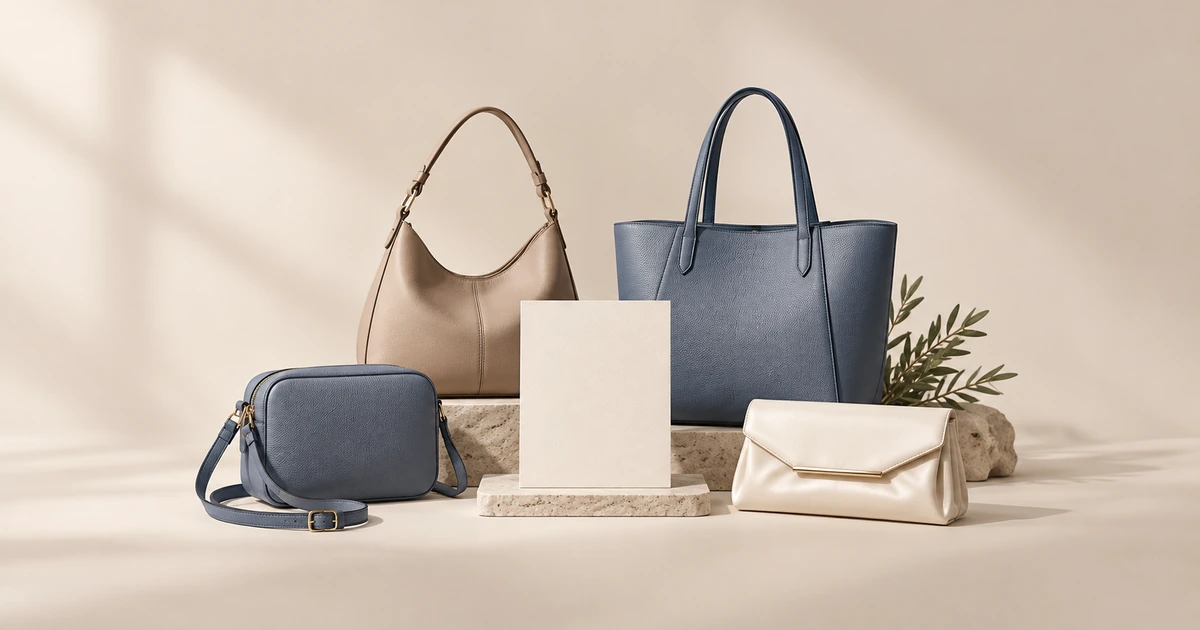
A handbag assortment is easier to review when every candidate has a job in the range. Start with what your customers need to carry and when they use a bag, then compare the shapes, size directions and color roles you are considering. A visually varied display can still contain several bags that answer the same need, while a focused range may cover different uses with fewer overlapping ideas.
How Should a Boutique Plan a Handbag Assortment?
A boutique handbag assortment should start with the customer jobs and use occasions the store needs to serve, then map each need to a distinct shape, size direction and color role. Keep quantity, branding, price and availability as project inputs, and leave uncertain choices Open. The goal is a reviewable range, not a universal best-selling formula.
Separate four kinds of input as you work. Buyer evidence is something your store or team can actually point to, such as customer questions or its own sales and return records. A candidate direction is a shape or role worth exploring, not an order decision. A confirmed project input is a requirement the buyer has approved for this project. An Open question has no agreed answer yet. Begin with customer use before selecting a bag silhouette; a photograph of one appealing style cannot define the whole collection mix.
Which Customer Jobs and Use Occasions Need Coverage?
Look at the channels you sell through, the customers you intend to serve and the situations in which they expect to carry a handbag. Existing sales, returns, customer questions and seasonal plans can help if you have them. If you do not, describe the use you want to explore and label the evidence Open rather than presenting a guess as demand. You can browse all handbag collection directions for a shortlist of possible shapes; a collection page is a visual and project conversation reference, not proof of current stock or sales performance.
Hands-free daily use, compact essentials, day-to-evening shoulder carry, work or carry-more use, and an event occasion are possible discussion prompts. They are not a checklist that every boutique must fill. A store whose customers do not need an occasion bag can leave that role out. Another buyer may need to distinguish two daily-use roles by opening, carry method or actual items carried. Let your customer and channel evidence decide which questions deserve attention.
How Should Shape, Size Direction and Color Role Be Mapped?
Give each customer job a candidate shape role, then test whether its carry method, opening and intended contents support that job. For a hands-free direction, shortlist crossbody bag directions and note the items, strap use and access your buyer wants reviewed. For a day-to-evening shoulder role, compare shoulder bag silhouettes against the intended carry and outfit context. If an occasion role is relevant to your customers, review evening bag references before deciding whether it adds something distinct. These links provide ideas to examine, not a conclusion that any pictured option is currently available or suitable.
Keep size directional: compact, everyday or carry-more may be enough to begin. Write down the actual items to fit, how the bag will be carried and which dimensions need checking on a project sample. Do not borrow a universal dimension or assume one region wants a particular size. Give colors a role chosen by your buyer—perhaps a core neutral, signature direction or seasonal/test idea—without assigning a fixed color, share or order volume. If two candidates have the same job, size and carry method, identify the real distinction or mark one Open.
How Can Buyers Avoid Duplicate Roles in the Range?
Compare each candidate on the same questions: customer job, evidence, carry need, shape and opening or strap direction, size role, color role and unresolved buying question. Different surface details do not necessarily make two bags serve different needs. Conversely, similar shapes may deserve separate consideration when the buyer can explain distinct uses or channels. The table is a non-numeric planning worksheet; its example rows can be removed or adapted.
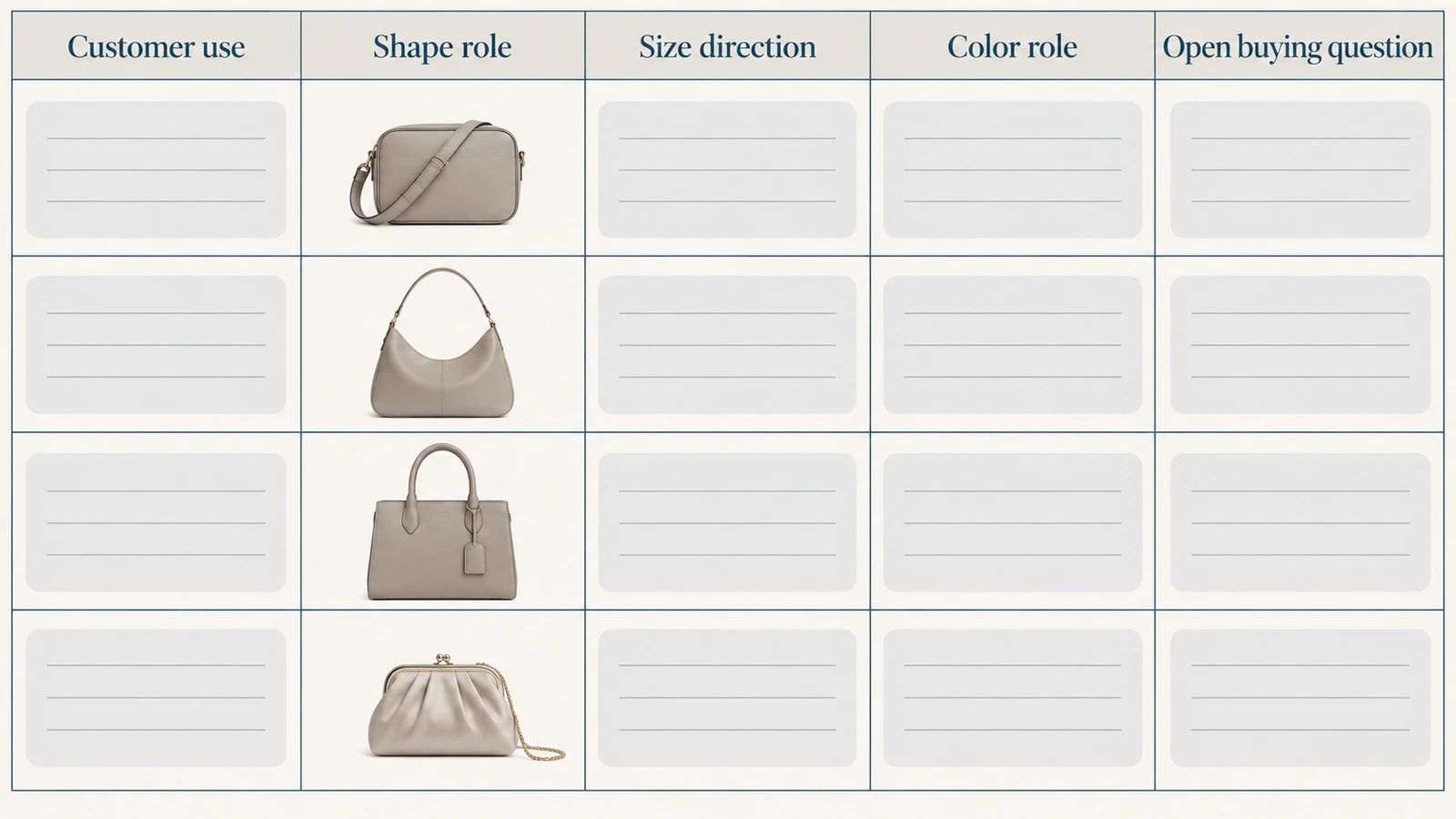
| Customer job / use occasion | Buyer evidence to check | Candidate shape role | Size direction / items to test | Color role | Why it is distinct | Open buying question |
|---|---|---|---|---|---|---|
| Hands-free daily use | Own channel or customer requests; otherwise Open | Crossbody direction | Expected daily items and preferred carry | Buyer-defined core, signature or test role | Hands-free carry and intended use | Which material, details and quantity need review? |
| Compact essentials / short outing | Own expected essentials and use occasion; otherwise Open | Compact bag direction | Essentials to fit; dimensions to confirm | Buyer-defined role | Lighter carry need or a different occasion | Is this distinct from the daily option? |
| Day-to-evening shoulder carry | Own customer and use evidence; otherwise Open | Shoulder direction | Intended items and strap comfort to review | Buyer-defined role | Different carry or use transition | Which shape and strap details remain Open? |
| Work or carry-more use | Own channel and carry requirements; otherwise Open | Structured or carry-more direction | Actual documents, devices or other items to test | Buyer-defined role | A stated higher carry requirement | Which construction, material and load questions need confirmation? |
| Event / occasion use | Event relevance in this buyer's market; otherwise Open | Evening or clutch direction | Occasion essentials to review | Buyer-defined role | Occasion-specific use, if supported | Does buyer evidence justify this role now? |
Keep evidence separate from the candidate column. A direction in the table is not an approved style, current quotation or availability statement. There is no required number of styles, colors or units in this worksheet. Add a row when you can identify a real new customer job; remove one when it does not apply, rather than changing the wording to create artificial variety.
Which Buying Questions Must Stay Open?
After the role map is clear, list what still needs project confirmation: quantity and color split, material and construction, branding method, packaging, destination requirements, price basis, available options, timing and approval owners. A concept can be suitable for discussion without every term being known. Mark an unknown item Open and say who needs to answer it; do not turn a reference image or collection description into a supplier commitment.
Trend and color stories can suggest questions, but they cannot replace what your own customers, channel and project records show. A regional preference, likely seller or margin cannot be inferred from a category page. Current materials, colors, minimums, price and schedule belong in the project's quotation and sample discussion, not in a generic assortment formula.
How many handbag styles should a boutique start with?
There is no number that fits every boutique. Start by identifying the customer jobs and channels the buyer wants to cover, then ask whether each candidate has a distinct role. Budget, quantity, available options and timing belong to the current project. A small or broad range should be justified by the buyer's own evidence and conditions, not a fixed article rule.
Should every handbag in the assortment have a different shape or color?
Not necessarily. A different color or silhouette can still serve the same customer job; similar shapes may serve different needs when the buyer can describe the use, carry method or channel difference. Keep both only when that distinction matters to the project. Otherwise, note the overlap and leave the choice Open until the buyer reviews it.
Should trend forecasts decide the boutique assortment?
No. Trends can be a discussion input, but the buyer's target customer, channel, use occasions, actual records and current project conditions should lead the review. Without relevant evidence, do not turn a trend into a claim about best sellers, color shares or universal regional demand. Mark the untested idea as a candidate, not a confirmed requirement.
What Should a Buyer Send for an Assortment Review?
Share the target customer and sales channel, the use occasions you want to cover and any style or shape references you already prefer. Add the size direction and items each bag should carry, its intended color role, branding needs, destination, estimated quantity if known, and any directions that must be retained. Include questions about materials, packaging or timing that remain Open. This is enough to start a useful conversation even if the range is not complete.
To discuss a boutique handbag assortment, send the customer and use information you have, plus your current shape, carry and color ideas. Mark unknown options and commercial terms Open so the shortlist can be reviewed without treating assumptions as fixed requirements. Available styles, materials, price, quantity conditions and timing must be confirmed for the specific project; this guide does not promise a sales or inventory result.
For reference, our current catalog includes styles such as the Vintage Satchel Crossbody Bag — useful as a specification baseline when briefing your own factory or sourcing agent.
B2B Buyer Checklist
Before you request a quote, prepare the information that affects MOQ, sample cost, lead time and final unit price.
- Target product category, size and reference images.
- Expected order quantity per style and per color.
- Material preference, lining requirements and hardware finish.
- Logo method, packaging items and delivery country.
- Target retail price or target factory price range.
Decision Table
| Buyer Question | Why It Matters | What to Send the Factory |
|---|---|---|
| What is my MOQ target? | MOQ affects material sourcing, production planning and unit price. | Quantity per style, per color and launch schedule. |
| Which material should I choose? | Material controls price band, durability and brand positioning. | Reference photos, desired texture and target market. |
| How much customization do I need? | Logo, lining, hardware and packaging change sample time and cost. | Logo files, packaging references and required details. |
| What is my delivery deadline? | Sampling, production and shipping need realistic planning. | Launch date, delivery country and preferred shipping method. |